The Southern Hills Aquifer: Baton Rouge’s Underground Treasure
Unlike most major Southern cities — like nearby New Orleans or Jackson, Mississippi — that rely on rivers or reservoirs, Baton Rouge gets virtually all its drinking water from groundwater — specifically the Southern Hills aquifer system, a massive freshwater resource beneath southeast Louisiana and southwest Mississippi.
The Baton Rouge Water Company and other area utilities operate hundreds of wells tapping multiple aquifer sands at depths ranging from 400 to 2,800 feet. The water is naturally filtered through sand and gravel, typically requires minimal treatment, and is consistently high quality.
In many ways, Baton Rouge has some of the best-tasting tap water in the South. Deep aquifer water is naturally cool — similar to Memphis’s prized Sand aquifer —, low in organic matter, and free of the surface water treatment challenges (algae, sediment, agricultural runoff) that plague river-dependent cities.
But this underground resource faces serious long-term threats.
Saltwater Intrusion: The Slow Emergency
The most significant threat to Baton Rouge’s water supply is saltwater intrusion. Heavy groundwater pumping since the early 1900s has altered underground pressure gradients, drawing saltwater from a geological fault zone (the Baton Rouge Fault) northward into freshwater aquifer sands.
The saltwater front has been advancing for decades. Several monitoring wells have shown increasing chloride concentrations, and some production wells in the southern part of the parish have already been affected. Once saltwater contaminates an aquifer zone, it’s extraordinarily difficult and expensive to reverse.
The Capital Area Groundwater Conservation Commission (CAGCC) was established to manage this crisis. The commission monitors water levels and saltwater movement, and has advocated for reduced pumping, alternative surface water sources, and aquifer recharge strategies.
In recent years, Baton Rouge has begun developing surface water from the Mississippi River as a supplemental supply — a significant infrastructure investment designed to reduce aquifer pumping pressure and slow saltwater intrusion.
Cancer Alley: The Industrial Neighbor
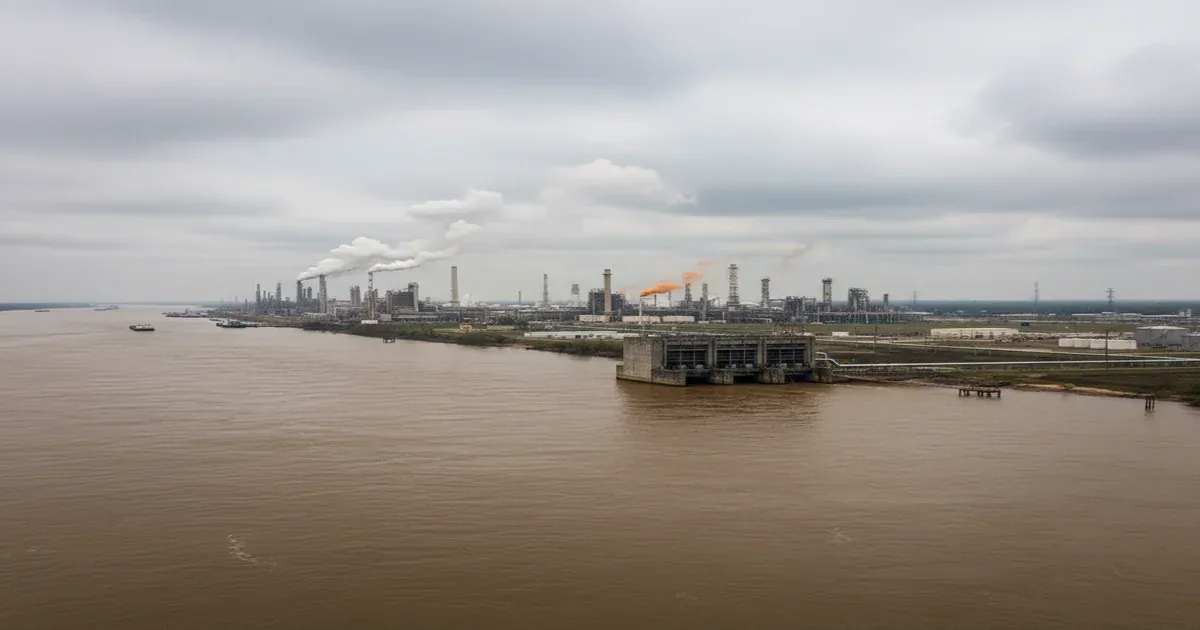
Baton Rouge sits at the northern end of an 85-mile stretch of the Mississippi River between Baton Rouge and New Orleans that’s home to more than 150 petrochemical plants, refineries, and industrial facilities. This area — known colloquially as “Cancer Alley” — has some of the highest industrial emissions and toxic releases in the country.
While the deep aquifer water that Baton Rouge drinks is largely isolated from surface contamination, the concentration of heavy industry creates risks:
- Historical industrial waste disposal — including injection wells and surface impoundments — has contaminated shallow groundwater in some areas
- The ExxonMobil Baton Rouge Refinery — one of the largest in the country — sits within the city limits. The refinery’s Superfund-listed groundwater contamination plume has been under remediation since the 1990s
- Chlorinated solvent contamination from dry cleaners, industrial operations, and waste disposal sites has affected shallow aquifer zones in parts of the metro area
- Air deposition of industrial pollutants can contribute to surface water contamination that may eventually affect aquifer recharge zones
For residents on the public water system drawing from deep wells, the risk from these surface and shallow contamination sources is low. But for anyone on a private shallow well — and there are many in unincorporated East Baton Rouge Parish — the industrial legacy is a genuine concern.
Lead: An Older Infrastructure Issue
Baton Rouge’s water distribution system includes aging infrastructure, and some older neighborhoods have lead service lines and lead solder in residential plumbing. The city’s main utility uses corrosion control treatment and has met the EPA’s action level for lead in system-wide testing.
However, Baton Rouge’s naturally soft, slightly acidic groundwater can be more corrosive than harder surface water — meaning corrosion control treatment is especially important. Any disruption to water chemistry or service line disturbance can elevate lead levels in individual homes.
Older neighborhoods in the urban core — Mid City, Old South Baton Rouge, North Baton Rouge — are most likely to have lead service lines and would benefit from lead service line inventory and replacement efforts under the EPA’s revised Lead and Copper Rule.
Disinfection: A Lighter Touch
Because Baton Rouge’s deep groundwater is naturally protected from surface contamination, treatment requirements are minimal compared to surface water systems. Most wells receive only chlorination for disinfection and sometimes pH adjustment for corrosion control.
This means lower disinfection byproduct formation — a significant water quality advantage. Residents accustomed to heavily treated surface water from other cities often notice the difference in taste.
However, the simplicity of treatment also means that if contamination does reach the deep aquifer, the existing treatment infrastructure may not be equipped to handle it without significant upgrades.
PFAS: Limited but Present
PFAS testing in Baton Rouge’s water supply has been limited compared to some other major cities, but the industrial environment suggests potential exposure sources. Petrochemical facilities use PFAS in various processes, and military installations in the area (including the now-closed Harding Field) may have used AFFF.
The EPA’s UCMR 5 program and the 2024 PFAS rule will bring more comprehensive testing data for Baton Rouge’s water systems. Louisiana has been slower than some states to adopt independent PFAS standards, relying primarily on federal guidelines.
Environmental Justice
Baton Rouge’s water quality challenges intersect with environmental justice. North Baton Rouge and communities along the industrial corridor bear disproportionate exposure to industrial pollution. These communities — predominantly Black and lower-income — face compounding environmental risks from air pollution, industrial contamination, aging infrastructure, and now saltwater intrusion threatening their long-term water supply.
Advocacy organizations and community groups have been pushing for stronger protections, better monitoring, and investments in water infrastructure for historically underserved areas.
What Residents Can Do
- If you’re on the public water system, your water is well-monitored and treated — review the annual Consumer Confidence Report for your utility
- If you’re on a private well, test annually for bacteria, nitrates, chloride (saltwater intrusion indicator), and consider testing for VOCs if you’re near industrial sites
- For older homes, flush the tap for 30 seconds to 2 minutes before drinking and use cold water for cooking
- Consider a certified water filter if you want additional protection — activated carbon for chlorine taste, reverse osmosis for comprehensive contaminant reduction
- Stay informed about saltwater intrusion — CAGCC publishes monitoring data and updates on the threat to the aquifer
If you’re concerned about your water quality, a certified water treatment professional can test your water and advise on solutions tailored to Baton Rouge’s unique groundwater chemistry.
Sources
- Baton Rouge Water Company, Annual Water Quality Reports
- Capital Area Groundwater Conservation Commission (CAGCC), Monitoring Reports
- Louisiana Department of Health, Drinking Water Program
- EPA SDWIS, Baton Rouge area water system compliance records
- USGS, Southern Hills Aquifer Studies and Saltwater Intrusion Monitoring
- Louisiana Department of Environmental Quality, Industrial Facility Reports