The Source: Clean Water, Old Pipes
Birmingham Water Works Board (BWWB) serves more than 600,000 customers across Jefferson County and parts of surrounding counties, making it one of the largest water utilities in the Southeast. The system draws from a network of reservoirs and lakes — primarily Inland Lake, Lake Purdy, and the Cahaba River — that benefit from protected forested watersheds in the Appalachian foothills.
The source water is genuinely good. Alabama’s mountain reservoirs typically have low mineral content, minimal agricultural runoff, and natural filtration through forested terrain. BWWB has invested in watershed protection for decades, purchasing land around its reservoirs to prevent development and contamination.
The problem isn’t where the water starts. It’s what happens between the treatment plant and your faucet.
Lead: Birmingham’s Infrastructure Problem
Birmingham has an aging distribution system with pipes dating back to the early 1900s. Like many Southern cities that industrialized early, Birmingham has a significant number of lead service lines connecting water mains to homes — though the exact count has been difficult to pin down.
BWWB has been working on a lead service line inventory as required by the EPA’s revised Lead and Copper Rule. Early estimates suggest thousands of lead service lines remain in service, concentrated in older neighborhoods including Avondale, Woodlawn, East Lake, Ensley, and parts of downtown.
The utility uses corrosion control treatment (orthophosphate) to minimize lead leaching, and system-wide testing has generally remained below the EPA’s action level of 15 ppb at the 90th percentile. However, individual homes with lead service lines can experience much higher levels, particularly after periods of stagnation or if the protective mineral coating on pipes is disturbed by construction or pressure changes.
In 2020 and 2021, Birmingham faced scrutiny after some sampling results showed elevated lead levels in specific neighborhoods. BWWB expanded its testing program and committed to accelerating lead service line replacement, but the financial burden of replacing thousands of lines is substantial for a utility serving a city where median household income is well below the national average.
Disinfection Byproducts: A Recurring Issue
BWWB has struggled with disinfection byproduct (DBP) compliance — specifically total trihalomethanes (TTHMs) and haloacetic acids (HAAs). These chemicals form when chlorine reacts with natural organic matter in source water.
Alabama’s warm climate exacerbates the problem. Higher water temperatures accelerate DBP formation, and during summer months, organic matter from the Cahaba River and reservoir systems can spike. BWWB has invested in treatment upgrades including enhanced coagulation and activated carbon to reduce DBP precursors, but maintaining consistent compliance across a large distribution system with long residence times remains a challenge.
The EPA’s Maximum Contaminant Levels are 80 ppb for TTHMs and 60 ppb for HAA5, measured as a running annual average. While the system generally meets these limits, quarterly results at some monitoring locations have exceeded them — particularly at the far reaches of the distribution system where water age is highest.
Long-term exposure to elevated disinfection byproducts has been associated with increased cancer risk, according to EPA risk assessments.
Sewer Overflows and Source Water
While not directly a drinking water issue, Birmingham’s combined sewer overflow (CSO) problem affects the broader water quality picture. The city entered a consent decree with the EPA over its aging sewer system, much like Atlanta faced with its aging sewer system, which overflows during heavy rain events and discharges untreated sewage into area waterways — including tributaries that feed into drinking water sources.
BWWB’s treatment processes are designed to handle pathogen contamination in source water, but the ongoing sewer infrastructure challenges highlight the interconnection between wastewater management and drinking water protection.
What About PFAS?
PFAS testing in Birmingham’s water system has been more limited than in some other major cities, but emerging data from the EPA’s fifth Unregulated Contaminant Monitoring Rule (UCMR 5) has provided new information. Results from Alabama water systems have shown detectable but generally low levels of PFAS compounds.
Birmingham’s potential PFAS sources include the Birmingham-Shuttlesworth International Airport, military facilities in the region, and industrial sites. As the EPA’s 2024 PFAS rule takes effect, BWWB will be required to test for and report on 29 PFAS compounds and take action if levels exceed the new Maximum Contaminant Levels.
Water Main Breaks
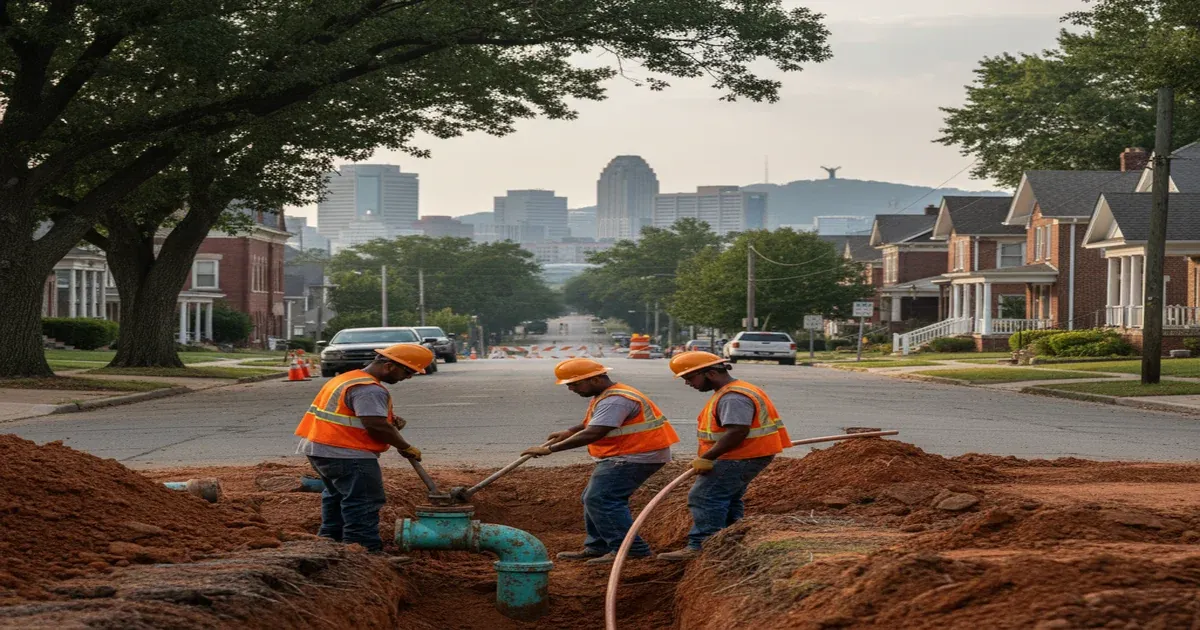
Birmingham’s aging distribution system experiences hundreds of water main breaks annually — a problem shared by Baltimore, Jackson, Mississippi, and New Orleans. These breaks can introduce contaminants into the system through negative pressure events, cause boil water advisories for affected neighborhoods, and disrupt the protective mineral coatings inside lead service lines.
BWWB has been investing in infrastructure replacement, but with over 4,000 miles of distribution mains — some over a century old — the pace of replacement has struggled to keep ahead of deterioration.
What Residents Can Do
- Check BWWB’s lead service line inventory to determine if your home has lead pipes — call the utility if you’re unsure
- Flush your tap for 30 seconds to 2 minutes before using water for drinking or cooking, especially first thing in the morning
- Use cold water for cooking and baby formula — hot water leaches more lead from pipes
- Request a water test from BWWB if you live in an older home — the utility offers testing for customers concerned about lead
- Consider a certified water filter — look for NSF/ANSI 53 certification for lead reduction and NSF/ANSI P473 for PFAS
- Stay informed about boil water advisories — sign up for BWWB notifications, especially during severe weather
If you’re concerned about your water quality, a certified water treatment professional can test your water and advise on filtration or treatment solutions appropriate for Birmingham’s specific water chemistry.
Sources
- Birmingham Water Works Board, Annual Water Quality Reports
- EPA SDWIS, BWWB compliance records
- Alabama Department of Environmental Management, Drinking Water Program
- EPA Enforcement and Compliance History Online (ECHO)
- Environmental Working Group, Tap Water Database
- USGS, Cahaba River Water Quality Studies