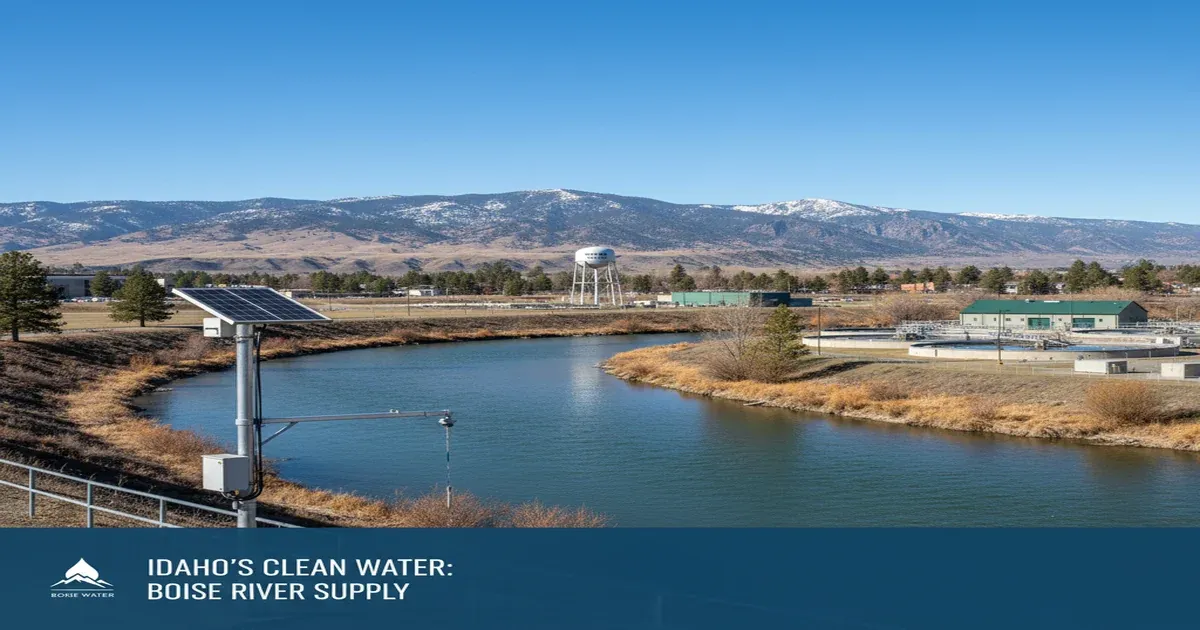
Boise, Idaho has a drinking water advantage most Western cities would trade for: abundant, clean groundwater from deep volcanic aquifers, supplemented by surface water from the Boise River. The water coming out of municipal taps here is genuinely excellent, and has been for decades.
But the Treasure Valley — the fastest-growing metro region in one of the fastest-growing states — is changing. What was dairy country and sugar beet fields 20 years ago is now subdivisions, strip malls, and Amazon distribution centers. All of it sitting on top of the same aquifer system.
The question isn’t whether Boise’s water is safe today. It is. The question is what happens next.
Who Supplies Boise’s Drinking Water
Veolia Water Idaho (formerly United Water Idaho, formerly Suez) serves approximately 300,000 people in the Boise metro area. The utility draws from a mix of sources:
- Groundwater wells pulling from the deep volcanic aquifer system beneath the Snake River Plain
- Surface water from the Boise River, treated at the Columbia Water Treatment Plant
The system operates more than 60 production wells and distributes roughly 25 billion gallons per year. Boise’s most recent Consumer Confidence Report (CCR) shows the municipal supply consistently meeting all EPA primary drinking water standards.
That said, meeting standards and being contaminant-free are two different things. Trace levels of disinfection byproducts (trihalomethanes and haloacetic acids), arsenic, and other naturally occurring minerals are detected — all within legal limits, but detected nonetheless.
Nitrate: The Legacy of Agriculture
The single biggest water quality concern in the Treasure Valley isn’t in Boise’s city pipes. It’s in the shallow wells west and south of the city — Canyon County in particular.
The Idaho Department of Environmental Quality (DEQ) has documented elevated nitrate levels in shallow aquifers throughout the western Treasure Valley. Here’s the picture:
- Canyon County (Nampa, Caldwell, Middleton): Multiple private wells have tested above the EPA’s maximum contaminant level (MCL) of 10 mg/L for nitrate. The Southwest District Health Department has flagged specific areas where well water consistently exceeds safe levels.
- Ada County (Boise, Meridian, Eagle): Municipal wells are generally deeper and better protected. The city’s water consistently tests below 5 mg/L for nitrate — well within standards.
- The sources: Decades of fertilizer application, dairy operations, feedlots, and aging septic systems loaded nitrogen into the soil faster than natural processes could remove it.
The contamination doesn’t disappear when farms become subdivisions. Nitrate is mobile in groundwater and migrates slowly downward. Wells that are safe today in rapidly developing areas like Star, Kuna, and south Meridian may see rising nitrate levels over the next 10–20 years as the legacy contamination works its way deeper.
Why Nitrate Matters
Nitrate above 10 mg/L is particularly dangerous for infants under six months old, causing methemoglobinemia (blue baby syndrome). It’s also increasingly linked in research to thyroid problems, certain cancers, and reproductive issues at chronic low-level exposure. If you’re on a private well anywhere in the Treasure Valley, annual nitrate testing isn’t optional — it’s essential.
PFAS: Gowen Field and the Emerging Threat
Boise’s Gowen Field — home to the Idaho Air National Guard’s 124th Fighter Wing and adjacent to the Boise Airport — used aqueous film-forming foam (AFFF) for decades in firefighting training and emergency response. AFFF contains PFAS, the “forever chemicals” that don’t break down in the environment.
Here’s what we know:
- Contamination confirmed: Groundwater monitoring wells near Gowen Field have detected PFAS compounds, including PFOS and PFOA, at levels above the EPA’s 2024 maximum contaminant levels of 4 parts per trillion (ppt) each.
- Investigation ongoing: The Idaho DEQ and the National Guard Bureau are conducting a Remedial Investigation/Feasibility Study (RI/FS) to define the extent of the contamination plume and assess risk to downgradient water supplies.
- Municipal supply so far: Veolia has tested its production wells for PFAS. Results have generally been below federal MCLs, but some wells have shown detectable levels — meaning the contamination exists, even if it’s currently below action thresholds.
- No state standards: Idaho has not established state-specific PFAS drinking water limits, so the EPA’s national MCLs are the regulatory floor.
The PFAS situation at Gowen Field mirrors what’s happening at hundreds of military installations and airports across the country. The difference in Boise is that the city is growing toward the contamination — new development south of the airport is pushing closer to the affected area.
Growth and Aquifer Stress
The Treasure Valley added roughly 150,000 people between 2010 and 2025. That growth is accelerating, not slowing. The implications for water:
- More demand: More people means more wells pumping from the same aquifer. Boise already uses about 25 billion gallons annually.
- Less recharge: Irrigated farmland was, ironically, a major source of aquifer recharge. Canal water seeping through fields topped off the aquifer for decades. When farms become subdivisions with paved streets and city sewer connections, that recharge disappears — even as demand increases.
- More wastewater: Growth means more treated wastewater discharged to the Boise River and more septic systems in areas without sewer service. Both can introduce pharmaceuticals, personal care products, and nutrients into the water cycle.
The Idaho Water Resource Board has recognized the problem and is developing a comprehensive groundwater management plan for the Treasure Valley. Boise has invested in managed aquifer recharge (MAR) projects — essentially injecting treated surface water back into the aquifer during high-flow periods — but the scale of recharge hasn’t kept pace with the scale of growth.
Emerging Contaminants: What’s Being Watched
Beyond nitrate and PFAS, several contaminants are on the radar in the Boise area:
- Arsenic: Naturally occurring in Idaho’s volcanic geology. Some wells in the Treasure Valley have arsenic levels close to the EPA MCL of 10 µg/L. Boise’s municipal supply is well below this threshold, but private wells can vary significantly.
- Hexavalent chromium (Chromium-6): Detected at low levels in some Idaho groundwater. There’s no federal MCL specifically for Chromium-6 (only total chromium at 100 µg/L), and environmental health advocates have argued the current standard doesn’t adequately protect health.
- Disinfection byproducts: As Boise treats more surface water to meet growing demand, managing trihalomethane and haloacetic acid levels — byproducts of chlorine disinfection — becomes more important. Current levels are within standards but worth monitoring as the treatment mix evolves.
- Microplastics: No federal standards exist yet, but Boise’s water, like nearly every municipal supply in the country, likely contains microplastic particles. Research on health effects is ongoing.
Geothermal Water: A Unique Boise Feature
Boise has one of the oldest geothermal heating districts in the country, tapping naturally hot water (170°F+) from deep faults near the Boise Front. The system heats government buildings, Boise State University, and portions of downtown.
The geothermal system operates in a separate aquifer zone from the drinking water supply and doesn’t affect tap water quality under normal conditions. But geothermal water has elevated fluoride, silica, and dissolved minerals — a reminder that Boise sits on complex geology with multiple aquifer layers at different depths, with different water chemistry.
What Boise Residents Should Do
If you’re on Boise city water:
- Your water is safe and well-monitored. A basic carbon filter (like a Brita or refrigerator filter) will handle any residual chlorine taste.
- Read your annual CCR from Veolia. It’s public record and tells you exactly what was detected.
- If you have concerns about PFAS at trace levels, a reverse osmosis (RO) system or NSF-certified activated carbon filter rated for PFAS reduction is the gold standard.
If you’re on a private well (especially Canyon County or south Ada County):
- Test annually for nitrate, coliform bacteria, and PFAS. This isn’t optional — it’s the only way to know what’s in your water.
- If you have infants, test for nitrate before using well water for formula. Nitrate above 10 mg/L is dangerous for babies.
- Consider a whole-house treatment system if your well shows recurring contaminant issues. RO for drinking water plus a sediment/carbon system for the whole house is a common setup.
Everyone:
- Support smart growth policies. How the Treasure Valley develops in the next 20 years will determine whether the aquifer system remains viable for the next 100.
- Stay informed about the Gowen Field PFAS investigation. Results are published through the Idaho DEQ.
If you’re concerned about your water quality, a certified water treatment professional can test your water and recommend the right system for your specific situation.
For more Pacific Northwest coverage, see our report on Spokane’s aquifer and water quality. Learn about choosing the right water filter for your home.
Sources: Veolia Water Idaho, Idaho Department of Environmental Quality, EPA SDWIS, EPA ECHO, USGS, Southwest District Health, Idaho Water Resource Board