
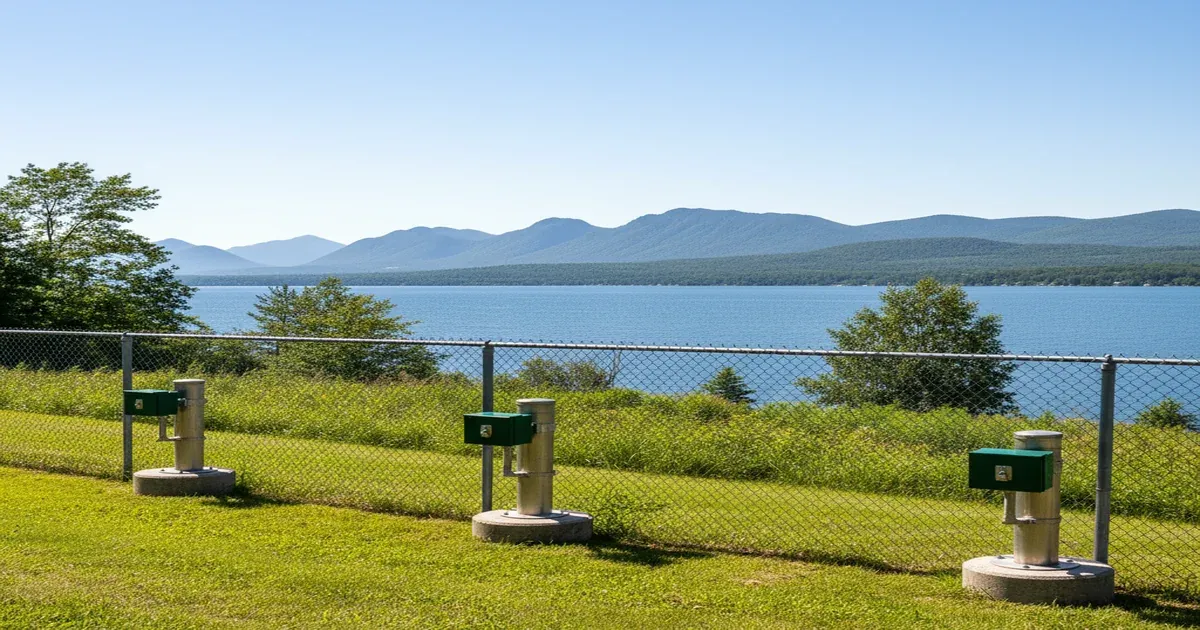
Burlington sits on the eastern shore of Lake Champlain, and for most of its history, the city’s water supply has been considered excellent. That reputation took a hit when PFAS — per- and polyfluoroalkyl substances, often called “forever chemicals” — were detected at alarming levels near the Patrick Leahy Burlington International Airport.
The contamination story isn’t just about one airport. It’s about decades of firefighting foam use, industrial discharge, and the slow realization that chemicals once considered harmless were building up in Vermont’s groundwater.
The Airport Problem
Burlington International Airport has been the epicenter of Vermont’s PFAS crisis. For decades, the airport used aqueous film-forming foam (AFFF) during fire training exercises. AFFF is extremely effective at suppressing fuel fires — and extremely persistent in the environment.
Testing in 2018 revealed PFOS and PFOA concentrations of 72,000 parts per trillion (ppt) near the airport. To put that in perspective, Vermont’s maximum contaminant level for PFAS is 20 ppt. The EPA has suggested levels as low as 4 ppt.
In August 2025, the Vermont Supreme Court reinstated a lawsuit filed against the City of Burlington over this contamination. A dairy farmer whose land and water were contaminated by AFFF runoff from the airport brought the case — a somewhat unusual situation, since most PFAS lawsuits target manufacturers rather than municipalities.
Bennington: The Other Contamination Hotspot
While Burlington deals with airport-related PFAS, the town of Bennington in southern Vermont has faced its own crisis. A former ChemFab factory that produced Teflon-coated products contaminated local groundwater with PFOA.
The contamination was first investigated in 2016, and a 2017 report linked elevated PFOA levels in residents’ blood samples directly to the water supply. Bennington has since been extending municipal water lines to households with contaminated private wells — but the process is slow and expensive.
As of April 2025, the town continues to extend water service to affected homes, but many rural residents remain on contaminated wells.
Vermont’s Regulatory Response
Vermont has been more aggressive than most states in addressing PFAS. In May 2019, the state set an MCL of 20 ppt for five PFAS chemicals: PFOS, PFOA, PFNA, PFHpA, and PFHxS. At the time, this was one of the strictest standards in the country.
The state also released a comprehensive PFAS roadmap in December 2023, outlining steps to prevent additional contamination and remediate existing sites. In October 2023, Vermont banned Class B firefighting foam containing intentionally added PFAS.
Other key drinking water standards Vermont enforces:
- Lead: Action level of 15 parts per billion (ppb), following the EPA’s Lead and Copper Rule
- Copper: Action level of 1.3 parts per million
- Arsenic: Action level of 10 ppb
Military Sites Add to the Problem
Beyond the airport, several military installations in Vermont have tested positive for PFAS:
- Chittenden County (2018): 47,300 ppt for PFOS and PFOA
- Camp Ethan Allen (2017-2018): 115.6 ppt for total PFAS
- Westminster Training Site (2017): 5.5 ppt for total PFAS
- North Hyde Park Training Site (2017): 6 ppt for total PFAS
The Chittenden County readings are particularly concerning given the area’s population density. Burlington and its suburbs are home to roughly a third of Vermont’s population.
Federal Policy Shifts Create Uncertainty
Vermont’s proactive approach has been complicated by shifting federal policy. In January 2025, an executive order rolled back proposed EPA guidelines on PFAS. Then in April 2025, the EPA released a new action plan that updates PFAS guidance annually rather than every three years.
For Vermont residents, this means the state’s own regulations — not federal standards — remain the primary protection against PFAS in drinking water. Vermont’s 20 ppt limit is significantly stricter than any current federal enforcement level.
What Burlington Residents Should Know
If you’re on Burlington’s municipal water system, the city treats and monitors its supply. But PFAS contamination doesn’t respect municipal boundaries, and private well owners in the greater Burlington area should be particularly cautious.
Here’s what you can do:
- Get your water tested. Vermont offers PFAS testing through the Department of Environmental Conservation. If you’re on a private well near the airport or any military site, this is essential.
- Check your location. The closer you are to the airport or military training areas, the higher the risk. The Vermont DEC maintains maps of known contamination sites.
- Consider filtration. Reverse osmosis and activated carbon filters can reduce PFAS levels significantly. Not all filters are created equal — look for NSF/ANSI 53 or 58 certification.
- Stay informed. Vermont’s PFAS roadmap is publicly available, and the state provides regular updates on remediation progress.
If you’re concerned about your water quality, a certified water treatment professional can test your water and advise on the right filtration system for your situation. Given the documented contamination levels in the Burlington area, getting a baseline test is a smart move — whether you’re on municipal water or a private well.
Related Reading
- Boston Water Quality: Quabbin Reservoir and PFAS Concerns
- Colorado PFAS: Military Base Contamination Across the State
- Camp Lejeune Water Contamination: Decades of Toxic Exposure
- PFAS Treatment: Ion Exchange vs. Activated Carbon
Sources
- Vermont Supreme Court ruling on Burlington airport PFAS case (August 2025)
- Vermont Department of Environmental Conservation PFAS Roadmap (December 2023)
- EPA PFAS action levels and testing data
- Vermont Water Supply Rule (February 2024)
- Bennington PFOA Health Report (September 2017)