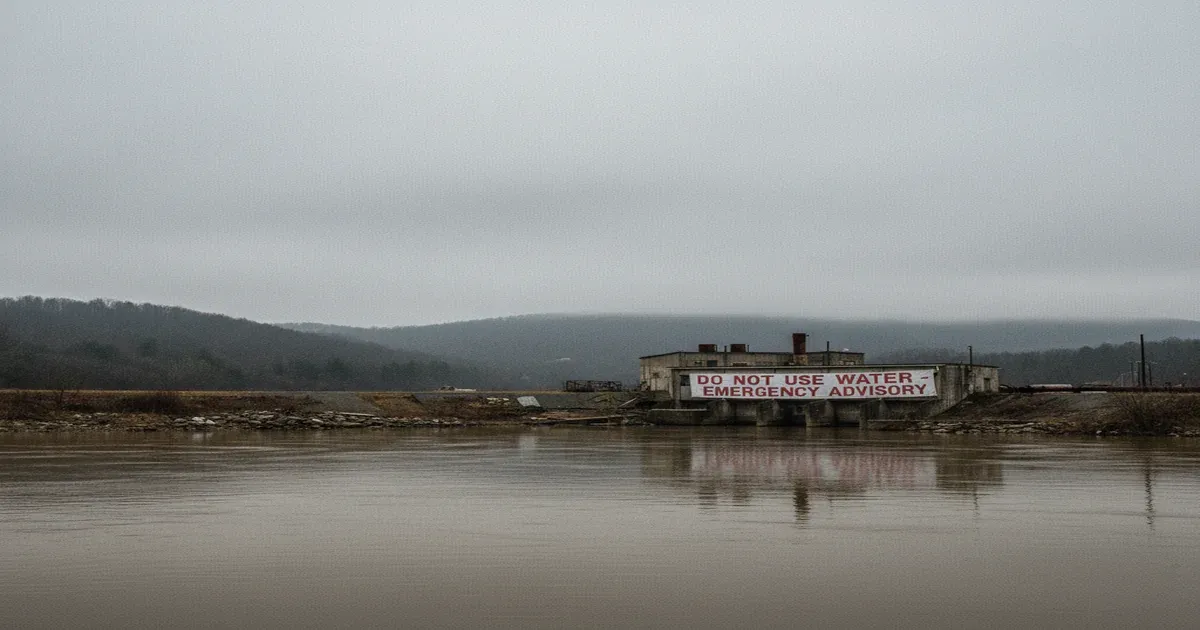
On January 9, 2014, roughly 10,000 gallons of crude MCHM — a chemical used to wash coal — leaked from a Freedom Industries storage tank into the Elk River, just upstream from West Virginia American Water’s intake for the Charleston metropolitan area.
Within hours, 300,000 residents across nine counties were told not to use their tap water. Not for drinking. Not for cooking. Not for bathing. The “do not use” order lasted days for some areas, weeks for others. It was one of the largest drinking water contamination events in modern American history.
More than a decade later, the spill’s legacy still shapes how Charleston thinks about its water.
What Happened in the 2014 Elk River Contamination
Freedom Industries operated a chemical storage facility on the banks of the Elk River, roughly one mile upstream from West Virginia American Water’s treatment plant intake. The facility held crude 4-methylcyclohexanemethanol (MCHM), a foaming agent used in coal processing.
A corroded storage tank leaked the chemical into the river. The leak went undetected for hours. By the time the water utility identified the contamination — partly from customer complaints about a licorice-like smell — MCHM had already entered the treatment system.
The treatment plant wasn’t designed to remove MCHM. Few treatment plants would be. The chemical wasn’t regulated under the Safe Drinking Water Act, and there was limited toxicological data on its health effects at the time.
Governor Earl Ray Tomblin declared a state of emergency. Schools closed. Businesses shut down. Hospitals scrambled. Residents lined up for bottled water in freezing January temperatures.
The Aftermath: Legal, Regulatory, and Infrastructure Response
Freedom Industries filed for bankruptcy within weeks. Criminal charges followed — the company’s former president was sentenced to 30 days in jail, a penalty many residents found insultingly lenient.
West Virginia’s legislature passed the Above Ground Storage Tank Act in 2014, requiring inspections and protections for chemical storage facilities near water sources. But critics noted the law was weakened through amendments in subsequent sessions, reducing the number of regulated chemicals and exempting some facilities.
West Virginia American Water invested in treatment upgrades, including granular activated carbon (GAC) filtration designed to handle organic chemical contamination. The utility also moved its intake further upstream and implemented enhanced source water monitoring.
Is Charleston WV Tap Water Safe to Drink Today?
Charleston’s water supply comes primarily from the Elk River, treated by West Virginia American Water’s Kanawha Valley Treatment Plant. The system serves approximately 70,000 direct customers and wholesale connections serving additional communities.
According to EPA ECHO data and the utility’s annual water quality reports, the system currently meets all federal drinking water standards. Key monitoring results include:
- MCHM — Not detected in treated water since the 2014 event. GAC filtration provides an effective barrier
- Lead and copper — The system has maintained compliance with the Lead and Copper Rule. However, as in many older cities, individual homes with lead plumbing or solder may see elevated levels at the tap
- Disinfection byproducts (DBPs) — THMs and HAAs have been within regulatory limits, though levels vary seasonally
- Volatile organic compounds (VOCs) — Monitored given the region’s industrial and chemical history. No violations reported in recent years
PFAS in Charleston’s Water Supply
Charleston sits in what’s known as “Chemical Valley” — a stretch along the Kanawha River that has hosted chemical manufacturing since the early 1900s. Companies like Union Carbide, Dow Chemical, and DuPont operated major facilities in the region for decades.
More recently, PFAS contamination has emerged as a concern across West Virginia. The state’s proximity to the DuPont Washington Works facility in Parkersburg — site of one of the most significant PFAS contamination events in U.S. history — has heightened awareness. While Charleston’s water hasn’t shown significant PFAS levels in public reporting, the broader regional context keeps residents watchful.
The EPA’s new PFAS maximum contaminant levels (MCLs) that took effect in 2024 require utilities to test and report on six PFAS compounds. Charleston residents should look for this data in the city’s annual Consumer Confidence Report.
The Lead Risk in Older Charleston Homes
Even when a water utility meets all compliance standards, lead can still enter tap water through household plumbing. Homes built before 1986 may have lead pipes, lead solder on copper joints, or brass fixtures that leach lead into standing water.
Charleston’s housing stock includes a significant number of older homes. If your home was built before 1986, testing your tap water for lead is a reasonable precaution — particularly if you have children or are pregnant. The West Virginia Bureau of Public Health can direct you to certified labs.
Chemical Valley: The Ongoing Industrial Context
That industrial legacy means the watersheds feeding Charleston’s water supply carry a complex history of contamination. Superfund sites dot the region. Legacy pollutants persist in sediments and groundwater.
When trust breaks that completely, it doesn’t come back with a press release saying the water tests clean now. It comes back — if it comes back at all — through years of transparency, consistent results, and honest communication about risks.
What Charleston Residents Should Do
If you live in the Charleston metro area, here’s what matters now:
- Read the annual CCR. West Virginia American Water publishes a Consumer Confidence Report each year detailing test results. Read it.
- Test your own water. Especially if your home has older plumbing. Lab tests for lead, VOCs, and general chemistry are available through certified labs in West Virginia.
- Know your source. If you’re on a private well rather than the public system, you’re responsible for your own testing. Wells in Chemical Valley should be tested for VOCs and metals at minimum.
- Check for PFAS data. With new EPA MCLs in effect, look for Charleston’s PFAS test results in the 2024 and 2025 CCRs.
- Stay informed about upstream activity. The Elk River watershed still hosts industrial operations. Community groups like the West Virginia Rivers Coalition track source water quality issues.
Home Water Treatment Options for Charleston
Given the region’s industrial history, many Charleston-area residents have invested in home water treatment. Common approaches include:
- Activated carbon filters — Effective for removing chlorine taste, VOCs, and many organic chemicals. Under-sink and whole-house options available
- Reverse osmosis — Provides comprehensive filtration for drinking water, removing lead, PFAS, chemical contaminants, and disinfection byproducts
- Whole-house sediment and carbon systems — Address taste, odor, and particulate issues throughout the home
If you’re concerned about your water quality, a certified water treatment professional can test your water and advise on solutions based on your specific situation and water source.
Frequently Asked Questions: Charleston WV Water Quality
Is Charleston WV tap water safe to drink? According to the most recent EPA and utility compliance data, Charleston’s water meets all federal drinking water standards. However, older homes with lead plumbing may have elevated lead at the tap, and the Chemical Valley industrial context means ongoing monitoring matters.
What contaminants are in Charleston WV water? Current monitoring shows the water meets standards for all regulated contaminants. Key watch areas include lead (older homes), disinfection byproducts (seasonal), PFAS (new EPA rules require expanded testing), and VOCs from the region’s industrial history.
Did the 2014 chemical spill permanently affect Charleston’s water? No — MCHM has not been detected in treated water since the spill. West Virginia American Water installed granular activated carbon filtration specifically to handle organic chemical contamination. The infrastructure is better prepared than before 2014.
Should I use a water filter in Charleston WV? Given the region’s industrial context and older housing stock, a quality under-sink or whole-house carbon or reverse osmosis filter is a reasonable precaution — particularly for households with young children, older plumbing, or concerns about taste and chemical exposure.
Where can I find Charleston’s water quality report? West Virginia American Water publishes an annual Consumer Confidence Report (CCR) at wvawc.com. The report covers all required contaminant testing for the prior year.
Looking Forward
Charleston’s water system is measurably better prepared than it was in January 2014. The GAC filtration, improved monitoring, and regulatory changes — however imperfect — represent real improvements.
But the fundamental challenge remains: Charleston draws its water from a river system in one of America’s most chemically intensive regions, using infrastructure that requires constant investment. The 2014 spill proved that “meeting current standards” isn’t the same as “safe from all threats.” That lesson cost 300,000 people their water supply, and it shouldn’t have to be learned again.