
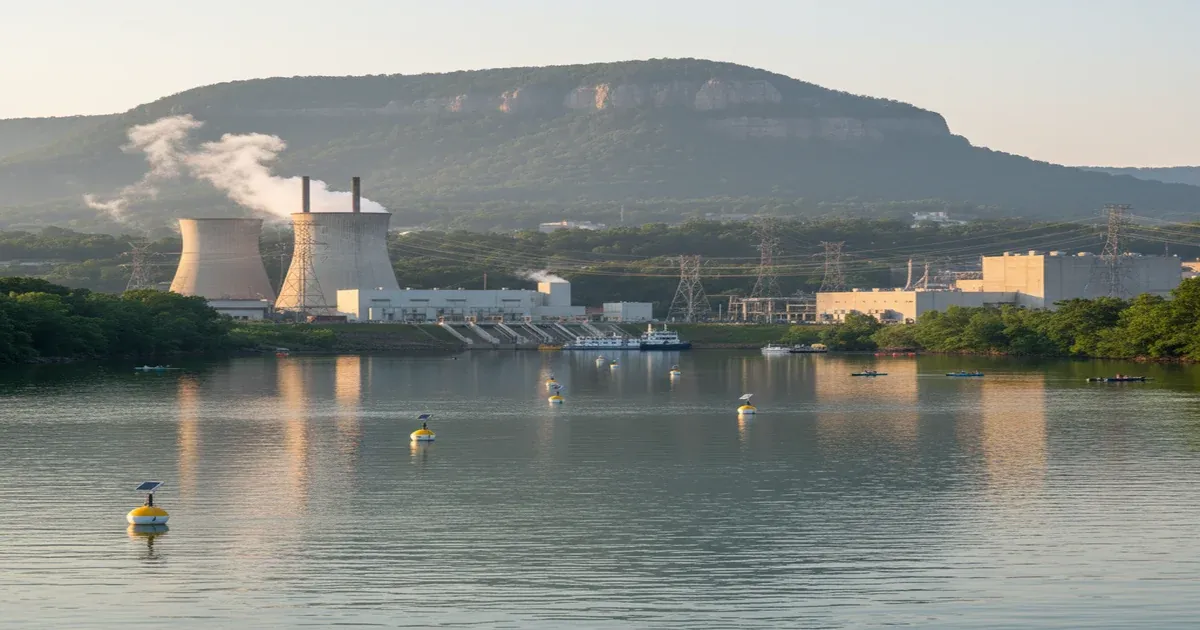
The Tennessee River: Chattanooga’s Lifeline
Tennessee American Water serves approximately 300,000 people in the Chattanooga metropolitan area, drawing from the Tennessee River — one of the largest river systems in the southeastern United States and a key component of the Tennessee Valley Authority (TVA) system.
The Tennessee River in Chattanooga is actually Chickamauga Lake, an impoundment created by Chickamauga Dam downstream. This gives the water supply characteristics of both river and lake water — flowing but with longer residence times that allow sediment settling and biological processing.
The treatment plant uses conventional treatment (coagulation, sedimentation, filtration) with chloramine disinfection. The finished water generally meets all EPA standards.
Coal Ash: TVA’s Legacy
The Tennessee Valley Authority operates multiple coal-fired power plants along the Tennessee River, and the coal ash produced by these plants is one of the most significant environmental legacies in the region.
Coal ash — the same contamination source affecting Charlotte — is the waste left after burning coal for electricity — contains heavy metals including arsenic, selenium, mercury, chromium, lead, and cadmium. TVA has stored millions of tons of coal ash in ponds and landfills near its power plants, often adjacent to waterways.
The national reckoning with coal ash began in 2008 when the TVA Kingston Fossil Plant in Harriman, Tennessee experienced a catastrophic coal ash spill — 5.4 million cubic yards of ash slurry burst through a containment wall and inundated 300 acres of land and waterways. It was the largest industrial spill in U.S. history and killed dozens of cleanup workers who were exposed to toxic ash.
For Chattanooga specifically, the nearby Widows Creek Fossil Plant (now retired) and other TVA facilities have coal ash storage that has been subject to EPA coal combustion residuals rules requiring closure and remediation of unlined ponds. The question is whether contaminants from these sites have reached or could reach the Tennessee River at levels that affect drinking water quality.
Tennessee American Water monitors for coal ash-related contaminants in its source and treated water. Treatment processes remove most heavy metals, but the long-term presence of coal ash near waterways remains a source water protection concern.
Industrial History: From Worst to Better
Chattanooga’s environmental reputation has undergone a remarkable transformation. In 1969, the federal government declared Chattanooga’s air the dirtiest in America. The city’s heavy industry — foundries, chemical plants, textile mills, and manufacturing — had also left a legacy of water contamination.
Superfund sites in the Chattanooga area include contaminated industrial properties with groundwater pollution from solvents, heavy metals, and petroleum products. While these don’t directly contaminate the Tennessee River drinking water intake (treatment handles the river water), they affect the overall environmental quality of the area and pose risks for anyone on private groundwater wells.
The city’s environmental transformation since the 1980s has been dramatic — the Tennessee Riverwalk, Chattanooga’s fiber optic network, and the revitalized waterfront are symbols of a city that chose reinvention. But the industrial contamination underground takes far longer to clean up than the visible landscape.
Disinfection Byproducts
Managing disinfection byproducts is an ongoing challenge for Chattanooga’s water system. The Tennessee River carries organic matter from upstream agriculture, urban runoff, and natural sources — material that reacts with chloramine to form regulated DBPs.
Tennessee American Water has generally maintained compliance with EPA limits for TTHMs (80 ppb) and HAA5 (60 ppb), but seasonal variations can push levels higher. Summer months bring warmer water, more algal activity, and higher organic loading — all of which increase DBP formation potential.
The utility uses chloramine rather than free chlorine for secondary disinfection, which helps control DBP formation while maintaining a disinfectant residual throughout the distribution system.
Lead and Infrastructure
Chattanooga’s distribution system includes aging infrastructure, and some older neighborhoods have lead service lines. The utility uses corrosion control treatment and meets the EPA’s action level for lead at the 90th percentile.
Older areas of Chattanooga — particularly North Chattanooga, Highland Park, East Chattanooga, and the Southside — have housing stock from the early 1900s with higher probability of lead service connections and lead solder in interior plumbing.
PFAS: Emerging Concern
PFAS monitoring in Chattanooga is ongoing under the EPA’s UCMR 5 and the 2024 PFAS rule. Potential PFAS sources in the area include the Chattanooga Metropolitan Airport, upstream military installations, and industrial facilities.
Tennessee has been developing its approach to PFAS regulation, and the EPA’s federal MCLs now apply to all public water systems. Tennessee American Water is testing for PFAS compounds and will report results as required under the new federal standards.
What Residents Can Do
- Review Tennessee American Water’s annual report for current water quality data
- For older homes, flush the tap before drinking and use cold water for cooking — lead exposure from old plumbing is the most controllable water quality risk
- Consider a certified water filter — NSF/ANSI 53 for lead, activated carbon for taste and DBPs, NSF P473 for PFAS
- If you’re on a private well, test annually for bacteria, nitrates, and metals — industrial contamination legacy in some areas makes testing essential
- Stay informed about TVA coal ash closure activities near waterways in your area
If you’re concerned about your water quality, a certified water treatment professional can test your water and recommend solutions appropriate for Chattanooga’s specific conditions.
Sources
- Tennessee American Water, Annual Water Quality Reports
- Tennessee Department of Environment and Conservation, Drinking Water Program
- Tennessee Valley Authority, Coal Combustion Residuals Compliance Data
- EPA SDWIS, Tennessee American Water compliance records
- EPA, Kingston Coal Ash Spill and TVA Coal Ash Storage
- Environmental Working Group, Tap Water Database