
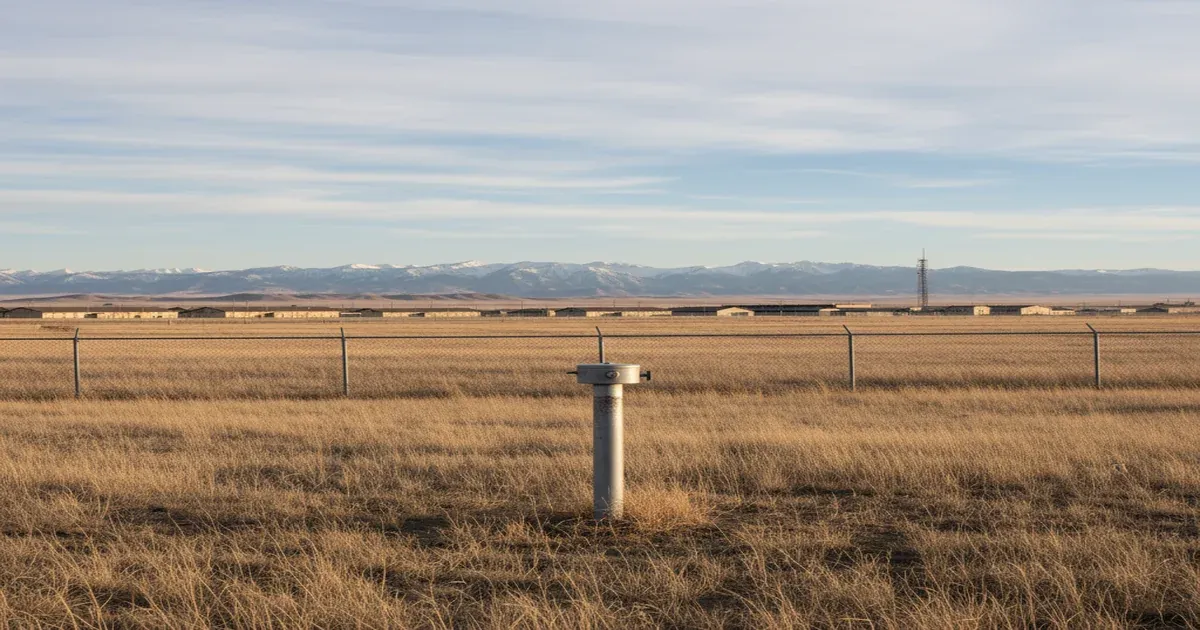
Cheyenne, Wyoming’s capital city of about 65,000 people, faces a water quality challenge that’s become disturbingly common near military installations across the country: PFAS contamination from aqueous film-forming foam (AFFF) used in firefighting training at F.E. Warren Air Force Base.
But PFAS isn’t Cheyenne’s only water concern. The city also grapples with High Plains aquifer depletion, drought-driven supply shortages, and the complications of blending multiple water sources.
F.E. Warren AFB and PFAS Contamination
F.E. Warren Air Force Base, established in 1867, is one of the oldest continuously active military installations in the country. Like virtually every military base with a fire training area, Warren used AFFF containing PFOS and PFOA — the most well-studied and concerning PFAS compounds — for decades.
The Department of Defense’s own investigations have confirmed PFAS contamination in groundwater on and around the base:
- Groundwater monitoring wells on the base property have detected PFOS and PFOA at levels well above the EPA’s health advisory of 70 parts per trillion (and far above the newer proposed MCL of 4 ppt for PFOA and PFOS individually)
- Off-base migration — PFAS plumes from military bases don’t respect property lines. Contamination has been detected in monitoring wells downgradient from the base
- The Air Force has conducted preliminary assessments and site investigations under the Defense Environmental Restoration Program, but cleanup timelines at military PFAS sites typically stretch into decades
The base sits on Cheyenne’s western edge, and the groundwater flow direction means contamination can migrate toward residential areas and agricultural land east and southeast of the installation.
High Plains Aquifer: Running Low
Cheyenne draws a portion of its water from the High Plains (Ogallala) Aquifer system, one of the most important — and most overdrawn — groundwater resources in the western United States.
While the Ogallala’s depletion is most severe in Kansas, Texas, and Nebraska, southeastern Wyoming isn’t immune:
- Water levels in the Laramie County portion of the High Plains aquifer have declined measurably over the past several decades
- Irrigation demand from agriculture competes with municipal supply
- Recharge rates in this semi-arid region are far slower than withdrawal rates
The Cheyenne Board of Public Utilities has invested in diversifying the city’s water supply, including a pipeline from the Little Snake River drainage in southern Wyoming. But supply constraints remain a persistent concern, particularly during drought years.
Drought and Supply Vulnerability
Cheyenne’s primary surface water sources include Granite Springs Reservoir, Crystal Lake Reservoir, and the Crow Creek system. These are relatively small, high-elevation sources that are vulnerable to:
- Drought — Wyoming has experienced multiple severe drought episodes, and climate projections suggest increasing variability in snowpack and precipitation
- Wildfire — Post-fire watersheds can produce dramatic spikes in sediment, ash, and contaminants that challenge water treatment systems
- Seasonal variation — Cheyenne’s supply depends heavily on spring snowmelt, creating a boom-and-bust cycle
The city has implemented tiered water pricing and seasonal use restrictions, but fundamental supply-demand imbalance during dry years remains Cheyenne’s biggest long-term water challenge.
What the Municipal Water Data Shows
According to Cheyenne’s most recent Consumer Confidence Report, the treated municipal water meets all EPA standards. The system uses conventional treatment with chlorine disinfection.
Detected contaminants (within EPA limits) include:
- Trihalomethanes and haloacetic acids from disinfection
- Naturally occurring fluoride
- Low levels of barium and chromium
- Turbidity spikes during spring runoff (managed through treatment adjustments)
PFAS testing of the municipal supply has shown detections, though the Board of Public Utilities has stated levels are below current EPA limits. However, with the EPA’s PFAS MCL tightening significantly, continued monitoring is critical.
Private Well Owners Face Higher Risk
An estimated 20-30% of Laramie County residents rely on private wells. These wells tap into shallow and intermediate aquifers that may be affected by:
- PFAS migration from Warren AFB
- Agricultural chemicals (nitrate, atrazine, and other herbicides)
- Naturally occurring uranium and selenium (common in Wyoming geology)
- Oil and gas activity, though less intense here than in Natrona or Campbell counties
Private wells in Wyoming are not regulated under the Safe Drinking Water Act. Testing is the well owner’s responsibility, and many wells have never been tested for PFAS.
What Cheyenne Residents Can Do
- Municipal customers — Review the annual water quality report. Ask the Board of Public Utilities specifically about PFAS testing results and how they compare to the newest EPA limits.
- Private well owners — Test for PFAS, uranium, selenium, nitrate, and bacteria. The Wyoming DEQ can direct you to certified labs.
- Know your proximity to the base — If you live downgradient (generally east/southeast) of F.E. Warren, PFAS testing of your well water is particularly important.
- Consider treatment — Activated carbon filters and reverse osmosis systems are effective at removing PFAS. For well water with multiple contaminants, a combination system may be appropriate.
- Conserve — Cheyenne’s supply constraints are real. Every gallon saved helps maintain system resilience during drought.
Cheyenne’s water is safe by current federal standards, but “current federal standards” are a moving target — especially for PFAS. Staying informed and proactive is the best approach.
Water quality challenges like these aren’t unique to this area. Residents in Casper, Wyoming Water Quality and Colorado Springs CO Water Quality face similar contamination concerns, while Fort Collins CO Water Quality deals with its own set of water infrastructure and quality issues.
If you’re concerned about your water quality, a certified water treatment professional can test your water and advise on solutions specific to your situation.