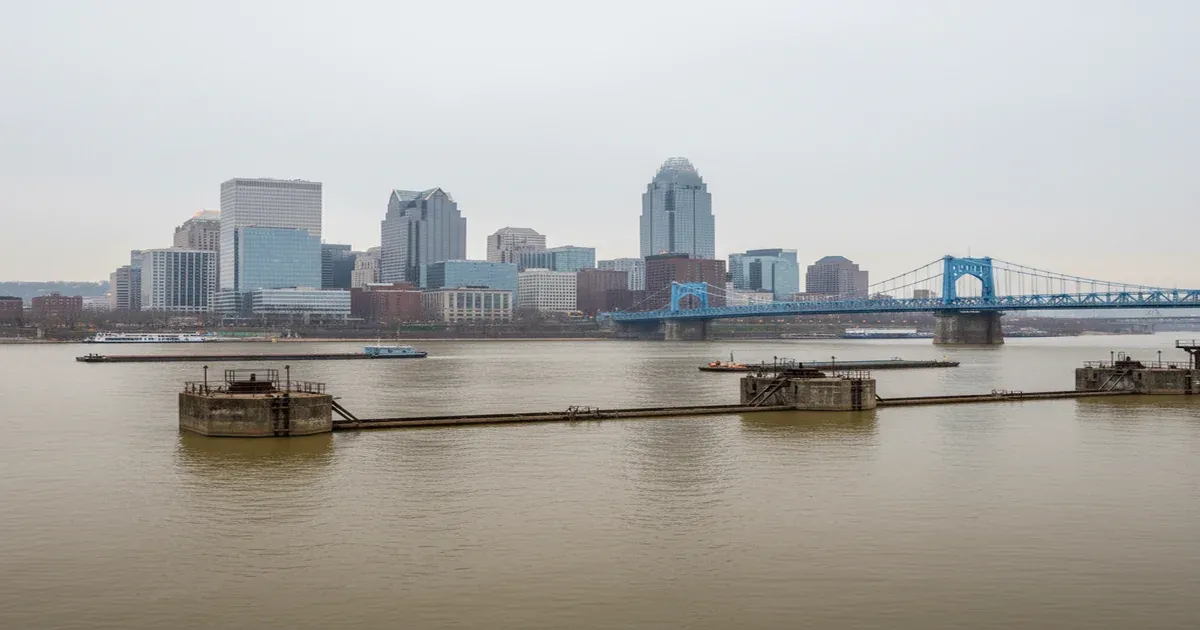
Cincinnati has a drinking water challenge that most cities don’t face: its raw water source is one of the most heavily used rivers in America.
The Ohio River drains 204,000 square miles across 15 states. By the time it reaches Cincinnati, it’s collected agricultural runoff from Indiana and Ohio farmland, treated wastewater from upstream cities like Pittsburgh and Louisville, industrial discharges, stormwater, and everything else that ends up in a major river system serving 25 million people.
Greater Cincinnati Water Works (GCWW) — one of the oldest water utilities in the country, established in 1817 — takes this challenging source water and turns it into some of the best-treated tap water in the region. The utility serves about 1 million people across Hamilton County and parts of Butler, Warren, and Clermont counties.
Treatment Innovation: Making the Ohio Drinkable
GCWW has been a national leader in water treatment technology, largely because it has to be. When your source water is the Ohio River, you invest in treatment or you accept undrinkable water.
The utility operates two treatment plants — the Miller Plant (built in 1907, extensively upgraded) and the Bolton Plant (1992). Treatment includes:
- Granular activated carbon (GAC) adsorption — GCWW was one of the first large utilities in the US to implement GAC for removing organic chemicals and improving taste and odor. This technology is also effective at reducing PFAS.
- Ozone disinfection — Used in addition to chloramine for pathogen inactivation, ozone also breaks down many organic compounds.
- Conventional treatment — Coagulation, sedimentation, and sand filtration for turbidity and particulate removal.
- UV disinfection — Added as an additional barrier against Cryptosporidium and Giardia.
GCWW’s multi-barrier approach reflects the reality that the Ohio River can throw almost anything at the treatment plant — and the plant needs to handle it.
PFAS in the Ohio River Basin
PFAS contamination in the Ohio River gained national attention through the story of DuPont’s Washington Works plant in Parkersburg, West Virginia — about 200 miles upstream from Cincinnati. The plant released PFOA (known as C8) into the Ohio River for decades, contaminating drinking water for communities along the river.
The story was documented in the book “Exposure” and the film “Dark Waters.” The resulting class-action lawsuit and health studies (the C8 Science Panel) established links between PFOA exposure and several diseases, including kidney and testicular cancer.
For Cincinnati, the PFAS picture includes:
- Ohio River source water contains detectable levels of multiple PFAS compounds from upstream sources. GCWW’s GAC treatment provides some PFAS removal, but not all PFAS compounds are effectively captured by activated carbon.
- Local sources — Military installations, airports, and industrial facilities in the Cincinnati area have contributed PFAS to local groundwater.
- EPA’s 2024 MCLs of 4 ppt for PFOA and PFOS individually will require GCWW and other Ohio River utilities to verify their treatment is achieving compliance. GAC provides a head start, but additional treatment upgrades may be needed.
Ohio River Spills and Emergency Events
Drawing from a major industrial river means Cincinnati’s water supply is periodically threatened by upstream chemical spills, industrial releases, and transportation accidents.
Notable incidents:
- 2014 Freedom Industries MCHM spill — While this primarily affected Charleston, West Virginia, the spill of 10,000 gallons of crude MCHM into the Elk River (an Ohio tributary) demonstrated how a single industrial accident can compromise downstream water supplies.
- Barge spills — The Ohio River carries enormous quantities of petroleum products, chemicals, and coal by barge. Spills from barge accidents can threaten water intakes downstream.
- Agricultural runoff events — Heavy rains in the Ohio Valley can flush large volumes of fertilizers, pesticides, and manure into the river system, spiking nutrient and contaminant levels.
GCWW maintains an early warning system with upstream monitoring stations and participates in the Ohio River Valley Water Sanitation Commission (ORSANCO), which coordinates water quality monitoring across the river’s length.
Lead Service Lines
Cincinnati, like other Rust Belt cities, has a significant inventory of lead service lines. Estimates suggest approximately 30,000 to 40,000 lead service lines remain in the GCWW system.
The utility has been working on a lead service line inventory and has begun replacement in priority areas. Under EPA’s LCRI, all must be replaced within 10 years — a multi-hundred-million-dollar undertaking.
GCWW uses corrosion control treatment to minimize lead leaching, and the system has generally maintained compliance with EPA’s Lead and Copper Rule. But individual homes with lead service lines, lead solder, or brass fixtures can still have elevated lead levels at the tap.
Older neighborhoods in Cincinnati — Over-the-Rhine, Price Hill, Avondale, Walnut Hills, Northside — have the highest concentrations of pre-war housing and lead service lines.
What Cincinnati Residents Should Know
- Your treatment is excellent. GCWW’s multi-barrier treatment approach — including GAC, ozone, and UV — provides better removal of organic contaminants than most utilities achieve. The Ohio River source water is challenging, but the treatment is among the best in the country.
- Check for lead in your home. If you live in a pre-1950s home, you may have a lead service line. Contact GCWW for a service line check and information about replacement programs.
- Flush before drinking. Run cold water for 30 seconds to 2 minutes if it’s been sitting in pipes for hours. This is standard advice for any home with potential lead plumbing.
- Private well owners in the Cincinnati metro — test your water regularly. Hamilton County’s geological formation includes areas with elevated naturally occurring contaminants, plus potential industrial and agricultural contamination.
- Stay informed about Ohio River events. GCWW issues alerts when upstream spills or water quality events could affect treatment. Sign up for their notification system.
Related Reading
- Louisville Water: Ohio River and Chemical Valley — Cincinnati’s downstream Ohio River neighbor.
- Columbus, Ohio Water: Lead and Algae — Ohio’s capital deals with different contamination sources.
- Cleveland’s Water: Lead and Lake Erie — Ohio’s three major cities each face unique water challenges.
- PFAS Treatment: Ion Exchange vs. Activated Carbon — How Ohio River cities are addressing PFAS contamination.
The Bottom Line
Cincinnati’s water story is a testament to what advanced treatment can accomplish with challenging source water. The Ohio River is not pristine — far from it — but GCWW has invested in technology that produces high-quality drinking water despite those challenges.
The ongoing concerns — PFAS from upstream sources, lead in the distribution system, and the ever-present risk of upstream spills — are real but manageable with continued investment and vigilance. Cincinnati is better positioned than many cities to handle PFAS regulations because its GAC treatment already provides partial removal.
If you’re concerned about your water quality, a certified water treatment professional can test your water and recommend whether additional home treatment makes sense for your situation.