
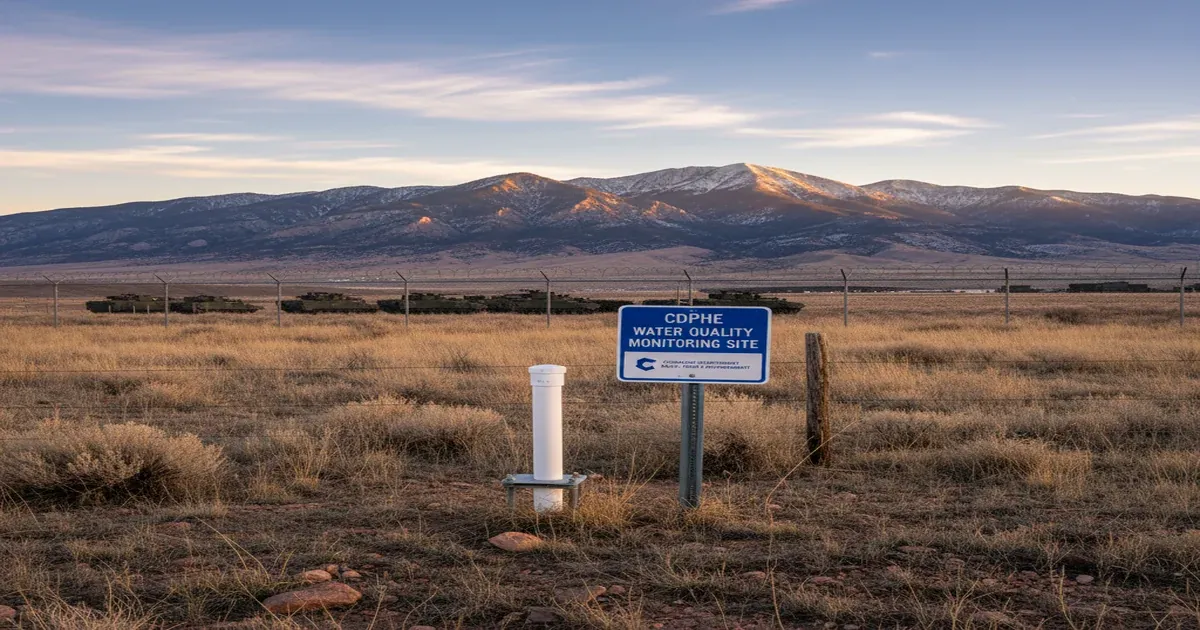
Colorado is facing a growing PFAS contamination crisis driven primarily by military firefighting activities. Communities near Air Force and Space Force installations — where PFAS-containing aqueous film-forming foam (AFFF) was used for decades in training exercises and emergency fire suppression — are discovering that the chemicals have migrated into the groundwater they depend on for drinking water.
The contamination isn’t theoretical. It’s measured, mapped, and affecting real water supplies. And for a state where groundwater is a critical resource for both urban and rural communities, the implications are far-reaching.
The Military PFAS Problem
AFFF — the foam that produces a blanket of fire-suppressant over burning jet fuel — has been the standard firefighting tool at military air bases since the 1970s. It’s extraordinarily effective at extinguishing hydrocarbon fires. It’s also loaded with PFAS compounds that don’t break down in the environment.
Every time AFFF was used in training exercises, equipment testing, or actual fire emergencies, PFAS compounds soaked into the ground and migrated into underlying aquifers. The Department of Defense has identified PFAS contamination at hundreds of installations nationwide, and Colorado has some of the most significant affected sites.
Peterson Space Force Base (Colorado Springs)
Peterson SFB, home of U.S. Space Command and the North American Aerospace Defense Command (NORAD), sits above the Widefield Aquifer — a critical groundwater source for the communities of Fountain, Security, and Widefield south of Colorado Springs.
PFAS contamination from decades of AFFF use at Peterson has migrated into the Widefield Aquifer, affecting the drinking water wells that serve approximately 90,000 people. Testing has found PFOS and PFOA levels well above the EPA’s health advisory levels — and in some cases, above the new enforceable maximum contaminant levels (MCLs) of 4 parts per trillion set in 2024.
The response has included:
- Shut down of contaminated wells and connection of affected communities to alternative water supplies
- Granular activated carbon (GAC) treatment installed at some well sites to remove PFAS
- Department of Defense investigation under CERCLA (Superfund) authority
- Ongoing groundwater monitoring to track plume migration
The affected communities — Fountain, Security-Widefield, and parts of unincorporated El Paso County — have been vocal in demanding faster cleanup and more transparent communication from the military.
Buckley Space Force Base (Aurora)
Buckley SFB, located in the Denver suburb of Aurora, has similar PFAS contamination from AFFF use. The base sits in an area that relies on both surface water and groundwater, and PFAS from the base has been detected in monitoring wells in the surrounding area.
Aurora’s municipal water system draws primarily from surface water sources, which reduces the direct drinking water risk from Buckley’s groundwater contamination. But private well users in the vicinity and downstream water bodies remain concerns.
Other Military Sites
Colorado’s military footprint extends beyond Peterson and Buckley:
- Fort Carson (south of Colorado Springs) — testing has identified PFAS in groundwater near firefighting training areas
- Former Lowry Air Force Base (Denver) — the closed base is already a Superfund site for other contaminants, and PFAS has been added to the investigation
- U.S. Air Force Academy (north of Colorado Springs) — PFAS investigation underway
Non-Military Sources
Military bases aren’t the only PFAS source in Colorado. Commercial airports (Denver International, Colorado Springs Airport), industrial facilities, and wastewater treatment plants also contribute PFAS to the environment:
- Denver International Airport uses AFFF for fire protection operations. PFAS has been detected in monitoring wells and drainage from the airport
- Wastewater treatment plant discharges release PFAS into rivers and streams, which can affect downstream drinking water intakes and agricultural irrigation
- Biosolids application — treated sewage sludge applied to farmland can contain PFAS, which then leaches into soil and groundwater
Colorado’s Regulatory Response
Colorado has been more aggressive than many states in addressing PFAS contamination:
- The Colorado Department of Public Health and Environment (CDPHE) adopted groundwater standards for PFOA (70 ppt) and PFOS (70 ppt) — more protective than the previous federal health advisory but less stringent than the 2024 federal MCLs of 4 ppt.
- CDPHE has required public water systems to test for PFAS and report results
- The state has pursued legal action against PFAS manufacturers, joining multi-state litigation
- Colorado passed legislation creating a PFAS cash fund to support investigation and cleanup
However, the gap between Colorado’s existing groundwater standards (70 ppt) and the new federal MCLs (4 ppt) creates tension. Many water systems that were “compliant” under state standards may need additional treatment to meet the more stringent federal limits.
Groundwater Vulnerability
Colorado’s groundwater situation adds urgency to the PFAS issue:
- The Denver Basin aquifer system — which underlies the Front Range urban corridor from Castle Rock to north of Denver — supplies water to hundreds of thousands of suburban and rural residents through individual wells and small water systems. These aquifers are largely non-renewable (recharge rates are extremely slow), making contamination particularly consequential.
- Alluvial aquifers along the South Platte, Arkansas, and other rivers are recharged by surface water that may carry PFAS from upstream sources.
- Agricultural areas in eastern Colorado rely on the Ogallala Aquifer and shallow alluvial wells, both of which can be affected by biosolids application and surface contamination.
For private well owners, the risk is especially acute because private wells aren’t subject to the same testing and treatment requirements as public water systems. If PFAS is in your aquifer, your well water may contain it — and you won’t know unless you test.
Related Reading
- Denver’s Water: PFAS, Lead, and Drought — PFAS from military bases impacts Front Range water supplies.
- Virginia Beach Water: PFAS and Military Contamination — Another major military community dealing with PFAS from base operations.
- Jacksonville Water: PFAS and Naval Station — Navy installations in Florida share similar PFAS contamination patterns.
- Camp Lejeune Water Contamination — The military base that became synonymous with water contamination.
- PFAS Treatment: Ion Exchange vs. Activated Carbon — Technologies being used to remediate military PFAS contamination.
What Colorado Residents Should Know
- If you’re on a public water system, check your utility’s water quality report for PFAS testing results. Under new federal rules, public systems must test for and report PFAS levels.
- If you have a private well near a military base, airport, industrial facility, or area where biosolids have been applied, get your water tested for PFAS. Colorado certified labs can test for the full suite of PFAS compounds.
- NSF-certified treatment options for PFAS include activated carbon filters (NSF/ANSI 53) and reverse osmosis systems (NSF/ANSI 58). Not all carbon filters are effective against PFAS — look specifically for PFAS certification.
- Follow developments on the Peterson SFB and Buckley SFB cleanup investigations. The Department of Defense holds public meetings and publishes investigation results.
- If you’re in the Fountain/Security/Widefield area, your water providers have been proactive about PFAS testing and treatment. Stay informed through their public notices.
If you’re concerned about PFAS or other contaminants in your Colorado drinking water or well water, a certified water treatment professional can test your water and recommend appropriate filtration or treatment systems.