
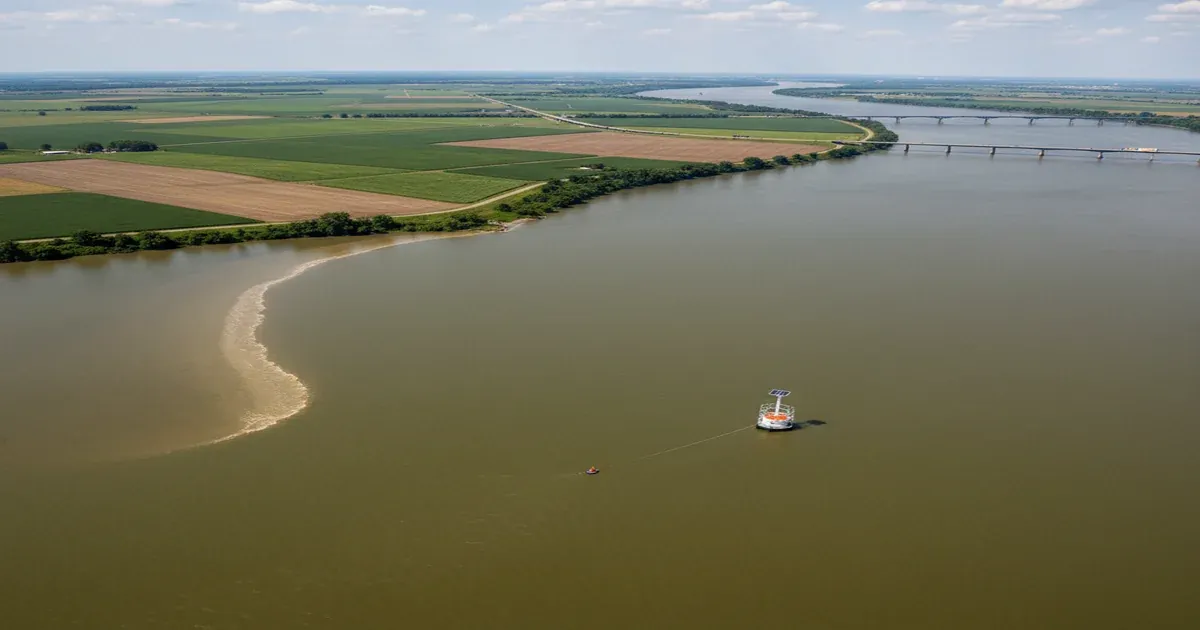
Davenport is the Iowa half of the Quad Cities, sitting directly on the Mississippi River across from Rock Island and Moline, Illinois. With about 102,000 residents, it’s Iowa’s third-largest city — and one of its most flood-vulnerable, since Davenport is famously the only major Mississippi River city without a permanent flood wall or levee system.
That vulnerability extends to drinking water. The Mississippi at this point has already collected agricultural drainage from millions of acres of Iowa, Minnesota, Wisconsin, and Illinois farmland. Every spring, Davenport’s water treatment plant faces the chemical consequences of upstream agriculture.
Mississippi River Source Water
The Iowa American Water treatment plant in Davenport draws directly from the Mississippi River. At this location, the river has already received major tributary inputs including the Minnesota, St. Croix, Wisconsin, Rock, and Iowa rivers — all draining heavily agricultural watersheds.
The result is source water with seasonally elevated levels of:
Nitrate: Iowa’s 23 million acres of corn and soybean production generate enormous nitrogen loads. Tile drainage systems that connect farm fields to ditches and streams efficiently deliver dissolved nitrate to the river. Spring flush — when snowmelt and rain move accumulated winter fertilizer into the drainage system — creates annual nitrate spikes in the Mississippi.
Atrazine and other herbicides: Atrazine application on corn fields across the upper Midwest creates seasonal pulses in the Mississippi. Metolachlor, acetochlor, and other herbicides are also routinely detected.
Sediment: The Mississippi carries heavy sediment loads, particularly during flood events. High turbidity increases treatment complexity and cost.
Iowa American Water’s treatment process includes coagulation, sedimentation, granular activated carbon filtration, and chloramine disinfection. The GAC step is critical for removing agricultural chemicals and improving taste and odor. Treated water meets all EPA standards.
Nitrate: Iowa’s State-Wide Problem
Iowa’s nitrate problem is well-documented and politically contentious. In 2015, Des Moines Water Works sued three upstream drainage districts, arguing that tile drainage systems constituted “point sources” of nitrate pollution under the Clean Water Act. The lawsuit was ultimately dismissed, but it put Iowa’s agricultural water quality challenges on the national stage.
Davenport faces the same dynamic as Des Moines — a downstream city bearing the treatment costs of upstream agricultural pollution. Key data points:
- The Mississippi at Davenport shows nitrate concentrations regularly exceeding 5 mg/L during spring, sometimes approaching or exceeding the EPA’s 10 mg/L MCL
- Iowa American Water uses blending and treatment to keep finished water below the MCL
- Treatment costs for nitrate removal are substantial and growing as agricultural intensification continues
- Iowa’s Nutrient Reduction Strategy, adopted in 2013, set a goal of 45% reduction in nitrogen and phosphorus loading — progress has been slow
Flooding and Water Infrastructure
Davenport’s decision not to build permanent flood walls is a source of local pride and national curiosity. The city has opted instead for a riverfront park system and temporary flood barriers deployed during high water events. This approach preserves river access and aesthetics but creates real risks during major floods.
The water quality implications of flooding include:
- Treatment plant stress during extreme high-water events, when source water turbidity and contamination levels spike
- Distribution system vulnerability — water mains and service connections in flood-prone areas can be compromised by floodwater intrusion, particularly at pipe joints and connections
- Well contamination in areas where private wells exist — floodwater carrying sewage, chemicals, and bacteria can infiltrate shallow wells
- Sewer overflows during floods that contaminate surface water and potentially affect areas near the water intake
Major floods in 2019 caused significant damage in Davenport when a temporary flood barrier failed, flooding downtown. The 2008 flood was even more severe for the broader region. Each event creates water quality impacts that last well beyond the floodwaters’ recession.
Rock Island Arsenal and PFAS
Rock Island Arsenal, located on Arsenal Island in the Mississippi River between Davenport and Rock Island, is one of the oldest active U.S. military installations. The Army’s use of AFFF firefighting foam at the arsenal has resulted in PFAS contamination:
- Testing has found PFAS in groundwater on and near Arsenal Island
- The Mississippi River’s flow dilutes any PFAS contribution from the arsenal, but it adds to the cumulative PFAS load from all upstream sources
- Iowa has been developing PFAS standards and monitoring requirements, with several Iowa communities finding PFAS in their drinking water
Iowa American Water has tested for PFAS under EPA’s UCMR 5 program, with results showing detectable but low-level PFAS in treated water.
Lead in Older Homes
Like many Midwest river cities, Davenport has a housing stock that includes significant pre-1950 construction. Lead service lines and lead solder are present in older neighborhoods.
Iowa American Water conducts Lead and Copper Rule sampling and maintains compliance through corrosion control treatment. The utility is conducting the service line inventory required under the revised Lead and Copper Rule.
Scott County’s childhood blood lead testing has identified neighborhoods in Davenport with elevated lead exposure — from a combination of water, paint, and soil sources. The city’s older housing stock makes comprehensive lead exposure reduction a multi-faceted challenge.
The Dead Zone Connection
Davenport sits roughly halfway along the Mississippi’s journey from Minnesota to the Gulf of Mexico. The nitrate and phosphorus that flow past Davenport’s water intake continue downstream, eventually contributing to the Gulf of Mexico’s hypoxic zone — the “Dead Zone” that forms each summer as nutrient-fueled algal blooms deplete oxygen in Gulf waters.
This connection underscores a fundamental truth about the Mississippi’s water quality: the same agricultural pollution that creates treatment challenges for Davenport creates ecological disasters 1,000 miles downstream. The solutions — reducing nutrient loading from agricultural land — would benefit both drinking water ratepayers and Gulf ecosystems.
What Davenport Residents Should Know
- Iowa American Water’s treated water meets all EPA standards. GAC filtration provides strong protection against agricultural chemicals and other organic compounds.
- Spring is the highest-risk period for source water quality. If you’re particularly sensitive, a point-of-use activated carbon filter during March through June provides additional nitrate and herbicide removal beyond what the treatment plant provides.
- After flood events, follow any boil-water advisories issued by the utility. If you’re on a private well in a flood-affected area, have your water tested before resuming use.
- Check your home’s plumbing age. Pre-1986 construction means potential lead exposure. Contact Iowa American Water about your service line material and consider a certified lead-removal filter.
If you’re concerned about your water quality, a certified water treatment professional can test your water and recommend the right system. In a river city that takes its water straight from the most agricultural river in the country, understanding what you’re drinking is worth the effort.
Related Reading
- Des Moines Water Quality: Nitrate and Agriculture
- Minneapolis Water Quality: PFAS, Lead, and the Mississippi
- Omaha Water Quality: Missouri River and Lead
- St. Louis Lead Service Lines and Water Quality
Sources
- Iowa American Water annual Consumer Confidence Reports for Davenport
- Iowa DNR Mississippi River water quality monitoring data
- USGS nutrient loading estimates for the Mississippi River basin
- Rock Island Arsenal PFAS investigation data
- Iowa Nutrient Reduction Strategy progress reports
- EPA UCMR 5 PFAS testing results