
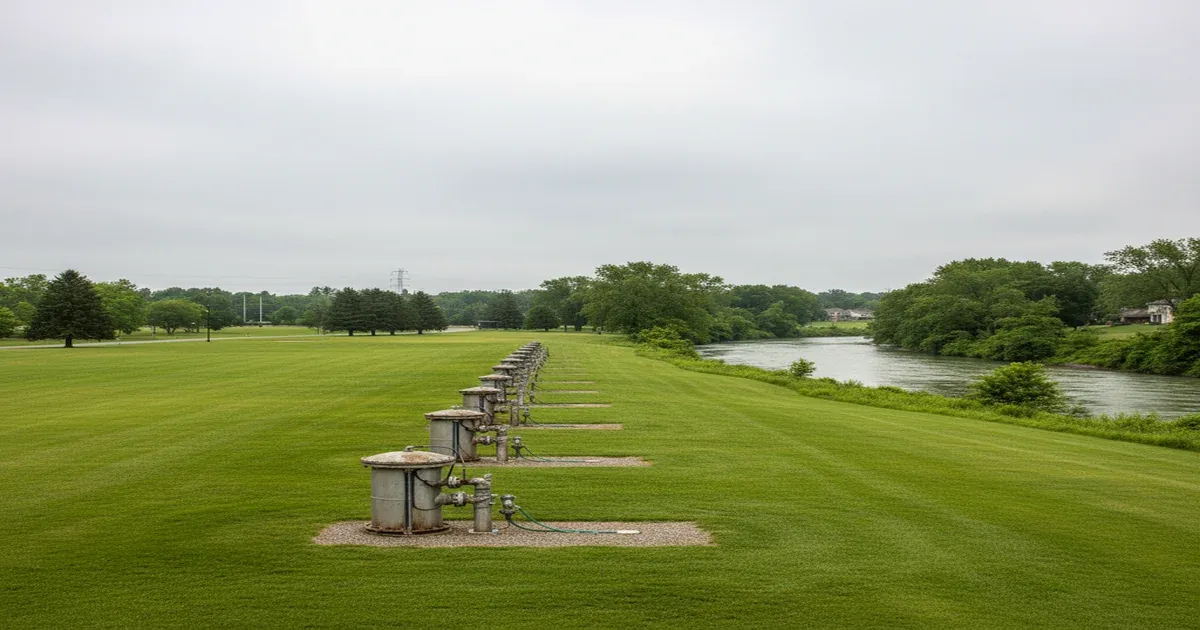
Dayton has something most American cities don’t: a world-class aquifer directly beneath its feet. The Great Miami Buried Valley Aquifer stretches across the Miami Valley of southwestern Ohio, holding an estimated 1.5 trillion gallons of groundwater. It’s so productive that Dayton is the largest city in the United States that relies entirely on groundwater for its public water supply.
That’s the good news. The bad news is that even the best aquifer is only as clean as what seeps into it.
The Great Miami Buried Valley Aquifer
This aquifer formed during the last ice age, when glacial meltwater carved deep valleys into the bedrock and filled them with sand and gravel — perfect geology for storing and filtering water. The aquifer’s recharge rate is exceptional, fed by precipitation and the Great Miami River system.
The City of Dayton operates wellfields along the Mad River and Great Miami River corridors, drawing water from depths of 50 to 100 feet. The natural filtration through sand and gravel means the water requires less treatment than surface water sources, and Dayton’s tap water consistently ranks among the better municipal supplies in Ohio.
But groundwater aquifers have a critical vulnerability: once contaminated, they’re extraordinarily difficult and expensive to clean. Contaminants can persist in groundwater for decades, slowly migrating through the subsurface in plumes that are hard to track and harder to remediate.
Wright-Patterson AFB: PFAS in the Water
Wright-Patterson Air Force Base, one of the largest military installations in the country, sits on the northeastern edge of Dayton. The base has been a center for aerospace research and development since the Wright Brothers era. It’s also been a source of PFAS contamination.
Aqueous film-forming foam (AFFF) — used for decades in firefighting training at military airfields — contains PFAS compounds that have leached into groundwater beneath and around the base. Department of Defense testing has confirmed PFAS contamination in monitoring wells near Wright-Patterson at levels well above the EPA’s health advisory limits.
The concern is migration. Groundwater flows, and the same aquifer that supplies Dayton’s drinking water underlies the base. The Air Force has been conducting remedial investigations and has provided bottled water and alternative water supplies to some affected properties near the base perimeter. But the full extent of the PFAS plume — and its trajectory through the buried valley aquifer — remains under investigation.
The EPA’s 2024 PFAS maximum contaminant levels (4 ppt for PFOA, 4 ppt for PFOS) have forced a reckoning for military-adjacent communities nationwide. Dayton’s municipal wellfields are monitored for PFAS, and levels in the city’s drinking water have generally been below the new MCLs. But “generally below” offers cold comfort when the contamination source is ongoing and the plume dynamics are still being characterized.
Industrial Legacy: A Manufacturing City’s Footprint
Dayton was a manufacturing powerhouse through the 20th century — home to NCR, Delco, General Motors, and dozens of smaller factories. That industrial base brought prosperity and pollution in roughly equal measure.
Multiple Superfund sites dot the Dayton metro area. The Valley Pike VOC site in Riverside, the Behr Dayton Thermal Products facility, and several former plating and machining operations have contributed volatile organic compounds (VOCs), heavy metals, and chlorinated solvents to soil and groundwater.
Trichloroethylene (TCE) — a common industrial degreaser — has been detected in groundwater wells across the Miami Valley. Several municipal wellfields have required treatment systems to remove TCE and related compounds. The Ohio EPA maintains an active monitoring program, but the sheer number of legacy contamination sites means new discoveries continue to surface.
Flood Control: An Unexpected Water Quality Factor
Dayton’s relationship with water was shaped by the catastrophic Great Flood of 1913, which killed over 360 people and destroyed entire neighborhoods. In response, the Miami Conservancy District built five dry dams — one of the first major flood control systems in the United States.
These retention structures protect the city from flooding but also affect water quality dynamics. The impoundment areas behind the dams accumulate sediment and agricultural runoff during storm events. When water is released, it can carry elevated levels of nutrients, bacteria, and suspended solids downstream into the same river corridors that recharge the aquifer.
Agricultural land use upstream — particularly in Champaign and Clark counties — contributes nitrogen and phosphorus to the Great Miami and Mad River systems. While the aquifer’s natural filtration handles much of this, intensive monitoring ensures that farm chemicals don’t compromise drinking water wells.
What the Data Shows
Dayton’s annual water quality reports show the city meeting all federal standards for regulated contaminants. Disinfection byproducts (trihalomethanes and haloacetic acids) are present at levels below MCLs — a consequence of chlorine treatment reacting with organic matter in the source water.
Nitrate levels have historically been below concern thresholds, though they trend higher in wells nearest agricultural areas. The city’s wellfield management program includes purchasing conservation easements around wellheads to limit land use that could introduce contaminants.
Hardness is notable — Dayton’s water is quite hard, typically 250-350 mg/L as calcium carbonate. This is a natural characteristic of limestone-aquifer groundwater and isn’t a health concern, but it does mean mineral buildup in pipes, fixtures, and water heaters.
What Dayton Residents Can Do
Dayton’s groundwater supply is a genuine asset, and the city’s treatment and monitoring programs are robust. But the proximity of military PFAS contamination and legacy industrial sites warrants awareness:
- Review annual water quality reports from the City of Dayton — they’re available online and detail every tested contaminant.
- Test private wells — if you’re outside the municipal system, particularly near Wright-Patterson or industrial sites, independent testing for PFAS and VOCs is strongly recommended.
- Monitor PFAS developments — the Air Force’s remedial investigation at Wright-Patterson is ongoing, and new data on plume migration will affect risk assessments.
- Consider water softening for the hardness, and point-of-use filtration for additional peace of mind.
If you’re concerned about your water quality, a certified water treatment professional can help you test your water and recommend the right solution for your home.