
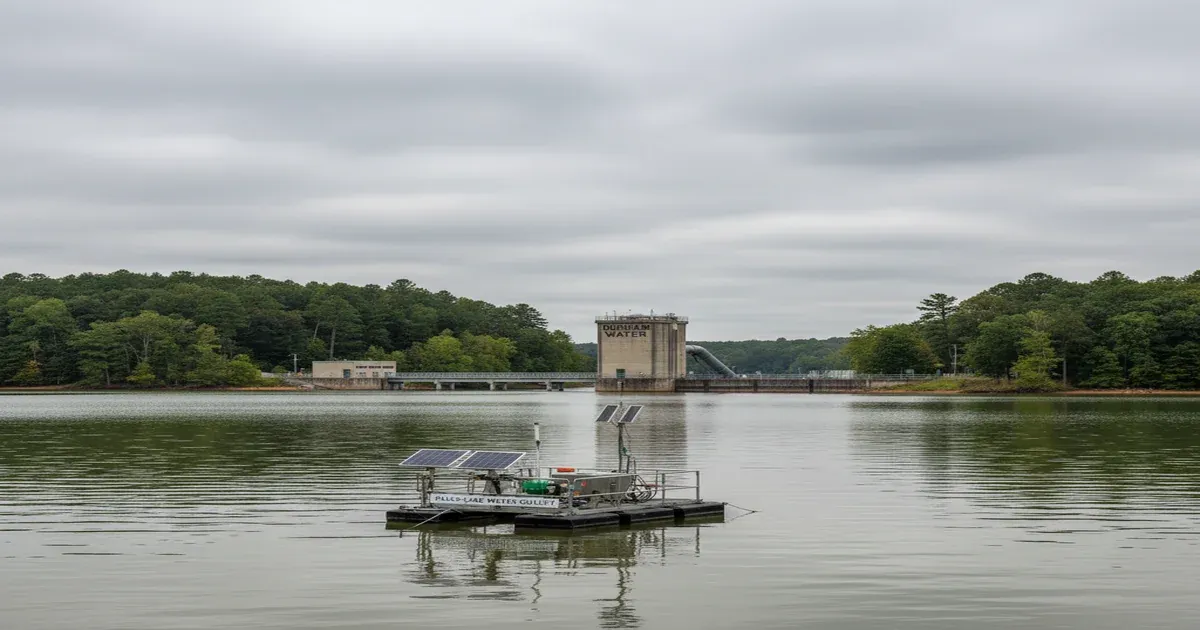
Durham, North Carolina — anchor of the Research Triangle — gets its drinking water from Falls Lake and Lake Michie, with the City of Durham Water Management Department serving about 290,000 people. The source water is surface water from the upper Neuse River watershed (Falls Lake) and the Flat River (Lake Michie).
North Carolina has been at the center of the national PFAS conversation since the 2017 discovery of GenX in the Cape Fear River near Fayetteville. While Durham’s water sources are in a different watershed, the GenX crisis heightened awareness statewide and pushed North Carolina to adopt some of the most aggressive emerging contaminant monitoring in the country.
Falls Lake: Nutrient Pollution
Falls Lake, Durham’s primary water source, has a nutrient problem. The lake was impounded in 1981 by the Army Corps of Engineers for flood control and water supply. Its watershed includes portions of Durham, Wake County, and rapidly developing suburban areas.
Decades of development, stormwater runoff, and wastewater discharge have loaded the lake with nitrogen and phosphorus. The result: algal blooms, low dissolved oxygen, and water quality that has triggered EPA concern. North Carolina adopted Falls Lake Nutrient Management Rules requiring upstream communities to reduce nutrient loading — an expensive, contentious, and slow process.
For drinking water, the nutrient-driven algal growth means Durham’s treatment plant deals with taste and odor compounds (geosmin, MIB) and elevated organic matter that forms disinfection byproducts when chlorinated. The city uses ozonation — a more advanced treatment step than many cities employ — specifically because of Falls Lake’s challenging water quality.
1,4-Dioxane: A Triangle-Specific Problem
1,4-dioxane, a likely carcinogen and emerging contaminant, has been detected in the groundwater and surface water of the Durham-Research Triangle area. The compound was widely used as a solvent stabilizer and is extremely persistent in the environment — it doesn’t adsorb well to soil and isn’t easily broken down by natural processes.
Sources in the Durham area include former industrial sites and wastewater treatment plant discharges. The Cape Fear River basin has received particular attention, but detections in the Neuse basin (which includes Falls Lake) have also been documented.
There is no federal MCL for 1,4-dioxane. North Carolina has established a health goal of 0.35 ppb. Advanced oxidation and UV treatment can address 1,4-dioxane, but standard activated carbon treatment is less effective against it.
PFAS Monitoring
North Carolina’s experience with GenX — a PFAS compound discharged by the Chemours facility near Fayetteville into the Cape Fear River — made the state a national leader in PFAS awareness. The discovery that hundreds of thousands of people had been unknowingly drinking PFAS-contaminated water for years triggered statewide testing.
Durham’s water supply has been tested for PFAS compounds, and results have been below the EPA MCLs. Falls Lake’s watershed is largely residential and institutional rather than industrial, which provides some protection from direct PFAS point sources. But PFAS is ubiquitous in the environment — from wastewater treatment plant effluent, stormwater runoff, and biosolids application on agricultural land.
North Carolina’s PFAS monitoring program is ongoing, and Durham residents benefit from one of the most tested water supplies in the state.
Growth and Development Pressure
The Research Triangle is one of the fastest-growing metro areas in the United States. Durham alone has added tens of thousands of residents since 2010. All that growth puts pressure on water supply, increases stormwater runoff into Falls Lake, and generates more wastewater that must be treated before discharge.
The city has invested in conservation programs, water reuse, and treatment plant upgrades. But the fundamental challenge — more people using the same watershed — requires long-term planning that extends beyond any single budget cycle.
What Residents Can Do
- Support Falls Lake cleanup. The nutrient management rules are working but slowly. Advocate for continued investment.
- Filter for taste and DBPs. Ozonation reduces but doesn’t eliminate disinfection byproducts. A carbon filter handles the rest.
- Know your home’s plumbing. Older Durham homes (pre-1986) may have lead solder. Test if you haven’t.
- Private well owners in Durham County: Test for 1,4-dioxane, PFAS, bacteria, and nitrates. The area’s industrial and research history means unexpected contaminants can appear.
- Stay informed. Durham Water publishes detailed quality reports. The GenX crisis taught North Carolina residents to pay attention — don’t lose that habit.
If you’re concerned about your water quality, a certified water treatment professional can test your water and recommend the right treatment approach.
For more North Carolina coverage, see our report on Wilmington NC and the GenX crisis.
Sources: City of Durham Water Management, NC DEQ, EPA SDWIS, USGS, Durham County Health Department