
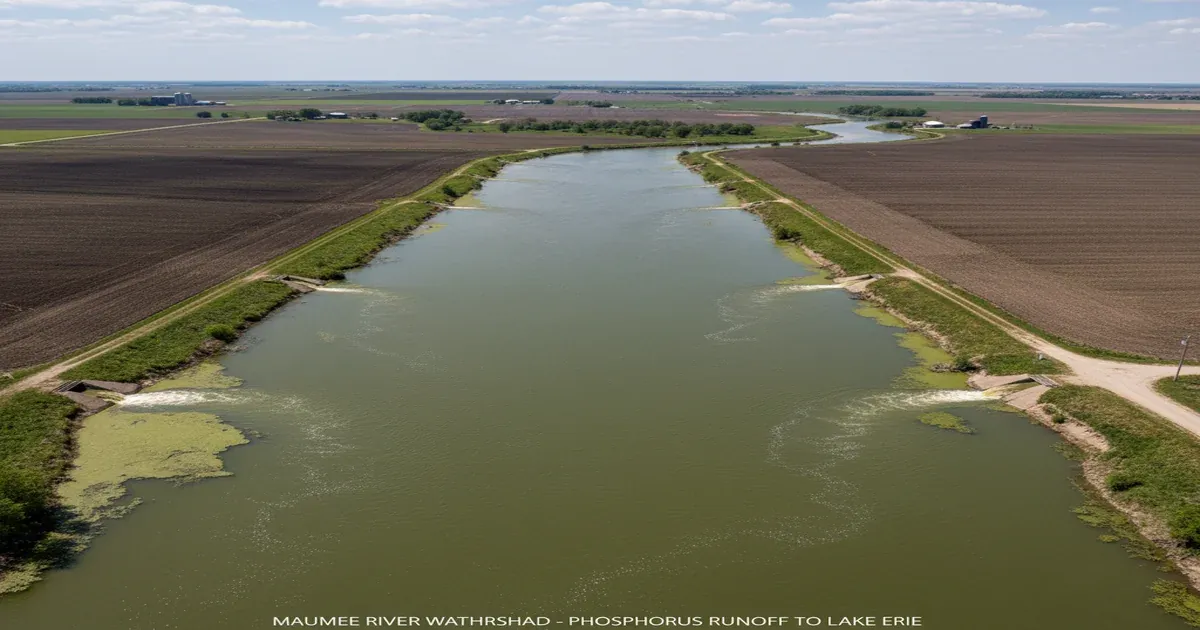
Fort Wayne has an unusual relationship with water quality. The city of 270,000 sits at the headwaters of the Maumee River, which drains an 8,300-square-mile watershed of northwestern Indiana and northwestern Ohio farmland before emptying into western Lake Erie near Toledo.
The Maumee delivers more phosphorus to Lake Erie than any other tributary — a dubious distinction that makes it the primary driver of the harmful algal blooms that have plagued western Lake Erie since the 2000s, culminating in the 2014 Toledo water crisis.
Fort Wayne’s Groundwater Supply
The city itself doesn’t draw drinking water from the Maumee. Fort Wayne City Utilities operates wellfields drawing from the Maumee River Valley glacial aquifer — alluvial sand and gravel deposits along the river corridors that provide natural filtration.
The wellfield system is robust, and Fort Wayne’s treated water consistently meets federal standards. The glacial aquifer is recharged primarily by the Maumee, St. Marys, and St. Joseph rivers, which converge at Fort Wayne — meaning the quality of those rivers ultimately affects groundwater quality over time, even if the filtration process handles most contaminants effectively.
Lead has been the primary infrastructure concern. Fort Wayne has an aging distribution system, and lead service lines remain in the older residential neighborhoods near downtown. The city’s corrosion control program has kept lead levels below federal action thresholds, but the replacement program for lead service lines is ongoing.
The Maumee: America’s Most Phosphorus-Loaded River
The Maumee River watershed is the most intensively drained agricultural landscape in the Great Lakes basin. Over 90% of the land is in corn and soybean production, and an extensive network of subsurface tile drains — estimated at hundreds of thousands of miles — channels water from fields directly into streams and rivers with minimal time for natural filtration.
Phosphorus from fertilizer applications, manure from hog and poultry confinements, and legacy phosphorus stored in soil moves through this tile drain network into the Maumee and its tributaries at rates that overwhelm the river’s capacity to assimilate it. USGS monitoring has documented the Maumee as consistently among the top phosphorus-loading tributaries to the Great Lakes.
That phosphorus feeds Cyanobacteria — blue-green algae — in the warm, shallow western basin of Lake Erie each summer. The 2014 Toledo crisis, when microcystin toxins from a Microcystis bloom contaminated the city’s intake, was the most dramatic manifestation of a problem that has been building for decades. Less severe but still significant bloom events occur most years.
Fort Wayne as an Upstream Source
Fort Wayne’s role in the Maumee phosphorus story is both as a victim of agricultural practices in its watershed and as an upstream contributor to Toledo’s water problems. Treated wastewater from Fort Wayne’s water resource recovery facility is discharged to the Maumee. While the treatment plant achieves significant phosphorus removal, any discharge adds to the river’s load.
The city has invested in enhanced phosphorus removal at its treatment plant, bringing effluent levels well below permit limits. But the agricultural contribution — roughly 80-90% of the total phosphorus load — dwarfs anything a municipal treatment upgrade can offset.
PFAS and Industrial Legacy
Fort Wayne has a significant manufacturing history — auto parts, electronics, defense equipment. Several former industrial sites in the city have soil and groundwater contamination from solvents, metals, and other industrial chemicals.
PFAS contamination has been detected near the Fort Wayne-Allen County Airport (FWA), where firefighting foam use during aircraft rescue training has been a historical practice. The Indiana Department of Environmental Management has conducted PFAS sampling in the vicinity, and some monitoring wells near the airport have shown PFAS at levels above health advisory thresholds.
Fort Wayne City Utilities samples its finished water for PFAS. Levels in the municipal supply have been below the EPA’s 2024 MCLs, but ongoing monitoring is warranted given the proximity of potential PFAS sources.
What Fort Wayne Residents Can Do
The city’s wellfield-based supply is generally good, and the treatment process handles most source water challenges:
- Check your home’s plumbing age — if built before 1986, consider lead testing.
- Review the annual CCR — Fort Wayne City Utilities publishes detailed water quality data.
- Private wells in Allen County should be tested for nitrate, VOCs, and PFAS, particularly near industrial sites or the airport.
- Support Maumee watershed initiatives — the Western Lake Erie Basin Partnership and similar programs are working on voluntary agricultural nutrient management, which is the only path to cleaner river water.
If you’re concerned about your water quality, a certified water treatment professional can help you test your water and recommend the right solution for your home.