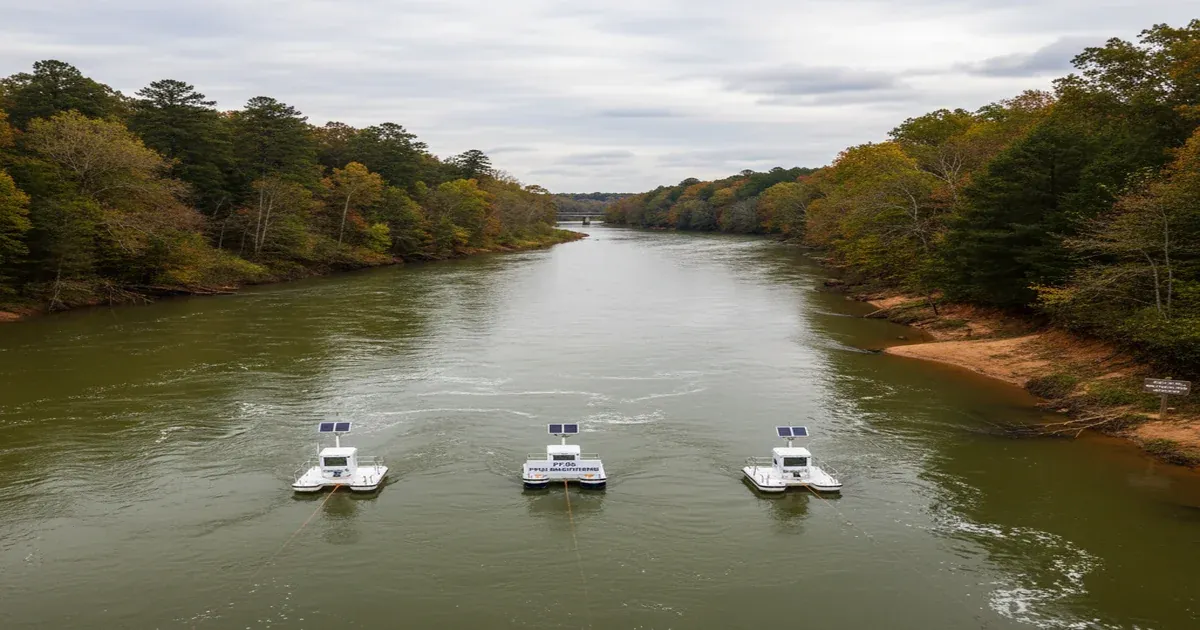
Greensboro is the third-largest city in North Carolina, anchoring the Piedmont Triad alongside Winston-Salem and High Point. The city’s 300,000 residents get their drinking water from a system of reservoirs — Lake Townsend, Lake Brandt, Lake Higgins, and the Mitchell Water Treatment Plant drawing from Lake Mackintosh on the Haw River.
The reservoirs capture surface water from the Haw River watershed, and that’s where the complications begin. The Haw River has a long history of receiving treated wastewater discharges and industrial runoff, and contaminants that enter the watershed eventually make their way into Greensboro’s drinking water supply.
1,4-Dioxane: An Emerging Concern
1,4-Dioxane has become one of the most closely watched contaminants in North Carolina’s water supply. It’s a synthetic chemical used as a solvent stabilizer in various industrial processes — and it’s a likely carcinogen, according to the EPA.
The Haw River and its tributaries have shown detectable levels of 1,4-dioxane, primarily from upstream industrial discharges and wastewater treatment plants. The chemical is notable for several reasons:
- It passes through conventional water treatment largely intact — standard coagulation, sedimentation, and chlorination don’t remove it effectively
- It’s highly mobile in water and doesn’t bind to soil or sediment
- There is no federal MCL for 1,4-dioxane. The EPA has a health advisory of 35 micrograms per liter, but many health advocates argue this is far too high
- North Carolina’s health goal is 0.35 micrograms per liter — 100 times lower than the EPA advisory
Greensboro’s water system has detected 1,4-dioxane at levels above North Carolina’s health goal but below the EPA’s advisory level. The city has invested in advanced treatment — including advanced oxidation processes — to reduce 1,4-dioxane concentrations in finished water.
The Textile Industry Legacy
North Carolina’s Piedmont region was the center of America’s textile industry for over a century. Mills in Greensboro, Burlington, High Point, and surrounding communities processed cotton, wool, and synthetic fabrics using a wide range of chemicals — dyes, solvents, finishing agents, and fire retardants.
Most of those mills are gone now, but their chemical legacy persists in the watershed:
- Solvents (trichloroethylene, perchloroethylene, 1,4-dioxane) from cleaning and processing
- Heavy metals (chromium, zinc, copper) from dyeing operations
- Petroleum compounds from equipment maintenance and fuel storage
Several former textile sites in and around Greensboro are listed as contaminated sites under North Carolina’s Inactive Hazardous Sites program. Groundwater contamination plumes at these sites continue to require monitoring and, in some cases, active remediation.
PFAS in the Haw River Watershed
Following the GenX contamination crisis in the Cape Fear River basin (centered around Fayetteville and Wilmington), North Carolina expanded PFAS monitoring across the state’s major river systems. The Haw River watershed, while not as severely affected as the Cape Fear, has shown detectable PFAS levels.
Sources in the Greensboro area include:
- Wastewater treatment plant discharges — municipal wastewater contains PFAS from consumer products, industrial users, and stormwater
- Piedmont Triad International Airport (PTI) — like many airports, PTI used AFFF firefighting foam containing PFAS for fire training. Testing has found PFAS in soils and groundwater near the airport
- Industrial discharges — various industrial operations in the Triad use or have used PFAS-containing products
North Carolina has been more aggressive than most states in testing for PFAS following the GenX crisis. The state’s Department of Environmental Quality has conducted extensive sampling of drinking water sources, including Greensboro’s reservoirs.
Reservoir Management Challenges
Greensboro’s reservoir system faces typical challenges for surface water supplies in the southeastern Piedmont:
Nutrient loading: Phosphorus and nitrogen from agricultural runoff, septic systems, and urban stormwater promote algal growth in the reservoirs. During warm months, algal blooms can produce taste and odor compounds (geosmin and 2-methylisoborneol) that, while not harmful, affect water taste.
Sedimentation: Soil erosion from construction, agriculture, and stormwater contributes sediment to the reservoirs, gradually reducing their storage capacity. Lake Townsend and Lake Brandt have experienced sediment accumulation over their decades of operation.
Disinfection byproducts: The organic material in surface water reacts with chlorine or chloramine during treatment, producing trihalomethanes and haloacetic acids. Greensboro manages DBPs through a combination of treatment optimization and distribution system management, maintaining compliance with EPA’s Stage 2 DBP Rule.
Lead in Older Homes
Greensboro, like many cities with housing stock from the pre-1986 era, has lead exposure risks from residential plumbing. North Carolina’s Lead and Copper Rule sampling shows Greensboro’s water system in compliance with the 15 ppb action level, but:
- Older homes with lead solder joints, brass fixtures, or lead service connections can see elevated levels
- The city treats its water with corrosion inhibitors (orthophosphate) to reduce lead leaching from pipes
- Under the EPA’s revised Lead and Copper Rule, Greensboro is inventorying its service line materials, with full inventory required by October 2024
The GenX Ripple Effect
While Greensboro wasn’t directly affected by the Chemours GenX discharge that contaminated the Cape Fear River, the crisis had significant ripple effects across the state:
- North Carolina passed legislation requiring industrial facilities to disclose PFAS discharges
- The state DEQ expanded water quality monitoring statewide
- Public awareness of emerging contaminants increased dramatically, driving demand for testing and treatment across the Piedmont
Greensboro residents, already primed by local 1,4-dioxane concerns, have been among the most active in demanding water quality transparency from their utility.
What Greensboro Residents Should Know
- Greensboro’s treated water meets all federal standards, but some contaminants of concern (1,4-dioxane, PFAS) are either unregulated or regulated at levels that some health experts consider insufficient.
- Check your home’s plumbing age. If your home was built before 1986, you may have lead solder in your plumbing. Running the tap for 30 seconds before drinking after periods of non-use reduces exposure.
- Activated carbon and reverse osmosis are the most effective residential treatment options for the mix of contaminants in Greensboro’s source water. Activated carbon handles 1,4-dioxane, PFAS, DBPs, and taste/odor issues. RO adds nitrate and lead removal.
- Stay engaged. Greensboro’s Water Resources Department publishes annual water quality reports and holds public meetings on water system issues.
If you’re concerned about your water quality, a certified water treatment professional can test your water and advise on the right system. In a region with both legacy industrial contamination and emerging chemical concerns, proactive filtration is a reasonable investment.
Related Reading
- Wilmington NC GenX PFAS: Chemours and the Cape Fear River
- Durham NC Water Quality: Falls Lake Challenges
- Raleigh Water Quality: Falls Lake and PFAS
- Charlotte Water Quality: Coal Ash and Duke Energy
Sources
- City of Greensboro Water Resources Department Annual Water Quality Reports
- North Carolina DEQ 1,4-dioxane sampling data for the Haw River watershed
- North Carolina PFAS statewide monitoring results
- EPA Lead and Copper Rule compliance data
- North Carolina Inactive Hazardous Sites program records for Guilford County
- NC DEQ GenX investigation and statewide PFAS response documentation