The Red Hill Crisis
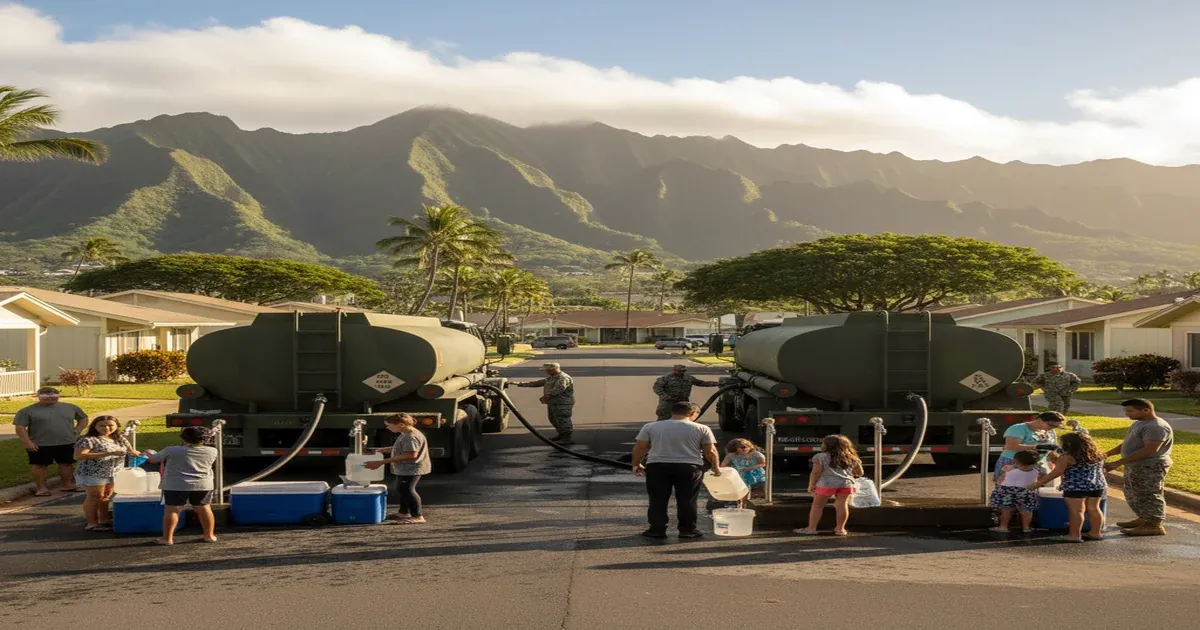
In November 2021, residents in military housing near Joint Base Pearl Harbor–Hickam began reporting fuel-smelling water, skin rashes, nausea, and other symptoms. What followed became the worst military water contamination crisis — surpassing even Camp Lejeune — in modern U.S. history.
The Navy’s Red Hill Bulk Fuel Storage Facility — a World War II-era underground tank farm holding 250 million gallons of jet fuel in massive steel-lined tunnels carved into the volcanic rock above Pearl Harbor — had leaked fuel into the groundwater. The contamination reached the Navy’s Red Hill well shaft, which supplied drinking water to approximately 93,000 military personnel and their families.
Testing confirmed petroleum compounds in the water, including total petroleum hydrocarbons, naphthalene, and other fuel constituents. The Navy’s initial response was widely criticized as slow and dismissive — families had been complaining for days before the water was declared unsafe.
The Hawaii Department of Health ordered the Red Hill well shut down, and eventually the Department of Defense agreed to defuel and permanently close the Red Hill facility. Defueling was completed in 2024, but the environmental damage to the aquifer remains.
Why It Matters for All of Honolulu
The Red Hill contamination hit the military water system hardest, but it threatened something much bigger: Oahu’s primary drinking water aquifer.
Honolulu Board of Water Supply (BWS) — the civilian utility serving most of Oahu’s 950,000 residents — draws from the same Southern Oahu Basal Aquifer that the Red Hill fuel plume contaminated. The Navy’s underground tanks sat directly above one of the most productive and pristine aquifer zones on the island.
BWS had been warning about the risk for years. In 2014, a 27,000-gallon fuel release from Red Hill prompted calls for the facility’s closure. The Navy resisted, citing national security needs. It took the 2021 crisis — families poisoned by their own tap water — to force action.
BWS shut down its nearby Halawa shaft as a precaution and installed additional monitoring wells to track the fuel plume’s movement. As of 2025, the contamination had not reached BWS production wells, but the aquifer remains under long-term monitoring.
Island Water: No Backup Plan
What makes Oahu’s water situation uniquely precarious is geography. Unlike mainland cities that can pipe in water from neighboring watersheds or states, Oahu is an island. The Southern Oahu Basal Aquifer provides the majority of the island’s drinking water — there’s no alternative source of comparable scale.
The aquifer is fed by rainfall percolating through volcanic rock — a process that takes years to decades. The water is naturally filtered and has historically been among the purest drinking water in the United States. That natural purity made the Red Hill contamination all the more shocking.
Demand pressures compound the vulnerability. Tourism, military operations, and residential growth all draw from the same finite aquifer. Climate change projections for Hawaii suggest reduced trade wind rainfall on the leeward (Honolulu) side of the island, which could decrease aquifer recharge rates.
PFAS: The Next Chapter
Beyond fuel contamination, PFAS has emerged as a growing concern for Honolulu’s water. Military installations across Oahu — part of a nationwide pattern of military PFAS contamination — — Pearl Harbor, Hickam, Schofield Barracks, Marine Corps Base Hawaii — used AFFF firefighting foam extensively for decades. PFAS from these activities has been detected in groundwater at and near military installations.
The Hawaii Department of Health has been conducting PFAS investigations at military sites, and BWS has implemented PFAS monitoring across its well network. So far, BWS production wells have not shown PFAS levels above the EPA’s 2024 Maximum Contaminant Levels (4 ppt for PFOA and PFOS), but monitoring is ongoing.
The state of Hawaii adopted its own notification levels for PFAS compounds, and the legislature has considered some of the strictest PFAS regulations in the country — driven in part by the Red Hill crisis and the broader military contamination legacy.
Current Water Quality
For most Honolulu residents on BWS water, the drinking water continues to meet all EPA standards. The utility’s 2024 Consumer Confidence Report shows:
- Low levels of disinfection byproducts (BWS uses chloramine disinfection)
- No lead or copper action level exceedances
- No detections of fuel compounds in BWS production wells
- PFAS monitoring ongoing with results below federal MCLs
The water is naturally low in minerals (soft water), which means less scaling but also less natural buffering against pH changes that can affect lead leaching in older plumbing.
Private Wells and Rural Oahu
Residents in rural areas of Oahu — particularly the North Shore, Windward side, and parts of Central Oahu — may rely on private wells or small community water systems. These sources face different contamination risks:
- Agricultural chemicals from pineapple and sugarcane farming (historical) including EDB and DBCP
- Cesspool contamination — Hawaii has more cesspools than any other state (approximately 88,000), and many contribute to groundwater contamination with nutrients and pathogens
- Naturally occurring manganese and iron in some aquifer zones
What Residents Can Do
- Know your water source — check whether you’re on BWS, military, or a private system
- Review BWS water quality reports at boardofwatersupply.com
- If you’re in military housing, stay informed about the Red Hill remediation progress and any advisories from your installation
- If you’re on a private well, test annually for bacteria, nitrates, and consider testing for fuel compounds and PFAS if you’re near a military installation
- Consider a certified water filter — particularly if you’re near the Red Hill area or military bases. NSF P473-certified filters address PFAS; activated carbon filters reduce fuel-related compounds
- Report any unusual taste or odor to BWS or your water provider immediately
If you’re concerned about your water quality, a certified water treatment professional can test your water and recommend solutions appropriate for Oahu’s specific contamination risks.
Sources
- Honolulu Board of Water Supply, Annual Water Quality Reports
- Hawaii Department of Health, Red Hill Investigation and Response
- U.S. Navy, Red Hill Defueling and Closure Reports
- EPA SDWIS, BWS compliance records
- Hawaii State Legislature, PFAS-related legislation
- U.S. Government Accountability Office, Red Hill Reports