
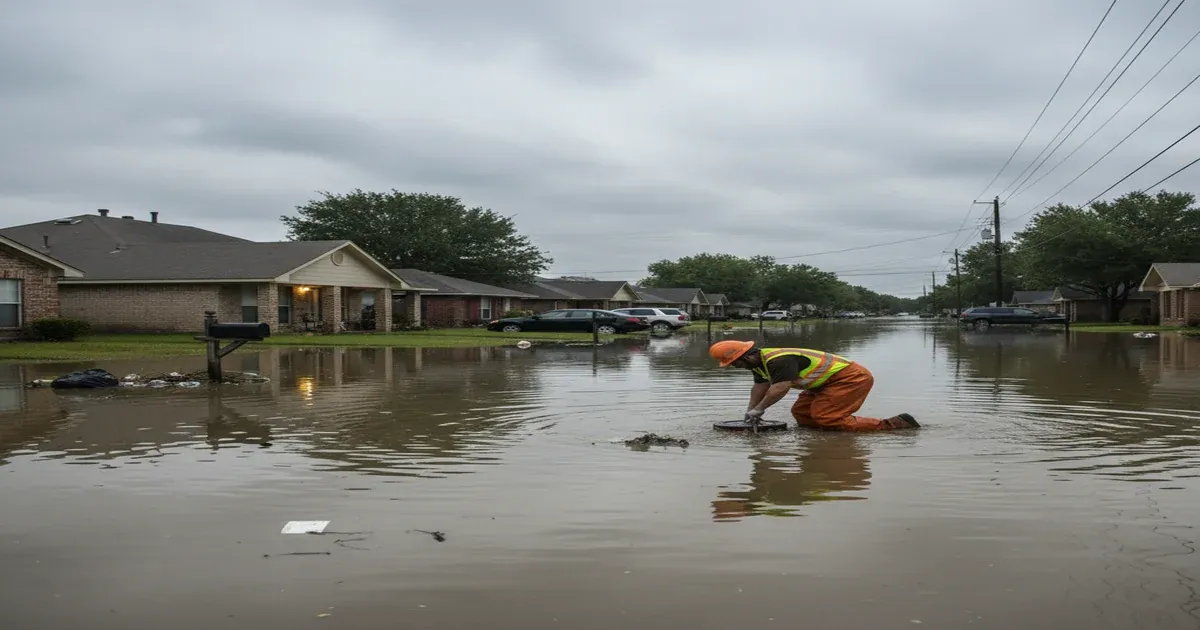
Houston has a water problem — actually, it has several. The nation’s fourth-largest city sits at the intersection of nearly every major water challenge in America: land subsidence from decades of groundwater overpumping, catastrophic flooding from hurricanes and tropical storms, aging infrastructure that fails under stress, and a growing population that keeps putting more demand on a system built for a smaller city.
For the 2.3 million people in the city — and the 7 million in the greater metro area — understanding Houston’s water challenges isn’t academic. It’s practical.
The Subsidence Problem
Houston’s relationship with groundwater goes back to the city’s founding. For much of the 20th century, the region relied heavily on groundwater from the Gulf Coast Aquifer for its municipal, industrial, and agricultural water supply. The pumping was massive — and it had consequences.
When you pump large volumes of groundwater from clay-rich sediments, the ground above compresses and sinks. This process, called subsidence, is essentially permanent. Parts of the Houston area sank by as much as 10 feet between the 1940s and 1970s, with the worst impacts near the Houston Ship Channel and in communities like Baytown, Pasadena, and the Brownwood subdivision.
The Brownwood subdivision in Baytown became the most dramatic example. The neighborhood sank so far below sea level that it flooded repeatedly and was eventually abandoned entirely — homes demolished, residents relocated. The area is now the Baytown Nature Center.
In response, the Harris-Galveston Subsidence District was created in 1975 to regulate groundwater withdrawal and force a transition to surface water. The program has been largely successful — subsidence rates have slowed dramatically in areas that switched to surface water. But the transition isn’t complete everywhere, and the Fort Bend Subsidence District (covering the rapidly growing suburbs southwest of Houston) is still working to reduce groundwater dependence.
Flooding: When Too Much Water Is the Problem
If subsidence is Houston’s chronic water issue, flooding is the acute one. The city’s flat topography, clay soils, rapid development, and Gulf Coast location make it extraordinarily flood-prone.
The numbers tell the story:
- Hurricane Harvey (2017): Dropped over 60 inches of rain on parts of the Houston area over four days. More than 300,000 structures flooded. Over 80 deaths. Estimated $125 billion in damage.
- Tax Day Flood (2016): 240 billion gallons of water fell on Harris County in a single day.
- Memorial Day Flood (2015): Killed 8 people and caused widespread damage.
- Tropical Storm Allison (2001): Dumped nearly 40 inches of rain, flooded the Texas Medical Center and thousands of homes.
Each flood event overwhelms the city’s water and wastewater infrastructure. Treatment plants lose power or flood. Sewage spills into bayous and floodwaters. Boil water notices go out across vast areas of the city.
After Harvey, the city and Harris County committed to a $2.5 billion flood mitigation bond program — the largest in Houston history. But the projects take years to complete, and the fundamental vulnerability remains: Houston sits in a floodplain, and climate change is delivering more intense rainfall events.
Infrastructure: The Boil Advisory Problem
Houston’s water distribution system is massive — approximately 7,700 miles of water mains serving the city proper. Much of it is old. And when old pipes fail under pressure drops, the result is boil water advisories that can affect hundreds of thousands of people at once.
The most disruptive recent example came in November 2022, when a power outage at a water treatment facility caused system-wide pressure drops, triggering a boil water notice for the entire city of Houston — 2.2 million people. The advisory lasted two days before water quality testing confirmed the system was safe.
But the 2022 event wasn’t isolated. Smaller-scale boil advisories happen regularly in Houston, often triggered by:
- Water main breaks: Aging pipes in older neighborhoods crack and fail, especially during temperature swings. Houston experiences hundreds of water main breaks per year.
- Pressure drops: When pumps fail or power is lost at treatment or distribution facilities, water pressure drops below the 20 PSI minimum, creating the potential for contaminant intrusion.
- Construction damage: Houston’s booming construction industry frequently strikes underground water mains.
- Extreme weather: Both freezes (February 2021’s Winter Storm Uri) and hurricanes can cause cascading infrastructure failures.
The city has increased capital spending on water and wastewater infrastructure in recent years, but the backlog is enormous. Houston’s water system serves an area that has grown from 617 square miles to over 670 square miles through annexation, and much of the infrastructure in older areas dates to the mid-20th century.
Water Quality Concerns
Beyond the infrastructure failures, Houston residents face several ongoing water quality considerations:
Disinfection Byproducts
Houston treats its surface water supply with chloramine (a combination of chlorine and ammonia) for disinfection. While effective at killing pathogens, chloramine can form disinfection byproducts, including haloacetic acids and trihalomethanes, as it reacts with organic matter in the water. Houston’s system generally meets EPA limits, but residents in areas with longer water residence times (where water sits in pipes longer before reaching the tap) may experience higher levels.
Lead Service Lines
Like many American cities, Houston has an unknown number of lead service lines connecting water mains to homes built before the 1980s. The EPA’s Lead and Copper Rule Revisions require the city to inventory and eventually replace all lead service lines, but the process is in its early stages.
Hardness
Houston’s water — whether from surface or remaining groundwater sources — tends to be moderately hard (100-200 mg/L as calcium carbonate). This isn’t a health concern, but it causes scale buildup in water heaters, spots on dishes, and soap scum.
Private Well Users
Residents outside the city limits who rely on private wells face a different set of concerns. The Gulf Coast Aquifer can contain naturally occurring arsenic, and agricultural areas may have elevated nitrates. Regular well testing is essential for private well owners in the greater Houston area.
What Houston Residents Can Do
- During boil advisories: Follow the notice — boil water for at least one minute before drinking, cooking, or brushing teeth. Use bottled water if boiling isn’t practical.
- Get your water tested if you live in a pre-1986 home, especially if you’re concerned about lead. The City of Houston offers testing programs, or you can use a certified independent lab.
- Consider a water filter if you’re concerned about disinfection byproducts or lead. NSF-certified carbon filters remove chloramine byproducts; NSF/ANSI 53-certified filters remove lead.
- Know your flood risk. If you’re on a private well in a flood-prone area, have your water tested after any significant flooding event — floodwater can contaminate wells with bacteria, chemicals, and sediment.
- Water softeners can address Houston’s hard water if mineral buildup is a concern in your home.
If you’re concerned about your water quality in the Houston area, a certified water treatment professional can test your water and advise on filtration, softening, or other treatment solutions for your specific situation.
Related Reading
- Dallas-Fort Worth Water: PFAS and the Trinity — Texas’s other major metro deals with different contamination issues.
- San Antonio Water System Infrastructure — Texas water infrastructure varies dramatically by region.
- New Orleans Water Infrastructure and Lead — Gulf Coast cities share flooding and infrastructure vulnerabilities.
- Miami Water: Biscayne Aquifer and Saltwater Intrusion — Coastal subsidence and water challenges run from Texas to Florida.