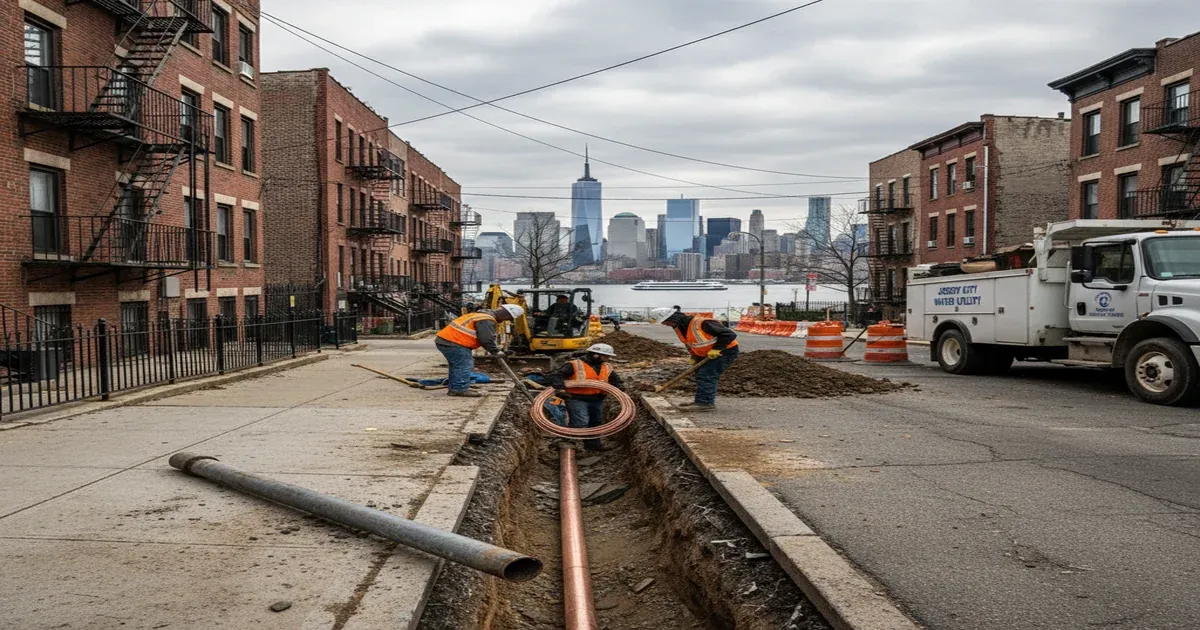
Jersey City is New Jersey’s second-largest city and one of the fastest-growing municipalities on the East Coast. Thousands of new residential units have gone up in the last decade, the population has surged past 290,000, and the development pipeline shows no signs of slowing down. But underneath the construction cranes and luxury high-rises, the water system that serves all those residents is showing its age.
The Jersey City Municipal Utilities Authority (JCMUA) manages the city’s drinking water, with operations handled by Veolia Water. The system draws primarily from the Boonton Reservoir in Morris County and supplemental sources in the North Jersey watershed. At the treatment plant, the water meets federal standards. But between treatment and the tap, things get more complicated.
Lead Service Lines: The Underground Problem
Like many northeastern cities built in the late 1800s and early 1900s, Jersey City has thousands of lead service lines connecting water mains to homes and businesses. These pipes were standard construction for decades before the dangers of lead exposure were well understood.
Lead doesn’t typically come from the source water — it leaches from the pipes themselves, especially when water chemistry shifts or corrosion control isn’t optimized. The risk is highest in older homes and buildings constructed before 1986, when lead plumbing was finally banned under federal law.
JCMUA has launched its “Lead-Free JC” campaign, a lead service line replacement incentive program aimed at getting lead out of the ground across the city. The program offers free replacement of the utility-owned portion of lead service lines and incentives for property owners to replace the private side. It’s a step in the right direction — but the scale of the problem in a city this old means the work will take years to complete.
Jersey City residents can check whether their property has a lead service line through JCMUA’s online tool or by calling the authority directly at 201-432-1150.
PFAS: The Emerging Contaminant
According to the Environmental Working Group’s Tap Water Database, which analyzed JCMUA testing data from 2021 to 2023, Jersey City’s water contains detectable levels of several PFAS compounds — including perfluorooctane sulfonate (PFOS), perfluorooctanoic acid (PFOA), and perfluorohexane sulfonate (PFHxS). All three exceeded EWG-recommended health guidelines during the testing period.
PFAS — per- and polyfluoroalkyl substances, often called “forever chemicals” — don’t break down in the environment or the human body. They’ve been linked to cancer, thyroid disease, immune system suppression, and developmental problems. The EPA finalized its first-ever enforceable PFAS limits for drinking water in 2024, setting maximum contaminant levels of 4 parts per trillion for PFOS and PFOA individually.
Jersey City’s PFAS levels reflect a broader regional challenge. Northern New Jersey has extensive industrial history, military installations, and firefighting training sites — all common sources of PFAS contamination. The compounds enter the watershed through surface runoff, groundwater migration, and wastewater discharge.
Chromium, Nitrates, and Disinfection Byproducts
PFAS and lead aren’t the only concerns. EWG’s analysis found that Jersey City’s water exceeded health guidelines for several additional contaminants:
-
Hexavalent chromium (chromium-6) — The carcinogen made famous by the Erin Brockovich case. Jersey City has historical chromium contamination from industrial processing operations, particularly in the Garfield Avenue area, which is a designated Superfund site. While the drinking water levels detected were below the federal maximum contaminant level, they exceeded more protective state and independent health guidelines.
-
Nitrate — Present above EWG health guidelines, though below the federal legal limit. Nitrate in drinking water is particularly dangerous for infants, where it can cause methemoglobinemia (blue baby syndrome). Sources include agricultural runoff, septic systems, and urban stormwater.
-
Total trihalomethanes (TTHMs) and haloacetic acids (HAA5 and HAA9) — These are disinfection byproducts that form when chlorine used to treat water reacts with organic matter. Long-term exposure is associated with increased cancer risk. Both TTHM and HAA levels exceeded EWG health guidelines in the 2021–2023 testing period.
In total, EWG identified 15 contaminants in Jersey City’s water that exceeded their recommended health guidelines — while the system remained in compliance with federal legal limits. That gap between what’s legal and what’s considered safe by independent health researchers is worth understanding.
Infrastructure Under Strain
Jersey City’s water infrastructure is a patchwork of pipes, mains, and treatment equipment installed across more than a century. Some of the oldest sections of the distribution system date to the late 19th century. Aging pipes don’t just carry lead risk — they’re prone to breaks, leaks, and pressure fluctuations that can introduce contaminants or disrupt service.
The city’s population boom adds another layer of strain. More residents means more demand on a system that was designed for a different era. New development in areas like the waterfront, Journal Square, and Bergen-Lafayette requires extensions and connections to a distribution network that’s simultaneously in need of rehabilitation.
JCMUA has ongoing capital improvement projects — including main replacements, valve upgrades, and treatment facility modernization — but the scope of deferred maintenance across the system is significant. This isn’t unique to Jersey City. The American Society of Civil Engineers has consistently given the nation’s drinking water infrastructure a near-failing grade, estimating that the US needs to invest over billion in water infrastructure over the next 20 years.
The Newark Lesson Next Door
Jersey City residents don’t need to look far for a cautionary tale. Neighboring Newark experienced a severe lead contamination crisis beginning in 2016, when a change in water treatment chemistry disrupted corrosion control and caused lead to leach from pipes into the drinking water of over 200,000 residents. The EPA intervened, bottled water was distributed, and the city undertook an emergency lead service line replacement program.
Newark’s crisis showed that even when source water is clean, the distribution system can introduce serious contamination. It also demonstrated that proactive pipe replacement — rather than waiting for a crisis — is the far better approach. Jersey City’s Lead-Free JC campaign appears to have learned from Newark’s experience, but the actual pace of replacement will determine whether the city stays ahead of the problem or falls behind.
What Jersey City Residents Can Do
If you live in Jersey City, especially in an older home or building, there are practical steps you can take:
-
Check your service line. Use JCMUA’s online tool or call 201-432-1150 to find out if your property has a lead service line. If it does, ask about the replacement program.
-
Get your water tested. New Jersey offers lead testing programs, and independent lab testing is available for a broader panel including PFAS. Testing is the only way to know exactly what’s in your water at your tap.
-
Use a certified filter. For lead, look for NSF/ANSI 53 certification. For PFAS, look for NSF/ANSI P473 or NSF 53 certification. Reverse osmosis systems are effective against both lead and PFAS, as well as most disinfection byproducts.
-
Run the tap before drinking. If your home has lead pipes or you’re unsure, run cold water for 2–5 minutes before using it for drinking or cooking, especially first thing in the morning.
-
Use cold water for cooking and formula. Hot water dissolves lead and other metals more readily from pipes.
-
Stay informed. JCMUA publishes annual water quality reports and updates on its capital improvement projects. Pay attention to boil-water advisories and main break notifications, which can affect water quality temporarily.
The Bottom Line
Jersey City’s water meets federal legal standards at the treatment plant. But federal standards don’t account for what happens in the pipes between the plant and your faucet, and they don’t always align with what independent health researchers consider safe. The combination of lead service lines, PFAS contamination, chromium history, and aging infrastructure means residents should take their water quality seriously — not panic, but not assume everything is fine either.
If you’re concerned about your water quality, a certified water treatment professional can test your water and advise on the best filtration or treatment solution for your specific situation.
Sources: EWG Tap Water Database (2021–2023 testing data, PWSID NJ0906001), EPA PFAS National Primary Drinking Water Regulation (2024), JCMUA Lead-Free JC Campaign, EPA Superfund Site: Garfield Avenue, American Society of Civil Engineers Infrastructure Report Card
Related Reading
- Newark, New Jersey Lead Water Crisis — The crisis that hit Jersey City’s neighbor and reshaped lead pipe policy in New Jersey.
- New Haven Water Quality: Lead and Aging Infrastructure — Another aging Northeast city managing similar infrastructure challenges.
- Hartford, Connecticut Water Quality — PFAS and lead issues in another Northeast city.
- Chicago’s Lead Service Lines and Drinking Water — The nation’s largest lead pipe replacement challenge.
- Cleveland Water Quality — Great Lakes city dealing with lead and aging infrastructure.