
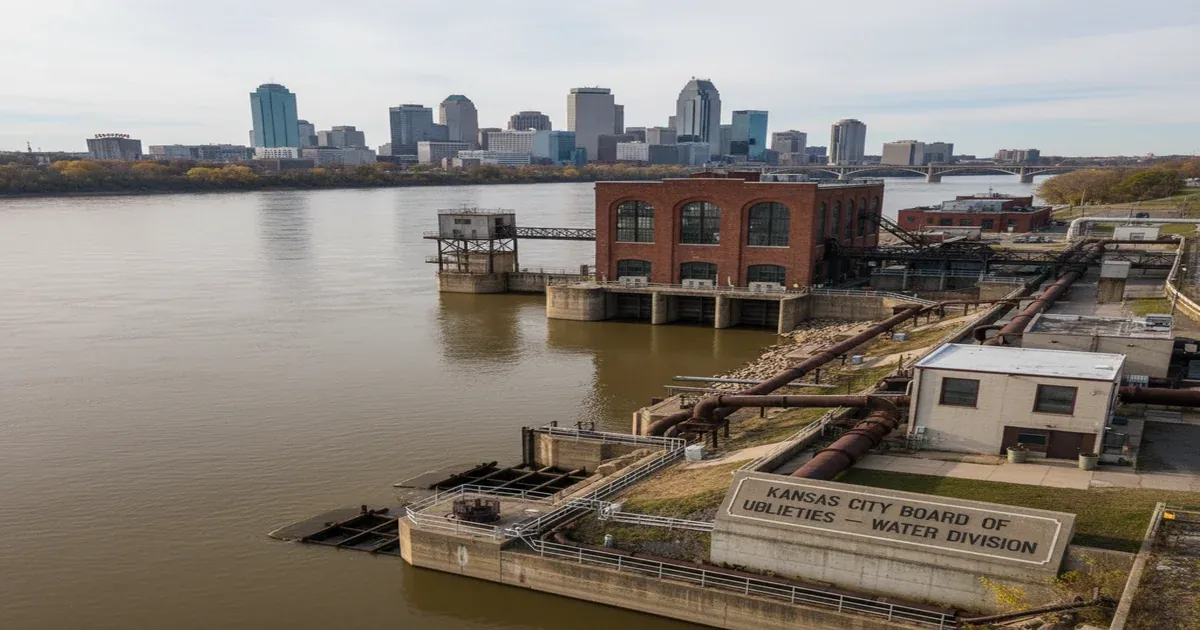
Kansas City straddles the Missouri-Kansas state line, and its water story is shaped by that geography in ways that go beyond the obvious.
KC Water (the Kansas City, Missouri, water utility) serves about 500,000 people, drawing from the Missouri River — one of the longest rivers in North America. On the Kansas side, multiple utilities serve Johnson County and other suburbs. The metro area totals about 2.2 million people across two states, with different water systems, different regulations, and different infrastructure challenges.
The Missouri River: Big Water, Big Watershed
The Missouri River drains 530,000 square miles across 10 states — from Montana to its confluence with the Mississippi at St. Louis. By the time it reaches Kansas City, it carries everything the upstream watershed contributes: agricultural runoff from the Great Plains, treated wastewater from upstream cities, sediment from eroding banks, and whatever else enters the system.
KC Water treats Missouri River water at two plants — the Quindaro and Water Works Park Treatment Plants — using conventional treatment including coagulation, sedimentation, filtration, and chloramine disinfection.
Source water challenges include:
- Sediment and turbidity — The Missouri is one of the muddiest major rivers in North America (its historic nickname: “Big Muddy”). High sediment loads, particularly during spring runoff and storm events, stress treatment processes.
- Agricultural chemicals — Atrazine and other herbicides from upstream farming operations are regularly detected in the Missouri River. KC Water’s treatment reduces these to below MCLs, but the presence of agricultural chemicals in raw water is a constant.
- Nutrient loading — Nitrogen and phosphorus from agricultural runoff contribute to algal growth and affect treatment processes.
- Pharmaceuticals and emerging contaminants — Treated wastewater from upstream cities introduces trace pharmaceuticals, personal care products, and other compounds.
Lead Service Lines
Kansas City, Missouri, has a significant inventory of lead service lines — estimated at 30,000 to 40,000 connections in the KC Water system. The city’s older neighborhoods, built from the 1880s through the 1940s, have the highest concentrations:
- Midtown and Westport — Dense pre-war housing
- Northeast Kansas City — Older working-class neighborhoods
- Brookside and Waldo — Early 20th century development
- Historic neighborhoods along Troost Avenue — The corridor that historically divided Kansas City has older housing stock on both sides
KC Water uses blended phosphate corrosion control and has been building its lead service line inventory under LCRI requirements. The replacement program is underway, but the 10-year mandate will require billions in investment across the metro.
On the Kansas side, Johnson County suburbs like Overland Park, Olathe, and Lenexa are generally newer construction with fewer lead service lines, though pre-1986 homes may still have lead solder.
PFAS: Military and Industrial Contamination
Kansas City has multiple PFAS sources:
- Former Richards-Gebaur Air Force Base — Located in south Kansas City, this former military installation has documented PFAS contamination from AFFF use. The base was closed in 1994 and is now partially redeveloped, but groundwater contamination persists.
- Kansas City International Airport (MCI) — AFFF use for firefighting training and emergencies has contaminated soil and groundwater near the airport.
- Former Sunflower Army Ammunition Plant — Located in Johnson County, Kansas, this former ordnance plant is a Superfund site with extensive contamination including potential PFAS.
- Lake City Army Ammunition Plant — An active facility in Independence, Missouri, with documented environmental contamination.
- Industrial sources — KC’s manufacturing heritage includes operations that used or produced PFAS compounds.
KC Water’s Missouri River surface water supply is less directly affected than groundwater near these sources, but the regulatory push for PFAS testing and compliance under EPA’s 2024 MCLs applies to all public water systems.
Two States, Two Regulatory Frameworks
The Kansas City metro’s split across Missouri and Kansas creates unique complications:
- Different water quality regulations — Missouri and Kansas have different state-level water quality standards and enforcement approaches. What’s regulated one way on the Missouri side may be handled differently in Kansas.
- Different utilities — Residents a mile apart may be served by completely different water systems with different source water, treatment processes, and testing results.
- Different lead service line programs — Each utility has its own inventory and replacement timeline under the federal LCRI mandate.
This isn’t just administrative complexity — it affects real people. Two families living in the same neighborhood but on different sides of the state line might get water from different sources, treated differently, with different contaminant profiles.
Infrastructure Challenges
KC Water’s infrastructure includes:
- Aging water mains — Many dating to the early 1900s, with main breaks causing service disruptions and boil water advisories
- Treatment plant upgrades — Both major plants need ongoing investment to handle modern contaminant requirements
- Combined sewer overflows — Kansas City’s combined sewer system produces overflows during heavy rain, and the city has been operating under a federal consent decree to reduce them. The $4.5 billion Overflow Control Plan has been one of the most expensive infrastructure projects in the city’s history.
What Kansas City Residents Should Know
- Know your utility. Which water system serves your address? The answer determines your source water, treatment, and testing results.
- Read your CCR. Every water utility publishes an annual Consumer Confidence Report. Find yours and read it.
- Check for lead. Especially on the Missouri side, if your home was built before 1950. Contact KC Water for a service line check.
- Flush before drinking in older homes. Run cold water for 30 seconds to 2 minutes, especially first thing in the morning.
- Private well owners — in both Missouri and Kansas, test annually for bacteria, nitrates, and any contaminants relevant to your area. Near military sites, add PFAS to the list.
- Consider a filter. A carbon block or reverse osmosis system addresses the most common concerns (lead, DBPs, trace chemicals, taste).
Related Reading
- St. Louis Lead Service Lines and Water Quality — Missouri’s other major city faces lead and aging infrastructure.
- Oklahoma City Water: Arsenic and Drought — The Southern Plains’ water challenges extend into Kansas City’s backyard.
- Minneapolis Water: PFAS, Lead, and the Mississippi — Another river city at the junction of PFAS and aging infrastructure.
- Dallas-Fort Worth Water: PFAS and the Trinity — The Southern Plains corridor shares PFAS contamination patterns.
The Bottom Line
Kansas City’s water story is complicated by geography, history, and the sheer scale of the Missouri River watershed. The water is well-treated and meets federal standards, but lead infrastructure, PFAS from military sources, and the ongoing CSO challenges require sustained investment.
The two-state reality means residents need to be more proactive about understanding which system serves them and what the specific water quality profile is for their area.
If you’re concerned about your water quality, a certified water treatment professional can test your water and recommend the right treatment for your home — regardless of which side of State Line Road you live on.