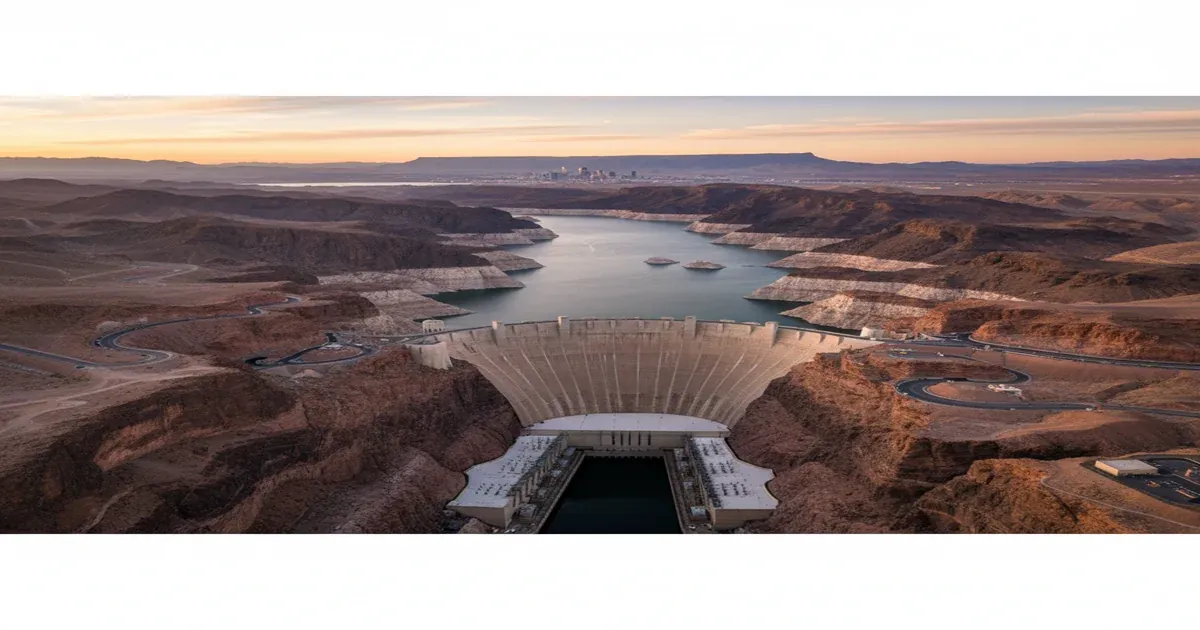
Las Vegas shouldn’t work. A metro area of 2.3 million people in the Mojave Desert, getting about 4 inches of rain per year, dependent on a single water source — Lake Mead — that’s been in a 25-year decline.
And yet, Las Vegas has become one of the most compelling water conservation success stories in America. Not because the situation isn’t dire — it is — but because the Southern Nevada Water Authority (SNWA) has implemented policies that most American cities haven’t even considered.
The Colorado River Crisis
Lake Mead, formed by Hoover Dam on the Colorado River, provides approximately 90% of southern Nevada’s water supply. It’s the largest reservoir in the United States by capacity — but it’s been shrinking since 2000.
At its peak in the 1990s, Lake Mead sat at about 1,225 feet above sea level. By 2022, it had dropped below 1,045 feet — the lowest level since the reservoir was first filled in the 1930s. Dead pool — the level at which water can no longer flow through Hoover Dam — is 895 feet.
The cause is straightforward: the Colorado River basin is in a megadrought intensified by climate change, and decades of overallocation have committed more water on paper than the river actually carries. Seven states, Mexico, and dozens of tribes depend on the Colorado. Denver and Tucson face similar supply pressure from the same basin, and there simply isn’t enough to go around.
For Las Vegas, this isn’t abstract. The city has already had to build a third intake pipe — called the Low Lake Level Pumping Station, completed in 2015 at a cost of $817 million — that draws water from deeper in Lake Mead to ensure supply even as levels drop. It was an engineering marvel born of desperation.
Conservation: The Unexpected Success
Here’s where the Las Vegas story gets interesting. Despite being in a desert with a shrinking water supply, SNWA has actually reduced southern Nevada’s total water consumption even as the population has grown significantly.
How? An aggressive, multi-pronged conservation program:
- Cash for Grass — SNWA pays homeowners and businesses to remove ornamental turf and replace it with desert landscaping. The program has removed over 200 million square feet of grass since 2000. In 2022, Nevada banned certain types of non-functional turf entirely — the first state to do so.
- Indoor water recycling — Nearly all water used indoors in the Las Vegas Valley is collected, treated, and returned to Lake Mead through the wash system. This “return flow credit” system means that indoor water use is essentially recycled. Every gallon that goes down a drain in a Las Vegas home is eventually returned to the reservoir.
- Outdoor water restrictions — Time-of-day watering limits, seasonal restrictions, and strict enforcement with water waste penalties.
- Tiered pricing — Water rates escalate sharply for high-volume users, creating a financial incentive for conservation.
The result: per capita water use in southern Nevada dropped from about 314 gallons per day in 2002 to approximately 110 gallons per day — a 65% reduction. Total consumption decreased by roughly 26% over that period, even as the population grew by nearly 800,000 people.
Water Quality: What’s in Las Vegas Tap Water?
SNWA treats Lake Mead water at two major treatment facilities — the Alfred Merritt Smith and River Mountains Water Treatment Plants — using conventional treatment plus ozone disinfection.
The water quality concerns:
- Hardness — Lake Mead water is very hard (high calcium and magnesium content) because it flows through limestone and sandstone formations across the Colorado Plateau. Hard water isn’t a health risk, but it causes scale buildup in pipes and appliances and affects taste. Many Las Vegas residents use water softeners.
- Disinfection byproducts — The combination of warm temperatures, high organic matter, and chlorine disinfection can produce elevated levels of trihalomethanes (TTHMs) and haloacetic acids (HAAs). SNWA monitors these closely and has invested in ozone treatment to reduce their formation.
- Perchlorate — Trace levels of perchlorate (a rocket fuel component) have been detected in Lake Mead, originating from a former manufacturing site in Henderson, Nevada. Cleanup and remediation have significantly reduced levels, but monitoring continues.
- PFAS — Like most surface water systems, SNWA monitors for PFAS under federal requirements. Levels have generally been low, but the regulatory landscape is evolving as EPA’s 2024 MCLs take effect.
The Drought Endgame
Despite Las Vegas’s conservation achievements, the fundamental math of the Colorado River basin hasn’t been solved. The 2026 negotiations for new river management guidelines — replacing the interim 2007 and 2019 agreements — are ongoing and contentious.
Key questions:
- How much will each state cut? California holds the largest allocation and the most senior water rights. Getting California to reduce usage has historically been politically impossible.
- What happens if Lake Mead drops further? Below certain trigger elevations, mandatory cuts escalate. Nevada has already absorbed its first tiers of cuts.
- Can water augmentation work? Proposals include desalination plants on the Sea of Cortez, Pacific Ocean desalination piped inland, and large-scale water recycling. All are expensive and years from implementation.
- Climate trajectory — If the current megadrought is actually a permanent aridification (as some climate scientists argue), the entire Colorado River allocation framework needs to be rebuilt from scratch.
Private Wells in the Las Vegas Area
The Las Vegas Valley sits over the Las Vegas Valley Groundwater Basin, which has been heavily overdrafted historically. The Nevada State Engineer manages groundwater rights, and pumping restrictions are in place.
Private wells in the valley are uncommon for residential use due to regulatory restrictions and poor water quality in many locations. Groundwater in parts of the valley contains elevated levels of arsenic, fluoride, and dissolved solids.
Residents in rural areas surrounding Las Vegas (Pahrump, Nye County, Lincoln County) often depend on private wells or small community water systems with less treatment capacity. Well water testing is essential in these areas.
What Las Vegas Residents Can Do
- Read your water quality report. SNWA publishes detailed annual reports with testing results for all regulated and many unregulated contaminants.
- Consider a water softener if hardness is affecting your appliances and plumbing. Look for models that are water-efficient in their regeneration cycle.
- Use a filter for drinking water if you’re concerned about taste, disinfection byproducts, or trace contaminants. Reverse osmosis systems are popular in Las Vegas for good reason.
- Continue conserving. Every gallon not used outdoors (where it evaporates rather than being returned to the system) is a gallon that stays in Lake Mead.
- Stay informed on Colorado River negotiations. The decisions being made in 2026 will determine southern Nevada’s water future for the next 20+ years.
Related Reading
- Phoenix Water Supply Challenges — Another Colorado River-dependent city managing drought and rapid growth.
- Salt Lake City Water and Great Salt Lake Drought — The broader western water crisis reaches into the Great Basin.
- San Diego’s Imported Water and PFAS — A city transitioning from imported water to recycled supply.
- Denver’s Water: PFAS, Lead, and Drought — Colorado’s Front Range faces its own Colorado River headwaters challenge.
The Bottom Line
Las Vegas has proven that a desert city can dramatically reduce water use through smart policy and infrastructure investment. The conservation story is genuinely impressive — and it’s a model other drought-affected cities should study.
But conservation alone can’t solve a supply problem this fundamental. Lake Mead’s future depends on climate, river management politics, and whether seven states can agree on cuts that none of them want to make. Las Vegas has done more than its share. The question is whether that’ll be enough.
If you’re concerned about your water quality at home, a certified water treatment professional can test your water and recommend solutions — whether that’s a softener, a filter, or a reverse osmosis system.