
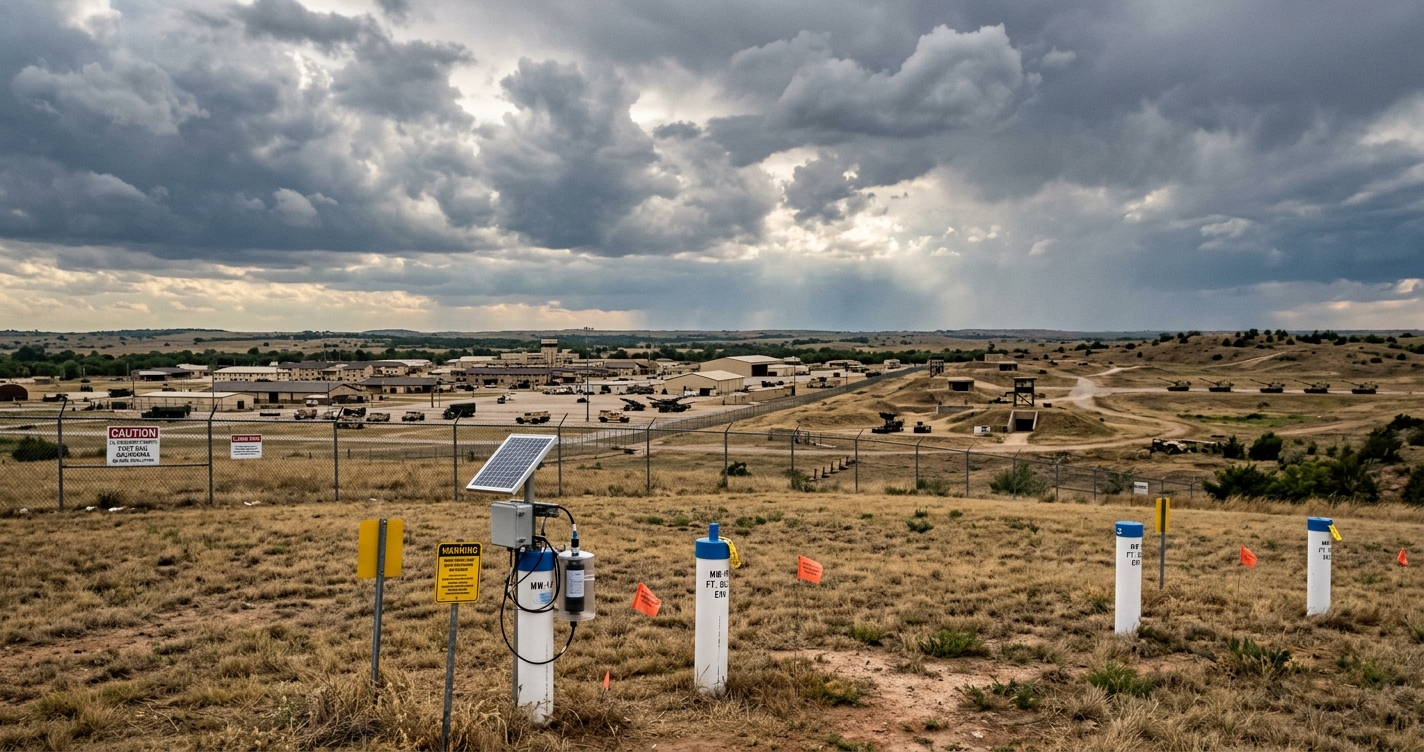
Lawton, Oklahoma — population about 90,000 — exists because of Fort Sill. The Army installation, established in 1869, is one of the oldest continuously operating military posts in the country and home to the U.S. Army Fires Center of Excellence. The base and the city are inseparable — economically and environmentally.
Fort Sill: PFAS and Military Contamination
Fort Sill has used AFFF (aqueous film-forming foam) at fire training areas, aircraft operations, and emergency response for decades. The PFAS contamination picture:
- Groundwater contamination confirmed — Department of Defense environmental investigations have detected PFAS in groundwater on and near Fort Sill
- Multiple fire training areas — The base’s size (over 94,000 acres) means AFFF was used at numerous locations
- Off-base migration — Groundwater flow from the base extends into areas where Lawton residents live and may draw well water
- Surface water connections — Runoff from the base enters streams that feed into the regional surface water system
Oklahoma has been slower than some states to establish PFAS standards, but the EPA’s new federal MCLs will require testing and potential remediation regardless of state action.
Reservoirs Under Stress
Lawton’s drinking water comes primarily from:
- Lake Lawtonka and Lake Ellsworth — two reservoirs northwest of the city
- Supplemental groundwater wells
These reservoirs face multiple pressures:
- Drought — Southwest Oklahoma experiences regular drought, and climate projections suggest increasing frequency and severity. Low reservoir levels concentrate contaminants and can trigger taste and odor issues from algal blooms.
- Algal blooms — Warm temperatures and nutrient loading from agricultural runoff promote harmful algal blooms in both reservoirs
- Agricultural runoff — The watersheds above Lawton’s reservoirs include cattle ranching and crop agriculture, contributing nitrogen, phosphorus, and sediment
- Sedimentation — Reservoirs are slowly filling with sediment from erosion, reducing storage capacity over time
The City of Lawton’s water treatment plant uses conventional treatment with seasonal adjustments for algae and taste/odor events.
Naturally Occurring Concerns
Oklahoma’s geology adds its own water quality challenges:
- Naturally occurring arsenic — Some groundwater in southwestern Oklahoma contains arsenic near or above the EPA MCL
- Fluoride — Naturally elevated in some Oklahoma groundwater formations
- Hardness — Oklahoma water is notoriously hard, with calcium and magnesium levels that cause scale, soap scum, and appliance damage
- Chloride and sulfate — Natural mineral content from Oklahoma’s geologic formations
What the Data Shows
From Lawton’s most recent Consumer Confidence Report:
- All regulated contaminants within EPA limits
- Seasonal taste and odor events managed through treatment
- Trihalomethanes and haloacetic acids within limits
- Lead at 90th percentile below action level
- PFAS testing being conducted under new federal requirements
- No SDWA violations
What Lawton Residents Should Do
- PFAS awareness — Ask Lawton’s water utility about PFAS testing results, particularly given Fort Sill’s proximity
- Private well owners near Fort Sill — Test for PFAS, arsenic, and bacteria. Contact Fort Sill’s environmental office for contamination maps.
- Water taste events — Seasonal taste and odor changes from reservoir algae are unpleasant but typically not dangerous. Activated carbon pitchers can help.
- Hard water — Consider a water softener if scale and hardness are affecting your appliances and plumbing. Oklahoma water can be very hard.
- Drought preparedness — Support water conservation measures. Lawton’s reservoir supply has finite capacity, and drought isn’t going away.
Lawton and Fort Sill have been partners for over 150 years. Addressing the environmental legacy of that partnership — including PFAS contamination — is part of honoring that relationship responsibly.
If you’re concerned about your water quality, a certified water treatment professional can test your water and advise on solutions for your situation.