
City of Wells
Madison is unusual among major American cities: it relies entirely on groundwater for its drinking water. Madison Water Utility operates 22 deep wells that tap the sandstone and dolomite aquifers beneath the city, serving approximately 260,000 people.
The wells range from roughly 600 to 1,000 feet deep, drawing water from geological formations that provide natural filtration and protection from surface contamination. Madison’s water is naturally cold, relatively hard (high in calcium and magnesium), and has historically been of excellent quality.
But being a groundwater-dependent city means that any contamination reaching the aquifer directly threatens the drinking water supply — and several contamination sources have done exactly that.
PFAS: Truax Field and the Air National Guard
The most significant water quality concern in Madison right now is PFAS contamination from Truax Field — home to the Wisconsin Air National Guard’s 115th Fighter Wing and the Dane County Regional Airport.
Decades of AFFF use in fire training at Truax have contaminated groundwater with PFOS, PFOA, and other PFAS compounds. Testing has confirmed PFAS in monitoring wells and in some Madison Water Utility production wells near the airport.
Well 15 — one of the utility’s highest-capacity wells — was taken offline in 2019 after PFAS levels exceeded Wisconsin’s recommended groundwater enforcement standard. The loss of this well forced the utility to redistribute pumping across other wells and raised concerns about system capacity during peak demand.
Madison Water Utility has since installed a granular activated carbon (GAC) treatment system at Well 15, allowing it to return to service with PFAS removal. The utility has also enhanced PFAS monitoring across its entire well network.
Wisconsin adopted some of the most protective PFAS standards in the country: a combined groundwater enforcement standard of 20 ppt for PFOA and PFOS. The state’s response to PFAS — driven in significant part by the Madison contamination — has been among the most aggressive in the Midwest.
Nitrate: Agriculture Meets Urban Fringe
Madison is surrounded by some of Wisconsin’s most productive farmland. Dane County’s agricultural activity — particularly dairy farming and row crops — contributes nitrate to groundwater through fertilizer application and manure spreading.
Several Madison wells have shown increasing nitrate trends over time, reflecting the slow percolation of agricultural nitrogen — the same process driving the crisis in Des Moines — through soil and rock into the deep aquifer. While no production wells have exceeded the EPA’s MCL of 10 mg/L, the trend lines are concerning.
The issue is compounded at the urban-rural fringe where suburban development, remaining farmland, and septic systems all contribute nitrogen loading to the aquifer recharge zone.
Madison Water Utility monitors nitrate closely and has the option of blending between wells or taking high-nitrate wells offline. Long-term, addressing the source of nitrate contamination requires changes in agricultural practice across the watershed — a much harder problem.
VOCs: Legacy Industrial Contamination
Madison has several known volatile organic compound (VOC) contamination plumes in its aquifer from historical industrial activity:
- The Madison-Kipp Corporation site — a die casting facility that contaminated groundwater with tetrachloroethylene (PCE) and trichloroethylene (TCE). The Superfund-listed site has been under remediation, and nearby wells are monitored for VOC contamination
- Other industrial sites — dry cleaners, manufacturing facilities, and gasoline stations have contributed VOC contamination to the shallow and intermediate aquifer zones
The deep production wells are partially protected by confining geological layers, but these protections aren’t perfect — particularly where old wells or geological features create conduits between shallow and deep aquifer zones.
Hardness: Madison’s Aesthetic Challenge
Madison’s water is hard — typically 18-22 grains per gallon, which is considerably harder than the national average. Hard water isn’t a health concern, but it causes:
- Scale buildup in pipes, water heaters, and appliances
- Soap and detergent reduced effectiveness
- White mineral deposits on fixtures and dishes
- Dry skin and hair
Many Madison residents use water softeners to address hardness. The city has looked at centralized softening but has determined it’s not cost-effective given the distributed well system.
Stormwater and the Lakes
Madison’s famous isthmus location — squeezed between Lake Mendota and Lake Monona — creates a unique stormwater dynamic. Urban runoff flows into the lakes, carrying nutrients, road salt, and contaminants. While the lakes aren’t a drinking water source, their health reflects the broader environmental pressures on the aquifer recharge zone.
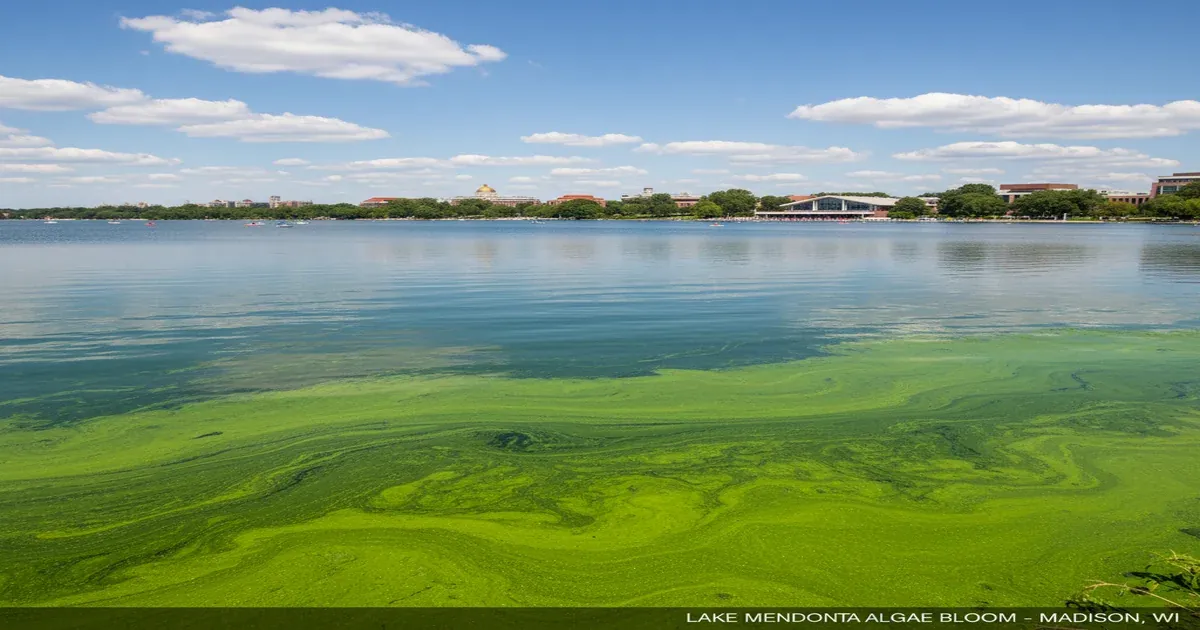
Lake Mendota has experienced recurring harmful algal blooms fueled by phosphorus from agricultural runoff and urban stormwater. These blooms close beaches and highlight the nutrient loading that also threatens groundwater quality.
What Residents Can Do
- Review Madison Water Utility’s annual report — the utility provides detailed data by well, so you can check quality specific to your neighborhood
- Consider a water softener if hardness is affecting your home — look for high-efficiency models that minimize salt use
- For PFAS concerns, an NSF P473-certified filter provides additional protection, especially if you live near Truax Field
- If you’re on a private well in Dane County, test annually for nitrate, bacteria, and consider PFAS testing. Wisconsin DNR offers guidance for private well owners
- Use cold water for cooking and baby formula — and flush the tap briefly in the morning if you have older plumbing
If you’re concerned about your water quality, a certified water treatment professional can test your water and advise on solutions for Madison’s specific water chemistry — particularly hardness and any contaminants of concern in your area.
Sources
- Madison Water Utility, Annual Water Quality Reports and PFAS Updates
- Wisconsin Department of Natural Resources, PFAS and Groundwater Programs
- Dane County, Land and Water Resources Department
- EPA SDWIS, Madison Water Utility compliance records
- USGS, Dane County Groundwater Studies
- Environmental Working Group, Tap Water Database