
South Florida has a water problem that no other major American metro faces quite the same way: the ocean is coming for its drinking water.
Miami-Dade County’s 2.8 million residents (and neighboring Broward and Palm Beach counties) depend on the Biscayne Aquifer — a shallow, porous limestone formation that sits just feet below the surface. It’s one of the most productive aquifers in the world, providing billions of gallons daily. It’s also one of the most vulnerable.
The Biscayne Aquifer is unconfined — meaning there’s no protective clay layer between the surface and the water table. Anything that goes on the ground can reach the aquifer quickly. And because it’s shallow and located at sea level, it’s uniquely susceptible to saltwater intrusion as sea levels rise.
Saltwater Intrusion: The Defining Threat
Saltwater intrusion has been a recognized problem in South Florida since the 1930s. The original drainage of the Everglades for development lowered the water table, allowing saltwater to migrate inland through the porous limestone.
The response was an elaborate system of canals, levees, and control structures managed by the South Florida Water Management District (SFWMD). These structures maintain freshwater head pressure in the aquifer to hold the saltwater interface at bay. It works — but it’s a constant balancing act.
Sea level rise is tilting that balance. Southeast Florida has experienced approximately 6 to 8 inches of sea level rise since the 1990s, and the rate is accelerating. Higher ocean levels increase the pressure driving saltwater inland. At the same time, more intense rainfall events (followed by longer dry spells) make water table management more volatile.
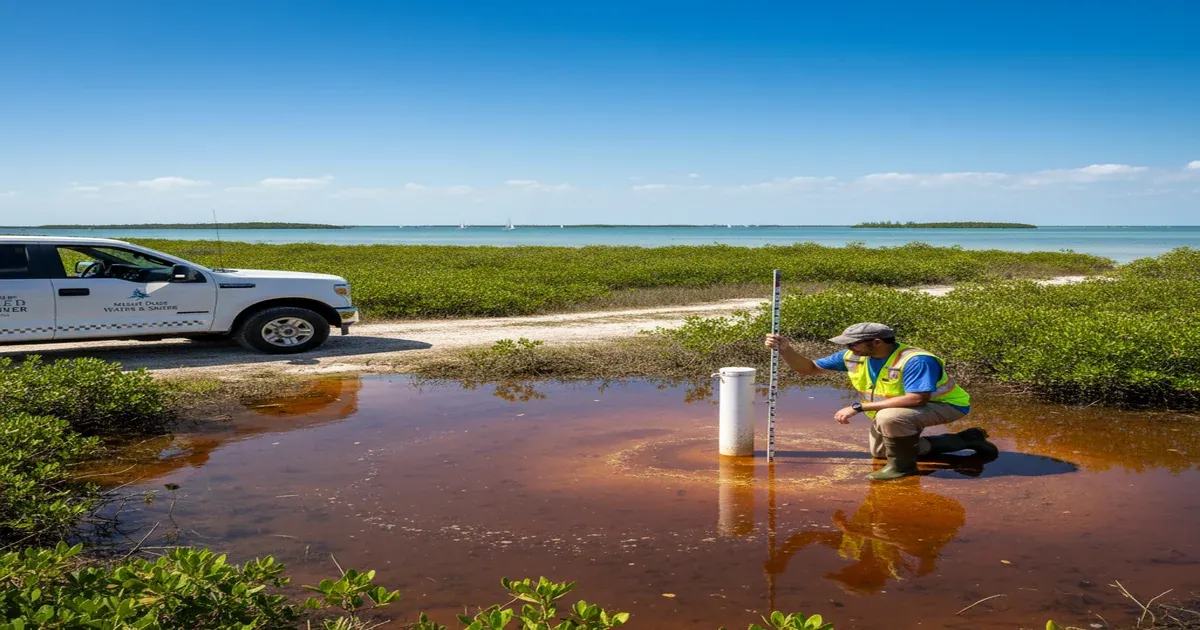
Miami-Dade Water and Sewer Department (WASD) has already had to relocate and deepen some wellfields in response to saltwater migration. The county monitors the saltwater interface continuously using a network of observation wells — and the trend is not in their favor.
Some projections suggest that by mid-century, portions of the Biscayne Aquifer currently used for public water supply may become too saline for cost-effective treatment. This isn’t a theoretical future problem — it’s an engineering and financial planning challenge that utilities are working on right now.
PFAS: Military Bases and Airports
South Florida has significant PFAS contamination sources:
- Homestead Air Reserve Base — Documented PFAS groundwater contamination from AFFF use. Given the aquifer’s extreme porosity, contamination spreads quickly.
- Miami-Dade’s multiple airports — Miami International Airport and several smaller airfields have used AFFF for firefighting training and emergencies.
- Former military installations — South Florida’s history of military activity includes numerous sites where AFFF and other PFAS-containing materials were used.
- Industrial sites — Manufacturing, waste disposal, and commercial operations across the county have contributed PFAS to soil and groundwater.
In a confined aquifer with protective clay layers, PFAS contamination might stay relatively localized. In the Biscayne Aquifer — with its high permeability and rapid groundwater flow — contamination can spread across miles relatively quickly.
Florida has been slower than some states to establish state-level PFAS drinking water standards, relying primarily on EPA’s federal MCLs finalized in 2024. But UCMR 5 testing has confirmed PFAS detection in South Florida water systems, and treatment upgrades will be necessary to meet the 2029 compliance deadline.
Surface Water Quality and Everglades Restoration
Miami’s water story is inseparable from the Everglades. The vast wetland system that historically covered much of South Florida functioned as a natural recharge area for the Biscayne Aquifer — filtering water through sawgrass marshes and slowly replenishing groundwater.
Development, agriculture (particularly sugar cane farming in the Everglades Agricultural Area), and drainage have dramatically reduced the Everglades’ natural water filtration capacity. Nutrient pollution — especially phosphorus from agricultural runoff — has degraded water quality in the remaining wetlands and canals that feed aquifer recharge.
The Comprehensive Everglades Restoration Plan (CERP), authorized in 2000 with an estimated cost exceeding $20 billion, aims to restore more natural water flows to the Everglades while maintaining flood control and water supply. Progress has been slow, but key projects including stormwater treatment areas and reservoir construction are advancing.
The connection is direct: healthier Everglades = better aquifer recharge = more resilient drinking water supply for South Florida.
Infrastructure and Treatment
Miami-Dade WASD operates three major water treatment plants serving the county. Treatment includes lime softening, filtration, and disinfection. The utility has been investing in upgrades to address emerging contaminants, including PFAS and disinfection byproducts.
The county also operates one of the world’s largest ocean outfalls for treated wastewater — though federal regulations are requiring a transition to deep well injection and increased water reuse. This is actually a water supply opportunity: recycled water can supplement the potable supply and help maintain aquifer levels.
South Florida utilities are increasingly exploring:
- Aquifer storage and recovery (ASR) — Injecting treated water underground during wet periods for later withdrawal
- Potable water reuse — Advanced treatment of wastewater to drinking water standards
- Desalination — Reverse osmosis treatment of brackish groundwater (already in use at some facilities in Broward and Palm Beach counties)
What Miami-Dade Residents Can Do
- Read your water quality report. WASD publishes annual reports with testing results. Look specifically at PFAS data and disinfection byproduct levels.
- Consider filtration. In South Florida’s warm climate, disinfection byproduct levels can be higher than in cooler regions. A carbon filter or reverse osmosis system can address most concerns.
- Conserve water. Every gallon saved reduces pumping pressure on the aquifer and helps maintain the freshwater head that holds back saltwater.
- Support Everglades restoration. It’s not just an environmental issue — it’s directly connected to the long-term viability of South Florida’s drinking water supply.
- Private well owners — Get your water tested. The Biscayne Aquifer’s vulnerability means private wells are exposed to everything from PFAS to agricultural chemicals to saltwater.
Related Reading
- Tampa Water: Desalination and PFAS — Florida’s other major metro takes a different approach to water supply.
- Jacksonville Water: PFAS and Naval Station — PFAS contamination is a statewide Florida issue.
- Houston Water Problems: Subsidence and Flooding — Another coastal metro dealing with subsidence and sea-level threats.
- Sarasota Water Quality and Wastewater Issues — Southwest Florida’s water challenges differ but connect.
The Bottom Line
Miami’s water situation is fundamentally different from any other major American city. The Biscayne Aquifer is simultaneously one of the most productive and most vulnerable drinking water sources in the country. Sea level rise, PFAS contamination, and development pressure create an existential challenge that will require billions of dollars and decades of sustained investment to address.
The good news: South Florida’s water utilities are among the most innovative in the country at developing alternative supply sources. The bad news: the physics of rising seas and porous limestone don’t care about innovation timelines.
If you’re concerned about your water quality, a certified water treatment professional can test your water and recommend the right treatment approach for your home.