
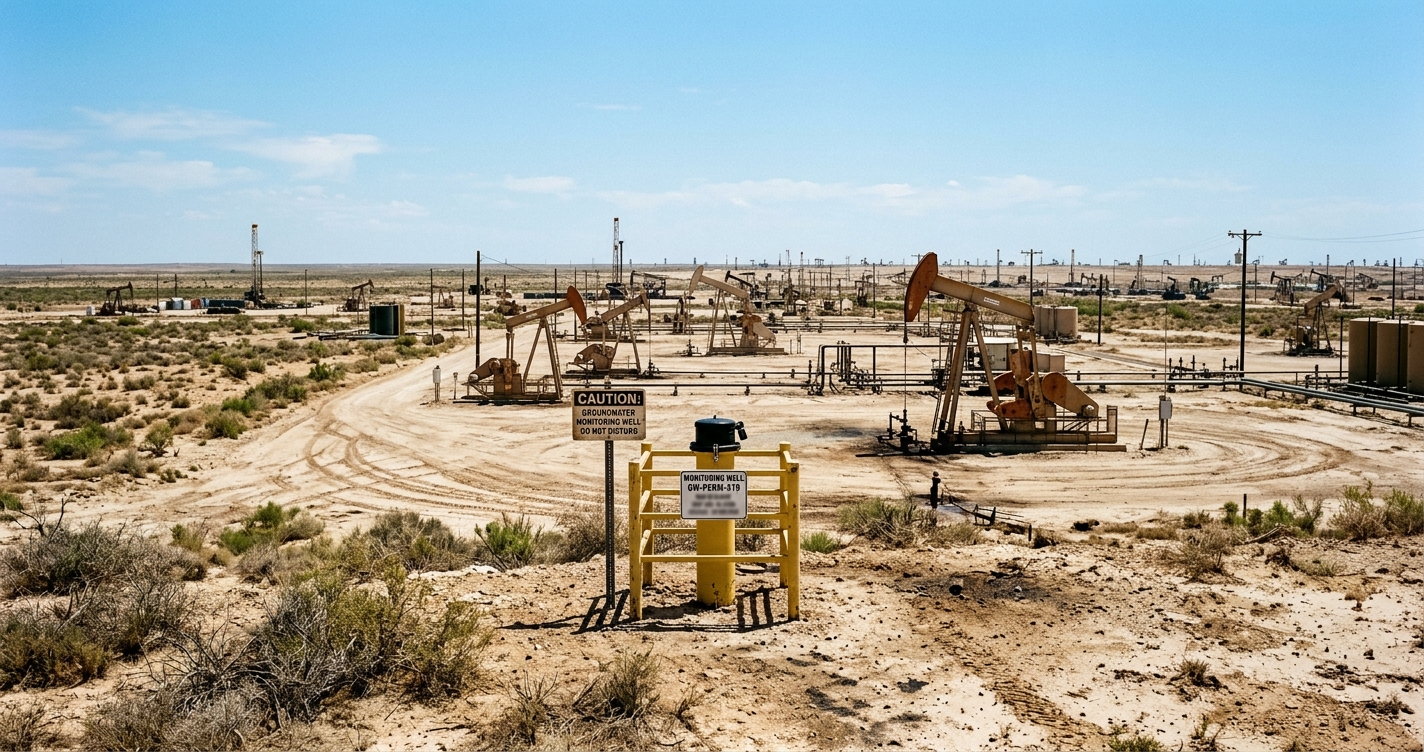
Midland and Odessa, Texas — combined population about 300,000 — are the twin cities of the Permian Basin, the most productive oil-producing region in the world. The Permian has produced oil since the 1920s and currently produces over 5 million barrels per day — more than any single country except Saudi Arabia and Russia.
That production comes with a water problem of staggering proportions.
Produced Water: The Permian’s Hidden Flood
For every barrel of oil extracted from the Permian Basin, roughly four barrels of produced water come up with it. This water is:
- Extremely salty — Often 3 to 10 times saltier than seawater
- Radioactive — Contains naturally occurring radioactive materials (NORM) dissolved from deep geological formations
- Chemically complex — Contains petroleum hydrocarbons, heavy metals, barium, strontium, and drilling chemicals
- Enormous in volume — The Permian Basin produces roughly 20 million barrels of produced water per day — enough to fill over 1,000 Olympic swimming pools daily
This produced water is primarily disposed of through injection into deep disposal wells. But the system isn’t perfect:
- Induced seismicity — Deep injection has triggered thousands of earthquakes across West Texas and New Mexico, some large enough to damage structures
- Well integrity failures — Injection wells can fail, allowing produced water to migrate into freshwater aquifers
- Surface spills — Thousands of produced water spills occur in the Permian Basin annually. Many go unreported.
- Legacy contamination — Before modern regulations, produced water was routinely dumped in unlined pits or discharged to land surfaces
Ogallala Aquifer: Running Out
Midland and Odessa rely on the southern Ogallala Aquifer for a significant portion of their water supply. The situation is dire:
- Water levels have declined dramatically — In some areas of the southern Ogallala, water levels have dropped over 100 feet since irrigation began
- The aquifer is effectively non-renewable in West Texas — Recharge rates are negligible compared to withdrawal rates in this arid climate (about 14 inches of annual rainfall)
- Agricultural competition — Irrigation for cotton, peanuts, and feed crops consumes the majority of Ogallala water in the region
- Oilfield use — Hydraulic fracturing (fracking) requires enormous volumes of water, much of which is now sourced from non-potable formations, but some still comes from freshwater sources
The cities have invested in alternative water sources, including the T-Bar Ranch water supply project, which pipes water from a distant aquifer. But the fundamental math — growing demand, declining supply — doesn’t work without dramatic changes.
Municipal Water Quality
Both Midland and Odessa operate municipal water systems that treat water from multiple sources. Key challenges:
- Blending — Water from different sources has different chemistry, and blending can create treatment challenges
- Hard water — West Texas water is notoriously hard, with mineral content that causes scale and affects taste
- Disinfection byproducts — The organic content in some source waters combined with chlorination produces THMs and HAAs
- PFAS — Midland International Airport and military-adjacent operations raise PFAS concerns, though West Texas hasn’t been the focus of PFAS investigations yet
Both cities’ most recent Consumer Confidence Reports show compliance with EPA standards, though aesthetic quality (taste, hardness) is a common complaint from residents.
What the Data Shows
From Midland and Odessa’s most recent CCRs:
- All regulated contaminants within EPA limits
- High mineral content (hardness, TDS) — legal but noticeable
- Trihalomethanes and haloacetic acids within limits
- Lead at 90th percentile below action level
- No SDWA violations
What Midland-Odessa Residents Should Do
- Water softening — West Texas water is extremely hard. A water softener protects plumbing and appliances and improves taste.
- Private well owners — If you’re on a private well in the Permian Basin, test for TDS, chloride, barium, strontium, and petroleum hydrocarbons. Know what oil and gas activity exists near your well.
- Know your water source — Both cities use blended water from multiple sources. Understand which sources serve your neighborhood.
- RO for drinking water — Many West Texas residents use point-of-use reverse osmosis systems for drinking and cooking water to address taste and mineral content.
- Conserve — The Ogallala is declining. Every gallon saved extends the aquifer’s life. Water conservation in West Texas isn’t an environmental luxury — it’s survival math.
Midland and Odessa exist because of oil. The irony is that the industry driving the economy is simultaneously depleting and contaminating the water supply. Solving that paradox is West Texas’s central challenge for the next century.
If you’re concerned about your water quality, a certified water treatment professional can test your water and recommend solutions for your specific situation.