
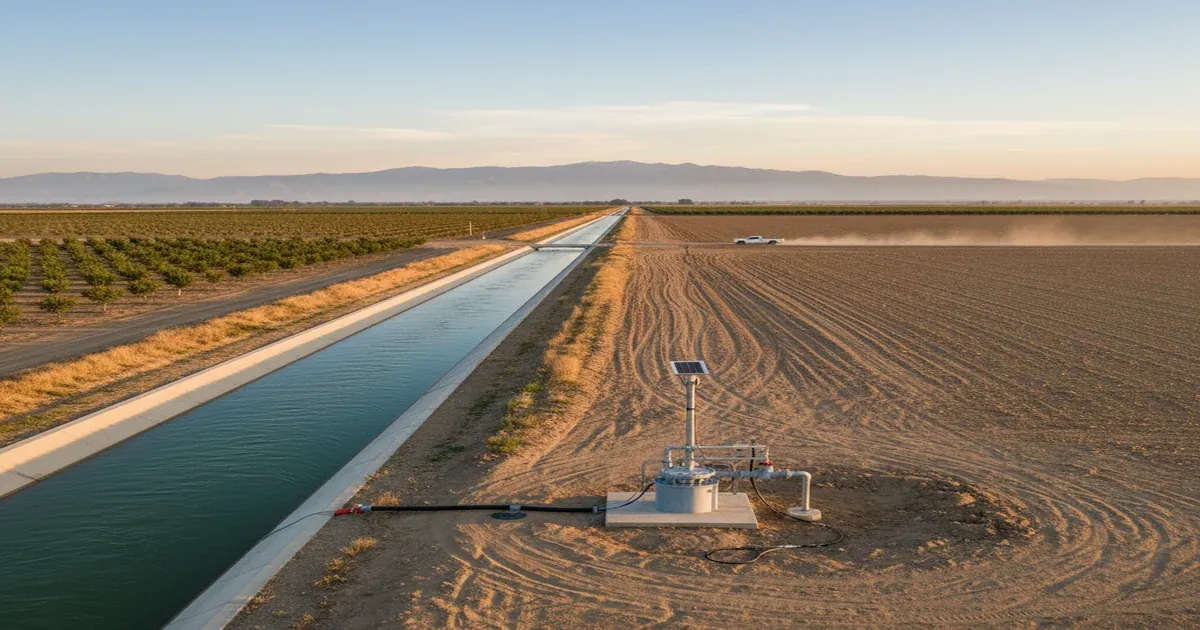
Modesto is the largest city in Stanislaus County, right in the heart of California’s San Joaquin Valley — one of the most productive agricultural regions on Earth. The same farming that drives the local economy has also created one of the state’s most complex groundwater contamination problems.
For a city of 215,000 people that relies heavily on groundwater, the legacy of decades of pesticide use, fertilizer application, and dairy operations presents an ongoing challenge that’s expensive to address and impossible to ignore.
Nitrate: The Valley’s Defining Water Problem
Nitrate contamination is the single biggest groundwater issue in the San Joaquin Valley, and Modesto is no exception. The primary sources are straightforward:
Agricultural fertilizer: Row crops, orchards, and vineyards in Stanislaus County receive heavy nitrogen fertilization. Not all of that nitrogen gets taken up by plants — the excess leaches through sandy soils into the underlying aquifer.
Dairy operations: Stanislaus County is one of California’s top dairy-producing counties. Each dairy cow produces roughly 120 pounds of nitrogen per year in manure. With hundreds of thousands of dairy cows in the county, the nitrogen loading is enormous. Manure applied to fields or stored in lagoons contributes to groundwater nitrate levels.
Septic systems: Outside Modesto’s city limits, thousands of homes use septic systems. In areas with sandy, permeable soils, septic effluent is a significant nitrogen source.
The EPA’s maximum contaminant level for nitrate is 10 mg/L (as nitrogen). The city of Modesto’s treated water meets this standard, but individual wells in the region frequently exceed it. A 2012 UC Davis study commissioned by the State Water Resources Control Board found that communities in the Tulare Lake Basin and Salinas Valley — geologically similar to the Modesto area — face nitrate contamination affecting an estimated 254,000 people.
Modesto Irrigation District and the City of Modesto have invested in blending strategies — mixing higher-nitrate groundwater with cleaner surface water from the Tuolumne River to keep treated water below the MCL.
DBCP: The Banned Pesticide That Won’t Leave
Dibromochloropropane (DBCP) was widely used as a soil fumigant in California’s agricultural regions from the 1950s through 1977, when it was banned after being linked to male sterility, kidney damage, and cancer. In the San Joaquin Valley, DBCP was applied extensively to orchards and vineyards.
The problem is that DBCP is extremely persistent in groundwater. Nearly 50 years after the ban, it continues to be detected in wells across the valley:
- Modesto area wells have tested positive for DBCP at levels above California’s maximum contaminant level of 0.2 parts per billion
- The contamination is concentrated in the shallow-to-intermediate depth aquifer zones where agricultural chemicals first entered the groundwater system
- DBCP breaks down very slowly — estimated half-life in groundwater ranges from years to decades depending on conditions
The City of Modesto has taken wells with elevated DBCP offline or installed treatment (typically granular activated carbon) to reduce levels in drinking water. But for rural communities and small water systems in Stanislaus County, the cost of treatment is a significant burden.
1,2,3-TCP: Another Persistent Legacy
1,2,3-Trichloropropane (TCP) is another agricultural chemical that’s become a major groundwater contaminant in the Central Valley. It was a manufacturing byproduct in soil fumigants like D-D and Telone, used widely from the 1940s through the 1980s.
California set an MCL for 1,2,3-TCP of 5 parts per trillion in 2017 — one of the most stringent drinking water standards for any contaminant. At that level, detection is essentially guaranteed in areas where the chemicals were applied.
In the Modesto area and broader Stanislaus County:
- Multiple wells have tested positive for 1,2,3-TCP above the state MCL
- Treatment requires granular activated carbon filtration, which is effective but adds cost
- Like DBCP, TCP is highly persistent in groundwater and continues to migrate through the aquifer system
Chromium-6
Hexavalent chromium (chromium-6), both naturally occurring and from industrial sources, has been detected in Central Valley groundwater. California had set an MCL of 10 ppb for chromium-6 in 2014, but a court struck it down in 2017 as insufficiently protective. The state has been working on a revised standard.
In the Modesto area, chromium-6 levels in some wells are elevated compared to other parts of the state. Whether the source is natural geology or industrial contamination varies by location, but the effect on drinking water is the same.
Water Supply Complexity
Modesto’s water supply is a blend of groundwater and surface water, managed by multiple entities:
- City of Modesto operates municipal wells and a surface water treatment plant using water from the Tuolumne River (via Modesto Irrigation District)
- Modesto Irrigation District (MID) manages surface water rights and delivery
- Surface water from the Tuolumne generally has better quality than local groundwater — lower nitrate, no DBCP or TCP
- The city’s strategy of blending surface and groundwater helps keep contaminant levels below MCLs in treated water
However, surface water availability varies dramatically with drought conditions. During California’s 2012–2016 drought, reduced surface water allocations forced greater reliance on groundwater — which meant drawing more from the contaminated aquifer.
The Sustainable Groundwater Management Act (SGMA), passed in 2014, requires the development of Groundwater Sustainability Plans for critically overdrafted basins. The Modesto Subbasin, part of the larger San Joaquin Valley Groundwater Basin, is working toward sustainability targets that include managing both water levels and water quality.
Small Community Vulnerability
While the City of Modesto has the resources to treat its water supply, dozens of smaller communities in Stanislaus County face the same contamination with far fewer resources. Disadvantaged communities — many of them predominantly Latino agricultural worker communities — often rely on small water systems or private wells that:
- Can’t afford granular activated carbon treatment systems
- Don’t have alternative supply options for blending
- May not test frequently enough to catch contamination
- Face the full burden of nitrate, DBCP, and TCP without treatment
California’s SAFER (Safe and Affordable Funding for Equity and Resilience) program, formerly known as the Safe Drinking Water Fund, provides financial assistance to these communities. But the scale of the Central Valley’s contamination problem vastly exceeds available funding.
What Modesto Residents Should Know
- City water meets standards, but if you’re on a private well in Stanislaus County, testing is essential. Test for nitrate, DBCP, 1,2,3-TCP, and bacteria at minimum. The Stanislaus County Environmental Resources Department can guide you.
- Don’t assume well depth means safety. While deeper wells often have lower contamination levels, contaminants in the Central Valley are migrating to deeper aquifer zones over time.
- Reverse osmosis is the most effective home treatment for the mix of contaminants found in Valley groundwater. It removes nitrate, DBCP, TCP, chromium-6, and most other contaminants of concern. Activated carbon alone handles DBCP and TCP but not nitrate.
- Watch for water quality reports. The City of Modesto publishes annual Consumer Confidence Reports detailing what’s in your water and how it compares to standards.
If you’re concerned about your water quality, a certified water treatment professional can test your water and recommend the right system. In the Central Valley, where multiple contaminants overlap, a comprehensive approach to filtration makes more sense than targeting one problem at a time.
Related Reading
- Fresno Water Quality: Nitrate and 1,2,3-TCP Contamination
- Stockton CA Water Quality: Delta Water and Nitrate
- Bakersfield CA Water Quality: Oil Fields and Agriculture
- Kern County CA Water Quality: Agriculture and Oil
Sources
- UC Davis Center for Watershed Sciences nitrate study for the State Water Resources Control Board (2012)
- California State Water Resources Control Board GAMA groundwater quality data
- City of Modesto Annual Consumer Confidence Reports
- California SAFER program funding allocations
- SGMA Groundwater Sustainability Plan for the Modesto Subbasin
- EPA SDWIS violation data for Stanislaus County water systems