
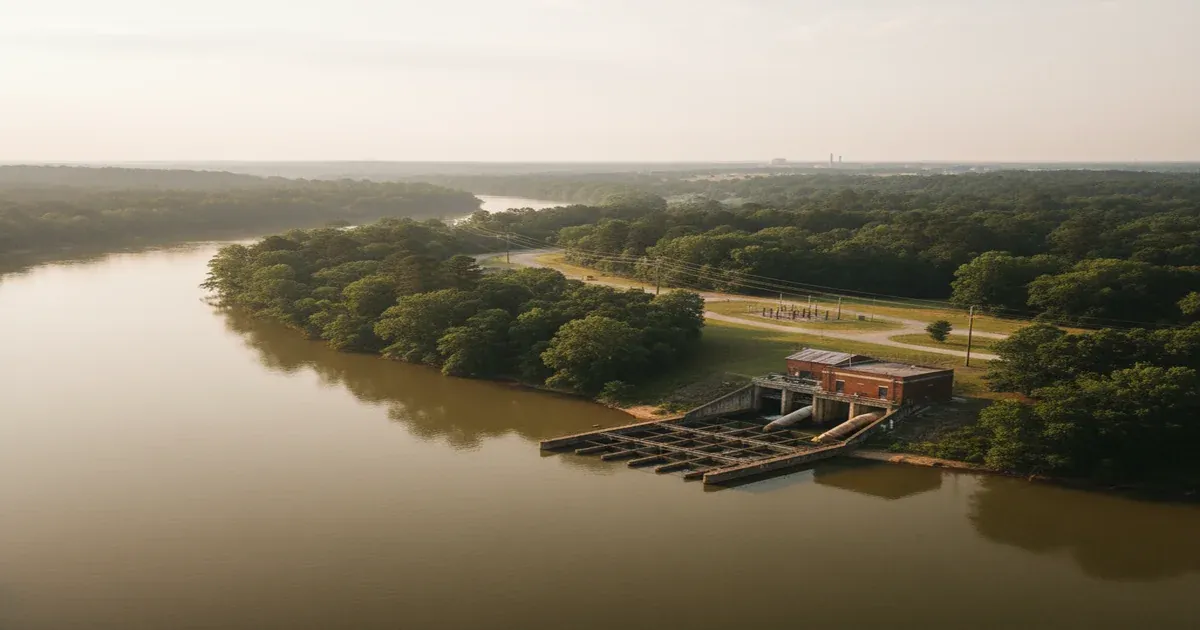
Montgomery is Alabama’s capital and its second-largest city, situated on the banks of the Alabama River. The city’s water supply comes from the Alabama River, treated at the Water Works and Sanitary Sewer Board’s (WWSSB) facilities before distribution to approximately 240,000 customers in the metro area.
The Alabama River: Montgomery’s Source
The Alabama River forms at the confluence of the Coosa and Tallapoosa rivers north of Montgomery, making it a downstream receiver of everything those river systems collect from across central and northern Alabama. The Coosa in particular drains the heavily industrialized Birmingham corridor, with its history of steel production, coal mining, and chemical manufacturing.
By the time the Alabama River reaches Montgomery’s intake, the water has traveled far enough and diluted enough that the industrial legacy of upstream Birmingham is a distant influence rather than a direct contamination source. But the river is not pristine. Agricultural runoff from Alabama’s cattle, poultry, and row crop operations contributes nutrients, sediment, and bacteria. The WWSSB’s treatment process includes enhanced coagulation, sedimentation, filtration, and chlorine disinfection to handle the varied source water quality.
Disinfection byproducts — trihalomethanes and haloacetic acids that form when chlorine reacts with organic matter — have historically been in the upper range of federal limits in summer months, when warm river temperatures increase organic loading and treatment intensity.
Industrial Legacy: The Coosa River Basin
The Coosa River, which feeds into the Alabama River north of Montgomery, drains one of Alabama’s most industrialized regions. The Anniston Army Depot and the former Monsanto PCB manufacturing plant in Anniston created a contamination legacy in the upper Coosa watershed that took decades to address and still shapes water quality monitoring today.
The Anniston PCB contamination — where Monsanto manufactured and disposed of PCBs for decades before they were banned in 1979 — was one of the worst environmental contamination cases in American history. While Anniston is over 100 miles upstream and the contamination was primarily to soil and shallow groundwater near the plant site, it demonstrated the scale of industrial pollution that the Coosa system has absorbed.
Closer to Montgomery, agricultural activity along the Alabama River — especially cattle operations — contributes E. coli, nitrogen, and phosphorus. The Alabama Department of Environmental Management monitors the river continuously and issues advisories when conditions warrant.
Lead Service Lines and Environmental Justice
Montgomery’s water infrastructure reflects the city’s history. The oldest neighborhoods — particularly in West Montgomery, where the city’s African American community has historically been concentrated — have the oldest pipes, the highest likelihood of lead service lines, and some of the worst infrastructure maintenance records.
The WWSSB has conducted lead service line identification and has been working on a replacement program. Lead levels at the 90th percentile have been below the federal action level, and orthophosphate corrosion control is in place. But environmental justice advocates have long noted that infrastructure investment in Montgomery has been unevenly distributed, with historically Black neighborhoods receiving less maintenance attention and experiencing more service disruptions.
Alabama’s overall water infrastructure investment has lagged behind national averages, and Montgomery’s system shows the accumulated effects of deferred capital spending. Main breaks, boil-water advisories, and service interruptions occur more frequently in the city’s oldest neighborhoods than in newer suburban areas.
Agricultural Runoff and Seasonal Quality Variations
The Alabama River watershed is predominantly rural and agricultural, and seasonal variations in water quality are significant. Spring rains flush fertilizers and manure from fields into the river. Summer drought concentrates whatever contaminants are present in lower river flows.
Poultry is a major agricultural sector across Alabama, and the concentration of chicken houses in many Alabama counties adds to nitrogen and pathogen loading in river systems. The Alabama River watershed isn’t as intensively farmed as Iowa or Indiana, but the combination of row crops, cattle, and poultry operations creates consistent nutrient and pathogen pressure on source water.
PFAS at Maxwell AFB
Maxwell Air Force Base occupies a significant portion of central Montgomery, straddling the Alabama River adjacent to the city’s downtown. As with virtually all Air Force installations, AFFF firefighting foam use at Maxwell has resulted in PFAS contamination in groundwater on and near the base.
The Air Force has conducted PFAS investigation and cleanup activities at Maxwell. PFAS have been confirmed in monitoring wells at concentrations above EPA health advisory levels. The WWSSB samples its source water and distribution system for PFAS, and levels in treated drinking water have been below the EPA’s 2024 MCLs.
What Montgomery Residents Can Do
Montgomery’s water is treated and meets federal standards, though the margins on some parameters can be thin during challenging seasonal conditions:
- Test for lead — especially in pre-1960 homes in older neighborhoods. The WWSSB can provide testing guidance.
- Flush before drinking — run cold water for 1-2 minutes before using tap water in older homes.
- Monitor boil-water advisories — Montgomery occasionally issues advisories after main breaks; sign up for utility alerts.
- Review the annual CCR — WWSSB publishes water quality data including all tested contaminants.
- Private well users near Maxwell AFB should test for PFAS.
If you’re concerned about your water quality, a certified water treatment professional can help you test your water and recommend the right solution for your home.