
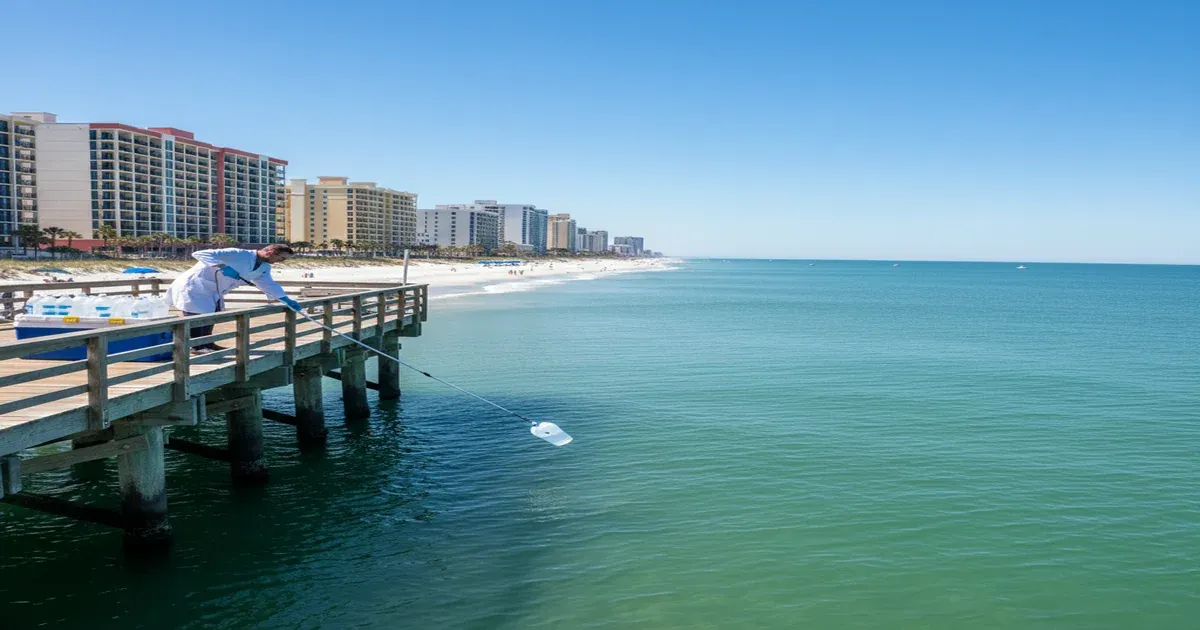
Myrtle Beach, South Carolina — home to about 35,000 permanent residents but hosting roughly 20 million visitors annually — faces a water quality paradox. The city markets itself as a paradise built around water, while quietly managing some of the most complex water quality challenges on the East Coast.
Tourism’s Water Demand Problem
The Grand Strand (the 60-mile stretch of coastline that includes Myrtle Beach) accommodates millions of visitors at peak season in hotels, condos, and vacation rentals. This creates:
- Seasonal demand spikes — Summer water demand can be five to six times winter demand, straining production and distribution capacity
- Hotel cooling tower contamination risk — Dense hotel concentrations with aging cooling systems raise Legionella risks
- Beach water quality — Stormwater and sewer overflows affect recreational water quality. South Carolina’s DHEC regularly monitors beach bacteria levels, and Myrtle Beach area beaches periodically post advisories.
- Septic system density — Many older properties in the Grand Strand use septic systems that can fail when heavily used, potentially contaminating groundwater
Saltwater Intrusion: Squeezing the Aquifer
Myrtle Beach and the Grand Strand draw heavily on the Floridan Aquifer System — the same massive aquifer underlying much of Florida and coastal South Carolina. The challenges:
- Sea level rise — The South Carolina coast is experiencing sea level rise, with Myrtle Beach among the regions at elevated long-term risk
- Overpumping — High groundwater extraction rates near the coast have reduced aquifer pressure, allowing saltwater to migrate inland
- Storm surge — Major hurricanes and extreme tidal events can push saltwater into coastal aquifers temporarily or permanently
- Chloride increases — Monitoring wells near the coast have shown increasing chloride concentrations in some parts of the aquifer
The Grand Strand Water and Sewer Authority (GSWSA) actively monitors saltwater intrusion and has been working to diversify source water to reduce dependence on potentially affected aquifer zones.
PFAS: Myrtle Beach Air Force Base Legacy
Myrtle Beach Air Force Base operated from 1941 until 1993, when it closed as part of the post-Cold War base realignment and closure (BRAC) process. The former base is now Myrtle Beach International Airport and a commercial/residential development area.
The PFAS contamination legacy:
- AFFF use — Decades of firefighting foam use during Air Force operations contaminated groundwater on and around the former base
- Off-base migration — PFAS plumes have been documented migrating beyond the former base boundary
- Airport continuation — Commercial airports continue to use AFFF, potentially adding to the existing contamination
- The Air Force has conducted remediation studies, but cleanup timelines at military PFAS sites are notoriously extended
GSWSA tests its water sources for PFAS. The results have shown detections, and the authority has stated compliance with current South Carolina standards. As EPA’s new MCLs take effect, monitoring requirements will intensify.
Stormwater and Beach Water Quality
The rapid development of the Grand Strand has paved over enormous areas, creating impervious surfaces that channel pollutants directly into storm drains and ultimately into the Atlantic:
- Bacteria exceedances — Beach monitoring regularly shows elevated bacteria counts after rain events, particularly near storm drain outlets
- Nutrient runoff — Fertilizer from golf courses, landscaping, and agriculture feeds algal growth in waterways
- Industrial spills — A 2024 sewage spill at a Myrtle Beach wastewater pump station released millions of gallons of partially treated sewage into local waterways, prompting beach closures
South Carolina DHEC maintains a beach monitoring program, and real-time results are available online.
What the Data Shows
From GSWSA’s most recent Consumer Confidence Report:
- All regulated contaminants within EPA and SC standards
- PFAS detected at low levels, below current state action levels
- Nitrate within limits
- Lead at 90th percentile below action level
- Disinfection byproducts within EPA limits
What Myrtle Beach Residents and Visitors Should Do
- Check beach water quality before swimming — South Carolina DHEC’s online portal shows current beach monitoring results. Check before entering the water, especially after heavy rain.
- Ask about PFAS — Request GSWSA’s most current PFAS testing data. With the former AFB nearby, this is an ongoing concern worth tracking.
- Water taste issues — Some Grand Strand residents notice seasonal changes in taste as source water blending adjusts. This is typically aesthetic, not a health concern — but filter if it bothers you.
- Private well owners — If you’re on a private well near the former base or near the coast, test for PFAS and saltwater intrusion (chloride, sodium, and hardness).
- Vacation rental tip — When staying in older condos or hotels, consider running the tap for a few minutes before using and carrying a water bottle with a certified filter for drinking.
Myrtle Beach’s water infrastructure serves an extraordinary visitor load reasonably well. But the city’s growth, coastal geography, and military legacy create real challenges that ongoing investment must address.
Water quality challenges like these aren’t unique to this area. Residents in Charleston SC Water Quality and Wilmington NC Water Quality face similar contamination concerns, while Columbia SC Water Quality deals with its own set of water infrastructure and quality issues.
If you’re concerned about your water quality, a certified water treatment professional can test your water and recommend appropriate solutions.