
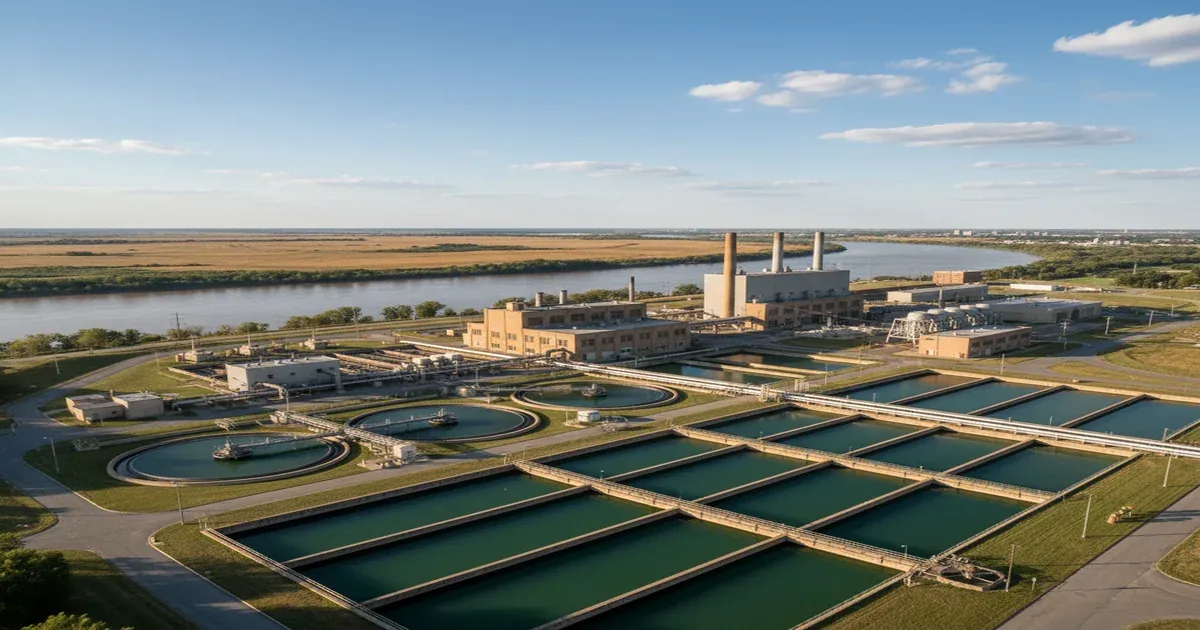
Where Omaha’s Water Comes From
Metropolitan Utilities District (MUD) supplies drinking water to more than 600,000 people in the Omaha metropolitan area. The system draws from two sources: the Missouri River (via the Florence Water Treatment Plant) and a network of wells in the Platte River wellfield south of the city.
The Missouri River water goes through a full conventional treatment process — coagulation, sedimentation, filtration, and disinfection. The wellfield water receives less intensive treatment since the natural sand and gravel acts as a filter, though it still undergoes disinfection and monitoring.
This dual-source system gives Omaha some resilience, but both sources face distinct contamination pressures.
Lead Service Lines: Omaha’s Biggest Challenge
Omaha has an estimated 68,000 lead service lines — one of the highest totals of any city — rivaling Chicago and Milwaukee in the United States. These are the pipes connecting water mains in the street to individual homes, and they’re the primary source of lead in Omaha’s tap water.
MUD has been running a lead service line replacement program since 2004, but the scale of the problem is enormous. At historical replacement rates, it would take decades to eliminate all lead lines. The EPA’s revised Lead and Copper Rule (LCRR), finalized in 2024, requires water systems to replace all lead service lines within 10 years — a timeline that puts significant pressure on Omaha to accelerate.
MUD adds orthophosphate to the water supply, which creates a protective coating inside lead pipes that reduces leaching. This corrosion control treatment has helped keep system-wide lead levels below the EPA’s action level of 15 ppb at the 90th percentile. But orthophosphate isn’t a permanent fix — any disruption to water chemistry, construction activity, or changes in water flow can disturb the protective layer and spike lead levels in individual homes.
Omaha’s lead challenge disproportionately affects older neighborhoods. Homes built before the 1950s are most likely to have lead service lines, with the highest concentrations in North Omaha, South Omaha, and the Midtown area.
Agricultural Runoff: Nitrates and Atrazine
Nebraska is one of the most agriculturally intensive states in the country, and that shows up in the water. Nitrate contamination from fertilizer application and livestock operations is a persistent concern for Omaha’s wellfield sources.
MUD’s Platte River wells draw from an alluvial aquifer that’s directly influenced by surface water and agricultural activity upstream. Nitrate levels in some wells have approached or exceeded the EPA’s Maximum Contaminant Level of 10 mg/L, requiring careful blending with lower-nitrate sources to keep delivered water in compliance.
Atrazine — one of the most widely used herbicides in the Corn Belt — is also detected seasonally in Omaha’s source water, particularly in late spring and early summer following field application. While treated water levels remain below the EPA’s MCL of 3 ppb, the presence of agricultural chemicals in source water is a long-term concern as farming practices intensify.
PFAS and Emerging Contaminants
PFAS contamination has been detected in Omaha’s water sources. Offutt Air Force Base, located just south — one of several military installations with PFAS issues, similar to Virginia Beach and Jacksonville of the city, is a known source of PFAS contamination from historical use of aqueous film-forming foam (AFFF) for firefighting training. The Department of Defense has acknowledged PFAS contamination at Offutt and is conducting remediation, but the contamination has reached groundwater.
MUD has been testing for PFAS compounds in both source and finished water. Nebraska has not yet adopted state-level PFAS drinking water standards, but the EPA’s 2024 PFAS rule established Maximum Contaminant Levels of 4 ppt for PFOA and PFOS individually — levels that may require additional treatment technology if exceeded.
Disinfection and Taste
MUD uses free chlorine for primary disinfection — unlike many large systems that have switched to chloramine. Residents occasionally notice chlorine taste and odor, particularly during spring and summer when higher chlorine doses are needed to manage increased organic matter from Missouri River flooding and agricultural runoff.
The system also produces disinfection byproducts (TTHMs and HAAs) within regulatory limits, though levels tend to be higher in summer months and at the ends of the distribution system where water age is greatest.
Missouri River Flooding
Omaha’s dependence on the Missouri River creates vulnerability to flooding events. The catastrophic 2019 floods caused significant damage throughout eastern Nebraska, and the Florence Water Treatment Plant had to adjust operations as floodwaters carried unprecedented sediment, debris, and agricultural contamination into the river.
Climate change projections suggest more intense precipitation events in the Missouri River basin, which could increase the frequency of these flood-related water quality challenges.
What Residents Can Do
- Check if you have a lead service line — MUD maintains a searchable database at their website. If you’re unsure, the utility can help identify your service line material
- Run the tap for 30 seconds to 2 minutes in the morning or after extended periods without use — this flushes standing water that may have absorbed lead from pipes
- Use cold water for cooking and baby formula — hot water dissolves lead more readily from pipes and solder
- Consider a certified water filter — NSF/ANSI 53-certified filters can reduce lead, while NSF/ANSI 401 or P473-certified filters address PFAS
- If you have a private well outside MUD’s service area, test annually for nitrates, bacteria, and consider PFAS testing — agricultural contamination is widespread in eastern Nebraska
If you’re concerned about your water quality, a certified water treatment professional can test your water and advise on solutions suited to your specific situation.
Sources
- Metropolitan Utilities District, Annual Water Quality Reports
- EPA SDWIS, MUD compliance data
- Nebraska Department of Environment and Energy, Drinking Water Program
- U.S. Department of Defense, Offutt AFB PFAS Investigation
- Environmental Working Group, Tap Water Database
- USGS, Missouri River Basin Water Quality Monitoring