
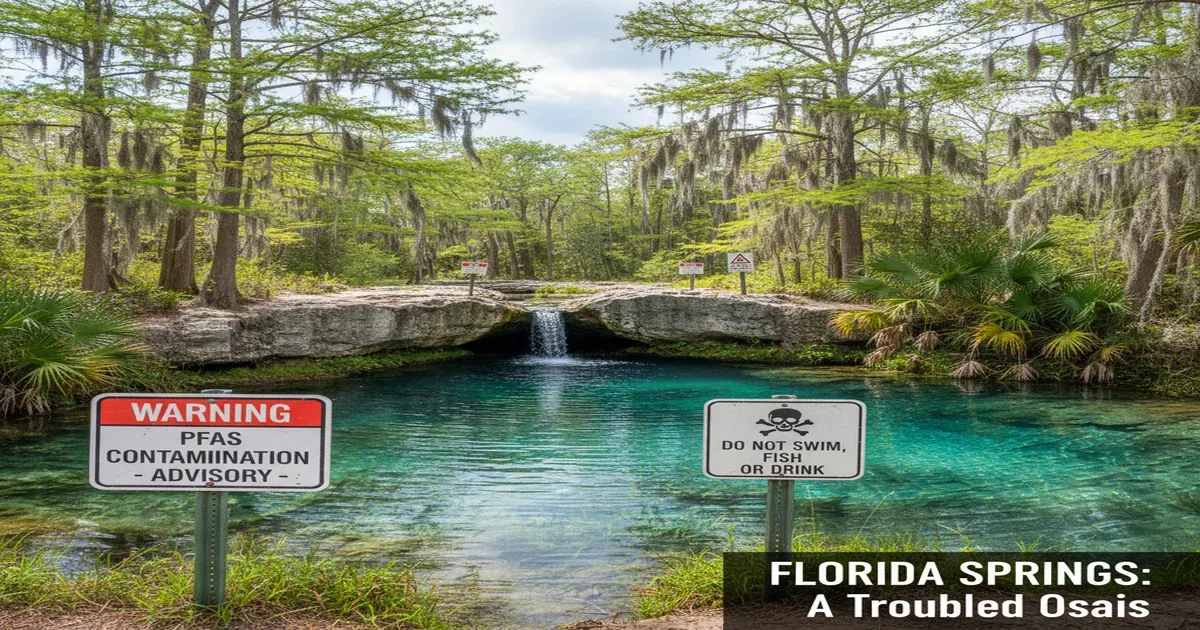
Orlando’s drinking water comes from the Floridan Aquifer, one of the most productive aquifer systems on Earth. It underlies most of Florida and parts of neighboring states, and for decades it’s provided Central Florida with abundant, generally clean water.
But Orlando’s explosive growth — the metro area now exceeds 2.6 million people — combined with PFAS contamination, industrial history, and the sheer demands of development are creating pressure the aquifer wasn’t designed to handle.
The Floridan Aquifer
The Floridan Aquifer is a limestone formation that holds trillions of gallons of water. Orlando sits right on top of it, and the Orlando Utilities Commission (OUC) draws from it through a network of deep wells.
The good news: the aquifer’s depth and limestone filtration provide natural protection against surface contamination. The water requires relatively minimal treatment compared to surface water systems.
The challenge: Florida’s porous geology means that contamination can still reach the aquifer through sinkholes, fractures, and recharge zones. And once contaminants enter a limestone aquifer, they can spread quickly through solution channels in the rock.
PFAS in Central Florida
PFAS contamination has emerged as a significant concern across Florida, and Orlando is no exception. The primary sources include:
Military installations. Central Florida is home to multiple current and former military bases, including the Orlando Naval Training Center (now Baldwin Park), Patrick Space Force Base, and various National Guard facilities. All of these have histories of AFFF firefighting foam use.
Orlando International Airport. Airports are consistent sources of PFAS contamination due to fire training and emergency response using AFFF foam. Orlando’s airport is one of the busiest in the country.
Commercial fire training facilities scattered across the metro area have contributed additional PFAS to the local environment.
Florida has been slower than some states to set enforceable PFAS standards, relying primarily on EPA health advisory levels. As of 2025, Florida has established health advisory levels for PFOS (70 ppt), PFOA (70 ppt), and GenX (HFPO-DA) at 21 ppt, but enforceable MCLs remain in development.
The Reclaimed Water Factor
Orlando is a leader in water reuse. The city uses treated reclaimed water extensively for irrigation — golf courses, parks, landscaping, and agricultural use. This helps conserve aquifer water, but raises questions about what contaminants make it through the treatment process and into the environment.
Reclaimed water is not treated to drinking water standards. It can contain trace pharmaceuticals, hormones, PFAS, and other emerging contaminants. When used for irrigation, these compounds can percolate through the soil and potentially reach the aquifer’s recharge zones.
The city maintains that reclaimed water meets all regulatory standards and does not pose a risk to the drinking water supply. Environmental groups have pushed for more monitoring, particularly for PFAS in reclaimed water streams.
Aging Infrastructure in Older Neighborhoods
Orlando’s older neighborhoods — particularly those built before 1986 — may have lead service lines or lead solder in household plumbing. While OUC treats its water to minimize lead leaching (through pH adjustment and corrosion control), the risk is never fully eliminated in older plumbing systems.
The city has been inventorying its lead service lines under the EPA’s revised Lead and Copper Rule, which requires utilities to identify and eventually replace all lead service lines.
What the Data Shows
OUC’s most recent water quality reports show the utility consistently meets all federal and state primary drinking water standards. Specific data points worth watching:
- Total trihalomethanes (TTHMs) and haloacetic acids (HAA5) — disinfection byproducts — have been within limits but are worth monitoring, especially during hot months when chlorine demand increases.
- Nitrates remain below the MCL, but urbanization and septic system density in some areas of greater Orlando create ongoing pressure.
- PFAS testing is increasingly required but results vary by well and location.
What Orlando Residents Should Do
- Read your water quality report. OUC publishes annual results. If you’re in unincorporated Orange County or a smaller utility, check their reports separately — quality varies by provider.
- Test for lead if your home is pre-1986. The city’s treatment reduces lead risk, but older plumbing is still the weak link. Home test kits are inexpensive and give peace of mind.
- Ask about PFAS. As testing requirements expand, more data will become available. Stay informed about what’s being found in your specific water supply wells.
- Consider filtration. A reverse osmosis system handles PFAS, lead, disinfection byproducts, and most emerging contaminants. It’s the broadest-spectrum protection available for home use.
- Support aquifer protection. Central Florida’s growth isn’t slowing down. Advocacy for responsible development, septic-to-sewer conversions, and aquifer recharge protection matters.
If you’re concerned about your water quality, a certified water treatment professional can test your tap water and recommend the right system for your home. Orlando’s water is generally good — but in a city growing this fast on a sole-source aquifer, staying ahead of the curve makes sense.
Related Reading
- Tallahassee FL Water Quality: Springs and the Floridan Aquifer
- Jacksonville Florida: PFAS From Naval Station Contamination
- Tampa Water Quality: Desalination and PFAS
- Savannah GA Water Quality: Floridan Aquifer Concerns
Sources
- Orlando Utilities Commission annual water quality reports
- Florida Department of Environmental Protection PFAS monitoring data
- EPA Floridan Aquifer sole source designation records
- Florida Department of Health PFAS health advisory levels
- USGS Floridan Aquifer characterization studies