
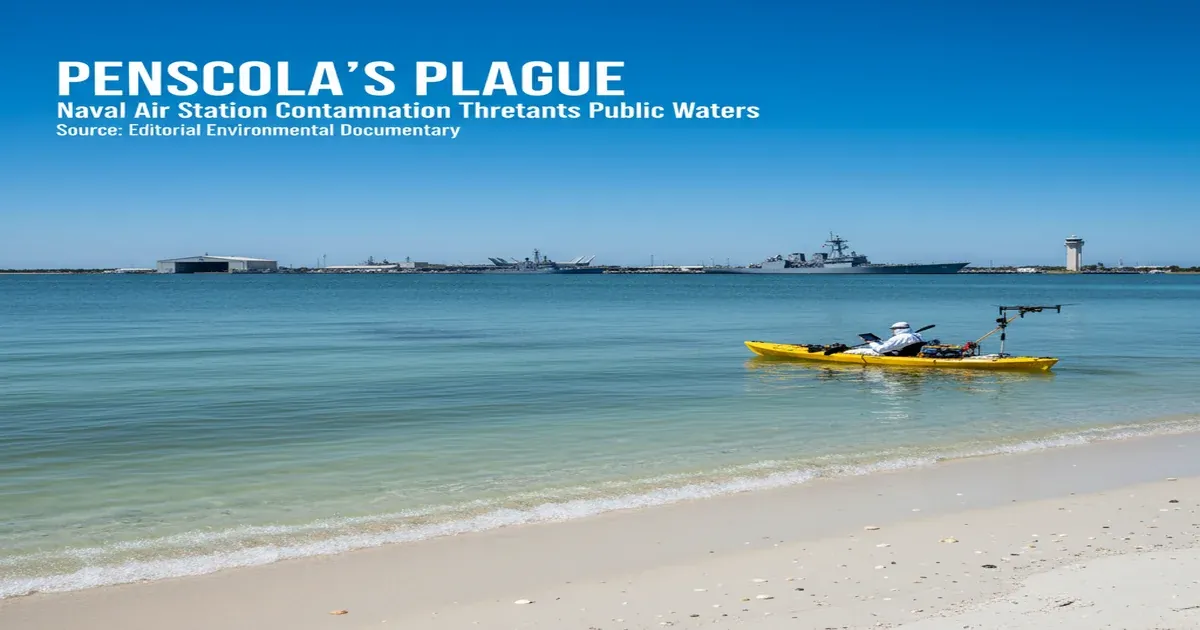
Pensacola sits at the western tip of Florida’s panhandle, where the Gulf Coast’s white sand beaches rest atop the same sandy geology that holds the region’s drinking water. The Sand-and-Gravel Aquifer that supplies Pensacola and Escambia County is relatively shallow and highly productive — but also highly vulnerable to surface contamination.
That vulnerability has become painfully clear as PFAS contamination from Naval Air Station Pensacola continues to spread through surrounding neighborhoods’ groundwater.
Naval Air Station Pensacola and PFAS
NAS Pensacola is one of the Navy’s oldest installations, dating back to 1825. For decades, the base used aqueous film-forming foam (AFFF) for fire training and emergency response. AFFF contains PFAS compounds that are extraordinarily persistent in groundwater — earning them the name “forever chemicals.”
Department of Defense testing has revealed PFAS contamination in groundwater on and around the base. Key findings include:
- PFOS and PFOA levels exceeding EPA health advisory limits in monitoring wells near fire training areas
- Contamination plumes extending off-base into residential areas to the north and west
- The Navy has provided bottled water and installed filtration systems for some affected households, but the full extent of the contamination plume is still being mapped
NAS Pensacola isn’t alone. Across Escambia County, three military installations have been identified as PFAS sources: NAS Pensacola, Saufley Field, and Corry Station. Together, they’ve created a complex contamination picture that overlaps with residential areas relying on private wells.
ECUA’s Municipal System
The Emerald Coast Utilities Authority (ECUA) manages Pensacola’s municipal water supply. ECUA draws groundwater from over 50 wells tapping the Sand-and-Gravel Aquifer, treating it at multiple water treatment facilities.
ECUA’s treated water generally meets all EPA standards. The utility conducts regular testing for a broad range of contaminants including:
- Lead and copper — ECUA has maintained compliance with the Lead and Copper Rule, with 90th percentile lead levels below the 15 ppb action level
- Disinfection byproducts — THMs and HAAs within EPA limits
- PFAS — ECUA has tested for PFAS compounds and reported levels in treated water below EPA advisory limits, though detectable
The concern isn’t ECUA’s treatment plants — it’s the thousands of residents on private wells in unincorporated Escambia County who don’t have the benefit of centralized treatment.
Private Well Vulnerability
Escambia County has a substantial population relying on private wells, particularly in areas north of Pensacola and in rural parts of the county. The Sand-and-Gravel Aquifer that feeds these wells has several characteristics that make it susceptible to contamination:
- Shallow water table — often just 10–30 feet below the surface
- High permeability — sandy soils allow contaminants to move quickly from the surface to groundwater
- Minimal natural filtration — unlike clay-rich aquifer systems that can slow or adsorb contaminants, sandy aquifers provide limited natural protection
For private well owners near military installations, this means PFAS contamination from surface use can reach their drinking water relatively quickly. Florida’s Department of Environmental Protection has conducted some testing of private wells near known PFAS sources, but comprehensive testing of all at-risk wells hasn’t been completed.
Historical Industrial Contamination
Military bases aren’t Pensacola’s only contamination concern. The Escambia Treating Company Superfund site, located on the north side of Pensacola, operated as a wood-treating facility from the 1940s to 1982. The site contaminated surrounding soil and groundwater with:
- Creosote compounds (polycyclic aromatic hydrocarbons)
- Pentachlorophenol (PCP)
- Dioxins and furans
EPA listed the site on the National Priorities List in 1983, and remediation has been ongoing for over 40 years. The contamination affected nearby residential wells, and a water line extension project connected affected homes to ECUA’s system.
The American Creosote Works site on the Pensacola bayfront is another legacy contamination area that required extensive remediation.
Saltwater Intrusion
As Pensacola and the broader Gulf Coast region continue to grow, increased pumping from the Sand-and-Gravel Aquifer creates another risk: saltwater intrusion. The aquifer sits near sea level along the coast, and heavy pumping can draw saltwater into freshwater zones.
ECUA and the Northwest Florida Water Management District monitor for saltwater intrusion through a network of sentinel wells along the coast. So far, intrusion has been manageable, but:
- Sea level rise is projected to increase the risk over coming decades
- Development pressure in Escambia and Santa Rosa counties means more wells, more demand
- Storm surge from hurricanes can temporarily introduce saltwater into shallow aquifer zones
The 2020 hurricane season, which brought Hurricane Sally directly through Pensacola with catastrophic flooding, demonstrated how storm events can affect water quality and infrastructure.
Hurricane Impacts on Water Quality
Hurricane Sally made landfall near Gulf Shores, Alabama, in September 2020, but Pensacola bore the brunt of its flooding. The slow-moving storm dumped over 30 inches of rain in some areas, overwhelming stormwater systems and flooding water treatment infrastructure.
Impacts included:
- Sewage overflows into Pensacola Bay and area waterways
- Flooding of water distribution infrastructure, requiring boil-water advisories
- Contamination of private wells by floodwater carrying sewage, chemicals, and debris
- Extended service disruptions in some neighborhoods
For a region dependent on a shallow, permeable aquifer, hurricanes represent a recurring threat to water quality that goes beyond immediate infrastructure damage.
What Pensacola Residents Should Know
Whether you’re on ECUA’s municipal system or a private well, here’s what matters:
- If you’re on a private well near a military installation, get your water tested for PFAS. Florida DEP offers resources for testing, and the Navy has testing programs for properties near NAS Pensacola, Saufley Field, and Corry Station.
- Know your aquifer. The Sand-and-Gravel Aquifer is productive but vulnerable. If you’re on a private well, annual testing for bacteria, nitrates, and common contaminants is essential — not optional.
- After storms, test your water. If your well was in a flood zone during a hurricane or major storm, have it tested before resuming use. Bacteria, nitrate, and chemical contamination can all enter shallow wells through floodwater.
- Consider filtration. For PFAS removal, activated carbon or reverse osmosis systems are most effective. For general well water protection, a combination of sediment filtration, UV disinfection, and carbon filtration covers most common concerns.
If you’re concerned about your water quality, a certified water treatment professional can test your water and advise on the right system. Pensacola’s combination of military PFAS contamination, shallow aquifer vulnerability, and hurricane risk makes proactive testing particularly important.
Related Reading
- Jacksonville Florida Water Quality: PFAS and Naval Station Contamination
- Tampa Water Quality: Desalination and PFAS Concerns
- Mobile AL Water Quality: Gulf Coast Challenges
- Honolulu Water Quality: Red Hill Navy Fuel Contamination
Sources
- Department of Defense PFAS testing results for NAS Pensacola and surrounding installations
- ECUA Annual Water Quality Reports
- EPA Escambia Treating Company Superfund Site records
- Florida Department of Environmental Protection PFAS investigation data
- Northwest Florida Water Management District aquifer monitoring
- National Weather Service Hurricane Sally post-storm report (2020)