One of America’s Oldest Water Systems
Providence Water Supply Board serves approximately 600,000 people — roughly 60% of Rhode Island’s population — making it the largest water utility in the state. The system dates back to 1871 and draws from the Scituate Reservoir, a 3.5-billion-gallon impoundment in the forested hills west of Providence.
The Scituate Reservoir is a high-quality surface water source. Surrounded by thousands of acres of protected watershed land, it’s one of the few large municipal water supplies in the Northeast that’s clean enough to avoid filtration — Providence Water operates under an EPA filtration avoidance waiver, meaning the water receives disinfection and corrosion control but doesn’t pass through a conventional filtration plant.
That’s a testament to how well the watershed is protected. But the lack of filtration also means certain treatment challenges — particularly around disinfection byproducts — require careful management.
Lead: The Infrastructure Legacy
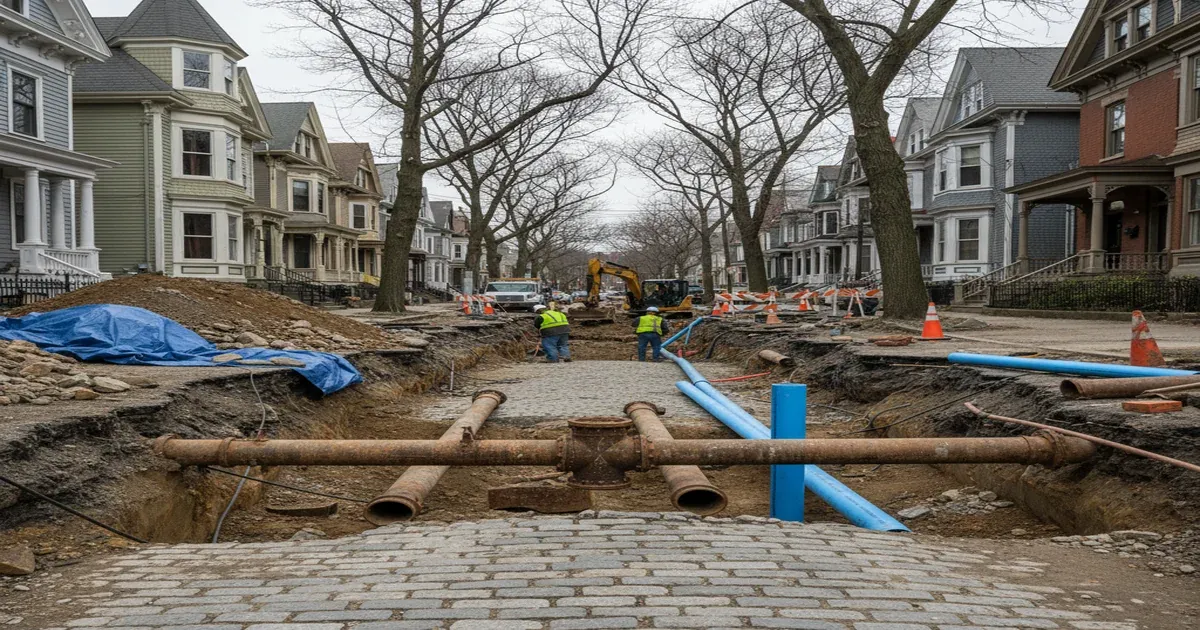
Like virtually every New England city with pre-World War II housing stock, Providence has a significant lead service line problem. The city’s older neighborhoods — Federal Hill, Smith Hill, Olneyville, South Providence, the West End — were largely built in the late 1800s and early 1900s when lead was the standard pipe material.
Providence Water estimates thousands of lead service lines remain in its distribution system. The utility has been conducting inventory work under the EPA’s revised Lead and Copper Rule, which requires complete lead service line identification and a 10-year replacement timeline.
The utility uses optimized corrosion control — adjusting pH and alkalinity to create a protective mineral layer inside lead pipes that reduces leaching. System-wide 90th percentile lead testing has met the EPA’s action level of 15 ppb — a challenge shared with nearby New Haven and cities like Newark — but individual homes with lead service lines can experience significantly higher levels.
Rhode Island has been particularly proactive on lead. The state’s Department of Health runs childhood lead screening programs, and Providence has some of the highest rates of childhood lead exposure in New England — driven by both lead paint in old housing and lead in drinking water.
In 2024, Rhode Island committed additional state funding to accelerate lead service line replacement in environmental justice communities, with Providence as a primary beneficiary.
Disinfection Byproducts: The Filtration Avoidance Trade-Off
Operating without filtration has advantages — lower treatment costs, less chemical use, simpler operations. But it also means the water retains more natural organic matter from the reservoir, which reacts with chlorine disinfectant to form disinfection byproducts (DBPs).
Providence Water has periodically struggled with compliance for total trihalomethanes (TTHMs) and haloacetic acids (HAAs) — the two regulated classes of DBPs. The EPA’s limits are 80 ppb for TTHMs and 60 ppb for HAA5, measured as running annual averages.
The challenge is seasonal: organic matter in the Scituate Reservoir increases during warm months when algae and decomposing vegetation contribute more precursors. By the time water reaches the far ends of the distribution system — where it may have traveled through miles of pipe over several days — DBP levels can approach or exceed regulatory limits.
Providence Water has invested in treatment upgrades, including UV disinfection, to reduce chlorine demand and DBP formation. The utility has also explored enhanced coagulation and activated carbon treatment as longer-term solutions.
PFAS: Emerging Data
Rhode Island adopted some of the earliest state-level PFAS drinking water standards in the country. In 2022, the state set a Maximum Contaminant Level of 20 ppt for the sum of six PFAS compounds — well ahead of the EPA’s 2024 federal rule.
Providence Water’s Scituate Reservoir watershed is relatively protected from major PFAS sources, but PFAS is pervasive in the environment. Testing under Rhode Island’s standards and the EPA’s UCMR 5 program has provided baseline data on PFAS levels in Providence’s water supply.
The utility has been monitoring results closely, and Rhode Island’s Department of Health provides regular updates on PFAS testing across the state’s water systems.
Potential PFAS sources in the broader Providence area include T.F. Green Airport (Warwick), industrial facilities, and landfills — though these are generally downstream or outside the Scituate watershed.
Manganese and Aesthetic Issues
Some Providence Water customers experience occasional taste, odor, or discoloration issues related to manganese — a naturally occurring mineral in the Scituate Reservoir that can cause brown or black water, particularly during seasonal reservoir turnover events.
Manganese isn’t a health concern at the levels found in Providence’s water, but it can stain laundry and fixtures and make water unappealing. The utility monitors manganese levels and adjusts treatment when seasonal spikes occur.
Climate and Water Supply
Rhode Island’s changing climate patterns present both opportunities and risks for Providence’s water supply. Increased precipitation has generally kept the Scituate Reservoir well-supplied, but more intense storms can increase turbidity and organic loading — challenging the filtration avoidance system.
Warmer water temperatures in the reservoir can promote algal growth, increase DBP precursors, and potentially create conditions for harmful algal blooms (HABs). Providence Water monitors the reservoir closely for algae and adjusts treatment protocols accordingly.
What Residents Can Do
- Check if your home has lead pipes — Providence Water can help identify your service line material. If your home was built before 1950, lead service lines are likely
- Run your tap for 30 seconds to 2 minutes before drinking or cooking, especially first thing in the morning or after being away
- Use cold water for cooking and formula — hot water dissolves more lead from pipes
- Consider a certified water filter — NSF/ANSI 53 for lead, NSF P473 for PFAS, activated carbon for DBPs and taste/odor
- If you notice brown or black water, flush cold taps for several minutes. If it persists, contact Providence Water
- Request a free lead test — Providence Water offers lead testing for residential customers
If you’re concerned about your water quality, a certified water treatment professional can test your water and recommend solutions tailored to Providence’s specific water chemistry.
Sources
- Providence Water Supply Board, Annual Water Quality Reports
- Rhode Island Department of Health, Drinking Water Quality Program
- EPA SDWIS, Providence Water compliance records
- Rhode Island Department of Environmental Management, PFAS Information
- Environmental Working Group, Tap Water Database
- EPA, Filtration Avoidance Determination for Providence Water