
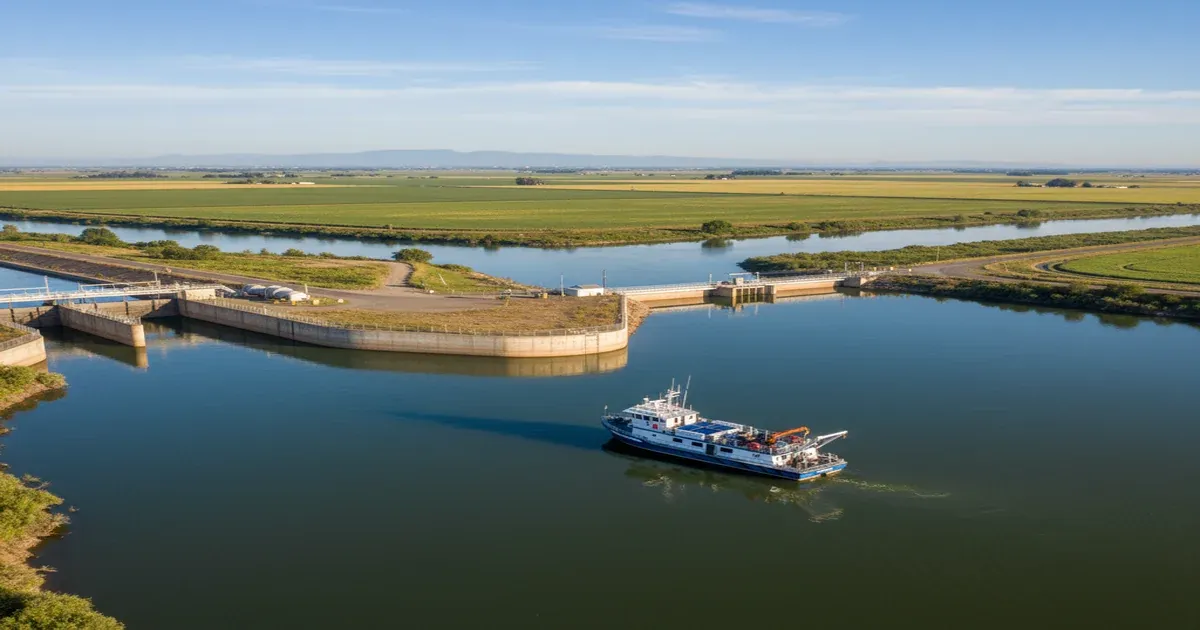
Sacramento sits at the confluence of the Sacramento and American Rivers — arguably the most water-rich location in California. While Southern California fights over Colorado River allocations and the Bay Area depends on distant mountain reservoirs, Sacramento has major rivers flowing right through the middle of the city.
That geographic advantage doesn’t make the water quality picture simple.
The City of Sacramento operates two water treatment plants — the E.A. Fairbairn Water Treatment Plant (drawing from the American River) and the Sacramento River Water Treatment Plant. Together, they serve about 500,000 people in the city proper. Sacramento Suburban Water District and other agencies serve surrounding areas, some using groundwater.
PFAS: The McClellan Air Force Base Legacy
Sacramento’s most significant water contamination issue is PFAS from the former McClellan Air Force Base in the northeastern part of the metro area.
McClellan operated as a major Air Force logistics hub from 1936 to 2001. During those decades, the base used massive quantities of AFFF firefighting foam, industrial solvents, fuels, and other hazardous materials. McClellan was designated a Superfund site in 1987, and cleanup has been ongoing for nearly four decades.
The PFAS contamination is extensive:
- Groundwater plumes containing PFOA, PFOS, and other PFAS compounds extend well beyond the former base boundary into surrounding residential and commercial areas.
- Multiple public and private wells in the North Highlands, Foothill Farms, and Carmichael areas have been affected.
- The cleanup timeline stretches decades into the future. While the Air Force has installed treatment systems on some wells and provided alternative water supplies, complete remediation of PFAS in groundwater is extraordinarily difficult and expensive.
In addition to McClellan, Mather Air Force Base (also closed) on the south side of Sacramento has similar contamination issues. The combined legacy of military PFAS contamination across the Sacramento region affects groundwater quality for hundreds of thousands of residents.
Sacramento-San Joaquin Delta: The Water War
Sacramento’s water supply is abundant locally, but the city sits at the epicenter of California’s most contentious water conflict: the Sacramento-San Joaquin Delta.
The Delta — where the Sacramento and San Joaquin Rivers meet before flowing into San Francisco Bay — is the hub through which water is pumped south to supply 25 million Californians and millions of acres of farmland. The State Water Project and Central Valley Project pump water from the Delta and export it hundreds of miles south.
The environmental consequences have been severe: native fish populations (including Delta smelt and salmon) have collapsed, water quality in the Delta itself has degraded, and the levee system protecting Delta islands is increasingly fragile.
For Sacramento residents, the Delta conflict matters because:
- Water quality in the Sacramento River can be affected by Delta management decisions, agricultural return flows, and tidal influence from the Bay.
- Any major Delta levee failure could cause saltwater intrusion that would temporarily compromise the region’s freshwater supply.
- The proposed Delta Conveyance Project (successor to the cancelled Twin Tunnels) would reroute some Sacramento River water around the Delta, potentially affecting downstream flow and quality.
Groundwater Quality in the Sacramento Valley
Much of suburban Sacramento relies on groundwater, and quality varies significantly by location:
- Arsenic — Naturally occurring arsenic has been detected in some Sacramento-area wells, particularly in the eastern and southern parts of the valley. Levels occasionally approach or exceed EPA’s MCL of 10 parts per billion.
- Nitrates — Agricultural areas surrounding Sacramento contribute nitrate contamination to shallow groundwater, particularly in southern Sacramento County.
- Hexavalent chromium (Chromium-6) — California has been working toward a state-level MCL for hexavalent chromium, which occurs naturally in Sacramento Valley groundwater and has been detected in some drinking water wells.
- VOCs from industrial sites — In addition to McClellan and Mather, multiple industrial and commercial sites have contributed volatile organic compounds to the local groundwater.
Infrastructure and Drought Resilience
Sacramento’s water infrastructure faces the usual challenges of age and growth:
- Aging treatment plants — Both the Fairbairn and Sacramento River plants have components dating to the mid-20th century that require ongoing investment.
- Distribution system — Older parts of Sacramento have water mains that are overdue for replacement. While the city has been investing in infrastructure renewal, the backlog is significant.
- Drought vulnerability — Despite abundant local rivers, Sacramento’s water supply can be curtailed during extreme drought when the state imposes mandatory restrictions and river flows drop.
The paradox of Sacramento’s location: the city has more water flowing through it than almost anywhere in California, but political and regulatory constraints sometimes limit how much it can actually use.
What Sacramento Residents Should Know
- Know your water source. Are you on city surface water or a suburban groundwater system? The water quality profiles are different.
- If you’re near McClellan or Mather — Check whether your water system has been affected by PFAS contamination and what treatment is in place.
- Private well owners — Test your water regularly. The Sacramento area has multiple overlapping contamination issues. At minimum, test for PFAS, nitrates, arsenic, and bacteria.
- Read your CCR. Every water system publishes an annual Consumer Confidence Report with testing results. Read it — especially the PFAS and DBP sections.
- Consider filtration for drinking water. A reverse osmosis system or certified carbon filter addresses most contaminant concerns.
Related Reading
- San Francisco’s Hetch Hetchy Water and PFAS — Northern California’s other major water system and its PFAS challenges.
- Los Angeles Water: PFAS and Drought — Southern California’s parallel battle with PFAS and water scarcity.
- San Diego’s Imported Water and PFAS — How San Diego is pivoting to water recycling while managing contamination.
- PFAS Treatment: Ion Exchange vs. Activated Carbon — Understanding the technologies being deployed to remove PFAS from drinking water.
The Bottom Line
Sacramento has the water — more than most California cities could dream of. The challenges are contamination from military and industrial sources, complex water politics that affect how much the city can actually use, and the standard American problem of aging infrastructure that costs billions to replace.
The McClellan and Mather PFAS contamination story is one of the most significant in California, and affected communities deserve faster cleanup and more transparent communication about exposure risks.
If you’re concerned about your water quality, a certified water treatment professional can test your water and recommend the right treatment solution for your home.