
San Diego is one of the driest major cities in the United States. With average annual rainfall around 10 inches and no major river running through the metro area, the city has spent over a century engineering its way to a reliable water supply. That supply comes from hundreds of miles away — and it’s getting harder to secure.
The San Diego County Water Authority (SDCWA) serves 3.3 million people across 24 member agencies. Historically, the region imported more than 80% of its water from two sources: the Colorado River via the Metropolitan Water District of Southern California’s Colorado River Aqueduct, and Northern California’s Sacramento–San Joaquin River Delta through the State Water Project.
Both sources face serious pressure. The Colorado River has been in a multi-decade drought that brought Lake Mead and Lake Powell to historic lows. The Delta faces chronic infrastructure challenges, drought risk, and regulatory restrictions to protect endangered species. San Diego learned the hard way in the 1990s — during a severe drought, imported supplies were curtailed, and the city faced mandatory rationing.
That experience changed everything.
Diversifying the Supply: Desal and the IID Deal
San Diego has been more aggressive than any other major U.S. city in diversifying its water sources. Two moves stand out.
In 2003, SDCWA signed the Quantification Settlement Agreement with the Imperial Irrigation District (IID) — the single largest user of Colorado River water in the region. The deal sends 80,000 acre-feet of conserved water per year to San Diego for 110 years. SDCWA funded canal lining and irrigation efficiency improvements in the Imperial Valley to free up the supply.
In 2015, the Claude Bud Lewis Carlsbad Desalination Plant came online as the largest seawater desalination facility in the Western Hemisphere. The plant produces roughly 56,000 acre-feet of water per year — about 10% of the region’s supply. It runs 24/7, independent of drought or snowpack conditions. The tradeoff: desalinated water is among the most expensive in the region, and the energy-intensive process carries its own environmental footprint.
Together, these projects dropped San Diego’s dependence on Metropolitan Water District imports from over 90% in the 1990s to around 40% today. That’s a remarkable shift for a region that was once almost entirely at the mercy of imported aqueduct water.
PFAS Contamination at MCAS Miramar
Marine Corps Air Station Miramar sits on 23,000 acres roughly 14 miles north of downtown San Diego. Like military installations across the country, Miramar used aqueous film-forming foam (AFFF) containing per- and polyfluoroalkyl substances (PFAS) for decades in firefighting training and emergency response.
The Department of Defense has confirmed PFAS detections in groundwater at and near MCAS Miramar. The base is among hundreds of military sites nationwide under investigation for PFAS contamination. In 2024, the EPA finalized enforceable maximum contaminant levels (MCLs) for six PFAS compounds in drinking water, including PFOS and PFOA at 4 parts per trillion each — levels far below what’s been detected at many military-adjacent sites.
San Diego’s municipal water system draws primarily from imported surface water rather than local groundwater, which limits direct exposure from Miramar’s contamination plume for most residents. But the situation is different for communities relying on local wells, and the contamination raises questions about future groundwater use as the city invests in local supply.
MCAS Miramar also hosts one of the nation’s largest landfills — the West Miramar Landfill — which has its own history of groundwater contamination concerns, including volatile organic compounds and landfill leachate.
Hard Water and Disinfection Byproducts
San Diego’s drinking water is among the hardest in California. The city reports typical hardness of 16 to 18 grains per gallon (272–284 parts per million), owing to the mineral content of imported Colorado River water. While hard water doesn’t pose a health risk, it drives significant residential demand for water softeners and creates scale buildup in plumbing and appliances.
Disinfection byproducts (DBPs) — including trihalomethanes (TTHMs) and haloacetic acids (HAAs) — are the contaminants most commonly flagged in San Diego’s water quality reports. These form when chlorine or chloramine used for disinfection reacts with organic matter in source water. The city’s water has consistently met EPA maximum contaminant levels, but the Environmental Working Group and California’s Office of Environmental Health Hazard Assessment have set health guidelines well below the legal limits.
San Diego has maintained a remarkable compliance record. City officials note they’ve never sold a drop of water deemed unsafe by any local, state or federal agency in over 100 years of operation.
Pure Water San Diego: The Recycled Water Gamble
San Diego’s most ambitious water project isn’t a pipeline or a dam — it’s a billion program to turn treated wastewater into drinking water.
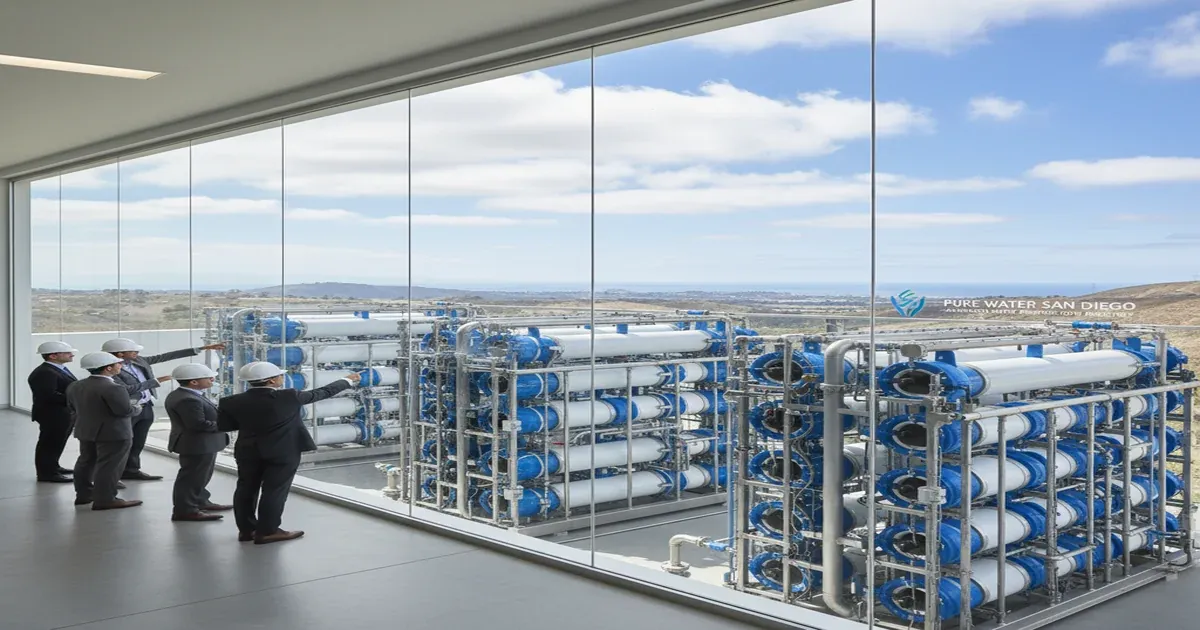
Pure Water San Diego is one of the largest potable reuse programs in the country. Phase 1, currently under construction at the North City Pure Water Facility, will produce 30 million gallons of purified water per day by treating wastewater through a multi-step advanced purification process: ozonation, membrane filtration, reverse osmosis, and ultraviolet disinfection with advanced oxidation.
By 2035, Phase 2 aims to scale production to 83 million gallons per day — enough to supply roughly one-third of San Diego’s total demand using locally recycled water. If completed on schedule, San Diego would become one of the first major U.S. cities to derive a substantial portion of its drinking water from direct potable reuse.
The program has a predecessor in the city’s existing purple pipe non-potable recycled water system, which has delivered treated wastewater for irrigation, industrial use, and other non-drinking purposes for decades. The purple pipes are a visible part of San Diego’s landscape in parks, golf courses, and commercial landscaping. Pure Water takes the concept further — recycling wastewater to drinking water standards.
Public acceptance was a hurdle. Early proposals for potable reuse in the late 1990s were killed by political backlash — the toilet-to-tap framing proved toxic. It took years of public education, pilot programs, and the growing reality of imported water insecurity before voters and city leaders got on board.
The Emergency Storage Project
SDCWA’s .5 billion Emergency and Carryover Storage Project provides a backstop if imported water deliveries are disrupted. The project includes the raising of San Vicente Dam (completed in 2014, adding 152,000 acre-feet of capacity), new pipelines, pump stations, and interconnected reservoirs designed to maintain supply for up to six months during an emergency.
This infrastructure proved its value during recent drought years when the State Water Project allocation was reduced to near-zero in dry years.
Related Reading
- Los Angeles Water: PFAS and Drought — San Diego’s northern neighbor faces similar PFAS and supply challenges.
- Las Vegas Water: Drought and the Colorado River — Another city whose future depends on the Colorado River.
- Tucson’s Water: CAP, PFAS, and Water Reuse — A fellow Southwest city advancing water recycling as a long-term strategy.
- PFAS Treatment: Ion Exchange vs. Activated Carbon — The treatment technologies cities are deploying against forever chemicals.
What San Diego Residents Should Know
San Diego’s municipal water meets all EPA and California standards, and the city’s compliance record is strong. But there are things to pay attention to:
PFAS exposure is primarily a concern for communities near MCAS Miramar or other military/industrial sites with local well water. If you’re on city water, your supply comes from treated imported surface water, not local groundwater.
Hard water is a fact of life in San Diego. A water softener or point-of-use reverse osmosis system can address mineral content and improve taste.
Disinfection byproducts remain the most common contaminant category detected above health guidelines (though below legal limits). Activated carbon filters — whether pitcher, faucet-mounted, or whole-house — effectively reduce DBPs.
Recycled water is coming to the tap. Pure Water San Diego will fundamentally change the city’s water supply within the next decade. The advanced treatment process exceeds current drinking water standards, but residents should stay informed as the program scales.
If you’re concerned about your water quality, a certified water treatment professional can test your water and advise on solutions. San Diego’s Water Quality Lab is also available at 619-668-3232.
Sources
- San Diego County Water Authority — sdcwa.org
- City of San Diego Public Utilities Department — Water Quality Reports
- EPA ECHO Facility Report — City of San Diego PWS CA3710020
- Environmental Working Group Tap Water Database — San Diego
- Department of Defense PFAS Task Force — MCAS Miramar Investigation
- EPA Final PFAS National Primary Drinking Water Regulation (2024)