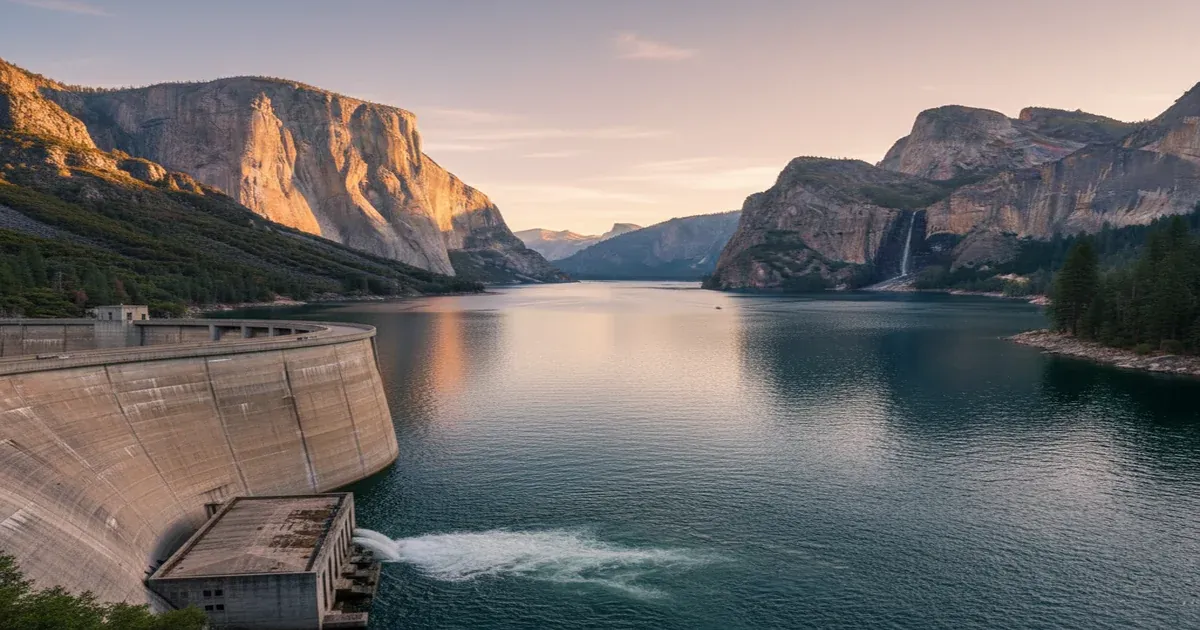
San Francisco gets its drinking water from one of the most spectacular sources in the world: Hetch Hetchy Reservoir, a glacially carved valley in Yosemite National Park, 167 miles east of the city.
The San Francisco Public Utilities Commission (SFPUC) operates the Hetch Hetchy Regional Water System, which delivers snowmelt from the Sierra Nevada to 2.7 million people in San Francisco, Silicon Valley, and other Bay Area communities. The water travels by gravity through tunnels and aqueducts across the San Joaquin Valley and under San Francisco Bay.
Like Portland and Boston, San Francisco’s water is so clean at the source that it meets EPA’s filtration avoidance criteria. Hetch Hetchy water receives UV disinfection and chloramine treatment, but doesn’t pass through a conventional filtration plant. It’s some of the purest municipal water in the country.
PFAS: San Francisco International Airport
San Francisco’s primary PFAS concern centers on San Francisco International Airport (SFO), located about 13 miles south of the city in San Mateo County.
SFO, like all major airports, has used AFFF firefighting foam for emergency response and training for decades. PFAS contamination has been confirmed in groundwater beneath and around the airport:
- Groundwater monitoring wells at SFO have detected PFOA, PFOS, and other PFAS compounds at levels exceeding EPA’s health advisory levels
- San Francisco Bay — PFAS from airport runoff and groundwater discharge enters the Bay, contributing to broader contamination of the estuarine environment
- Adjacent communities — While most nearby communities are served by treated surface water (not local groundwater), the contamination plume raises concerns about exposure pathways
Other Bay Area PFAS sources include:
- Military installations — Former Naval Air Station Alameda, Moffett Federal Airfield (NASA Ames), and Treasure Island all have documented PFAS contamination
- Industrial facilities — Silicon Valley’s semiconductor manufacturing history includes extensive use of PFAS compounds
- Wastewater treatment — Bay Area wastewater plants discharge treated effluent containing PFAS into the Bay, contributing to bioaccumulation in fish and wildlife
San Francisco’s Hetch Hetchy supply is largely unaffected by these local PFAS sources since it comes from a protected Sierra Nevada watershed. But communities in the Bay Area that rely on local groundwater — parts of the South Bay and East Bay — face more direct exposure risk.
Earthquake Vulnerability: The Big Risk
San Francisco’s most significant water infrastructure vulnerability isn’t contamination — it’s seismology.
The Hetch Hetchy system crosses the Hayward Fault, the San Andreas Fault, and several other active fault zones on its 167-mile journey from Yosemite to San Francisco. A major earthquake on any of these faults could sever the pipelines and leave the city without water for weeks or months.
SFPUC has been investing billions in seismic upgrades through its Water System Improvement Program (WSIP), a $4.8 billion capital program that includes:
- Pipeline replacement and seismic reinforcement along the major transmission lines
- New tunnels that bypass the most vulnerable fault crossing points
- Local storage expansion — Increasing reservoir capacity within San Francisco to provide emergency supply if the long-distance transmission system is interrupted
- Emergency interconnections with other water systems
The 1906 earthquake and subsequent fire famously destroyed much of San Francisco, in large part because the earthquake ruptured water mains and firefighters couldn’t get water to fight the blaze. A century later, the risk of a major earthquake disrupting the water supply remains real — though the infrastructure is dramatically more resilient than it was in 1906.
Local Water Quality Issues
Within San Francisco itself, several water quality factors deserve attention:
- Lead in building plumbing — San Francisco’s housing stock includes significant numbers of pre-1986 buildings with lead solder and, in some cases, lead service lines. SFPUC’s corrosion control program (pH and alkalinity adjustment) minimizes lead leaching, but older buildings remain at risk.
- Disinfection byproducts — Chloramine disinfection produces fewer DBPs than free chlorine, but trihalomethanes and haloacetic acids are still monitored. San Francisco’s system generally maintains DBP levels well below EPA’s MCLs.
- Chloramine — SFPUC uses chloramines for residual disinfection. While effective at controlling DBPs, chloramines can be problematic for kidney dialysis patients, aquarium owners, and some individuals with chemical sensitivities. Standard carbon filters remove chloramines.
Bay Area Groundwater: A Different Story
While San Francisco proper relies on Hetch Hetchy surface water, many Bay Area communities — particularly in the South Bay and East Bay — use local groundwater as a significant portion of their supply.
- Santa Clara Valley Water District manages groundwater in Silicon Valley, where decades of semiconductor manufacturing contaminated shallow groundwater with solvents (TCE, PCE) across multiple Superfund sites. Extensive cleanup has been ongoing since the 1980s.
- Alameda County — Former NAS Alameda and other military sites have contaminated groundwater with PFAS, fuels, and solvents.
- Contra Costa County — Industrial and agricultural contamination affects some groundwater sources in the East Bay.
The Bay Area’s groundwater picture is a patchwork of contamination plumes from military, industrial, and agricultural sources — layered on top of naturally occurring contaminants like arsenic and manganese in some formations.
Climate and Supply Resilience
California’s recurring droughts affect the Hetch Hetchy system, though less dramatically than they affect Southern California’s imported water:
- Sierra Nevada snowpack — Like Denver’s system, Hetch Hetchy depends on mountain snowpack melting gradually through the summer. Climate change is reducing snow and shifting melt timing.
- Drought restrictions — During severe droughts (2012-2016, 2020-2022), Bay Area residents faced mandatory water use restrictions.
- Wildfire risk — The Rim Fire of 2013 burned 257,000 acres near Hetch Hetchy, threatening the watershed and the infrastructure. While the reservoir itself was not directly affected, future fires in the Sierra could impact source water quality.
- SFPUC diversification — The agency is investing in local groundwater development, water recycling, and conservation to reduce dependence on the long-distance Hetch Hetchy system.
What Bay Area Residents Should Know
- San Francisco tap water is excellent. Hetch Hetchy is one of the best municipal water sources in the country. The main risk is in building plumbing, not the supply.
- Check your building’s plumbing age. In pre-1986 buildings, run the cold tap for 30 seconds before drinking, and consider a point-of-use filter.
- Know your water source. Not everyone in the Bay Area gets Hetch Hetchy water. Check with your local utility to understand your source and review their water quality report.
- Prepare for earthquake disruption. Store at least 3 days of emergency water (1 gallon per person per day). San Francisco’s earthquake preparedness plans include water supply, but individual preparation is essential.
- Private well owners in the Bay Area — test your water regularly, especially for VOCs and PFAS if you’re near former military or industrial sites.
Related Reading
- Sacramento’s Water Quality and PFAS in the Delta — Another Northern California city grappling with PFAS in its water supply.
- Seattle’s Cedar River Water Quality — A fellow protected-watershed city facing similar emerging contaminant challenges.
- Los Angeles Water: PFAS and Drought — California’s largest city fights PFAS contamination amid chronic drought.
- Denver’s Water: PFAS, Lead, and Drought — Another western city balancing water quality with supply constraints.
The Bottom Line
San Francisco’s water system is an engineering and environmental marvel — gravity-fed from Yosemite, unfiltered, and consistently high quality. The investment in seismic resilience through the WSIP demonstrates a seriousness about infrastructure that many cities lack.
The Bay Area’s broader water quality picture is more complex, with groundwater contamination from Silicon Valley’s industrial past, military PFAS across multiple installations, and the ongoing challenge of serving millions of people in an earthquake-prone, drought-variable region.
If you’re concerned about your water quality, a certified water treatment professional can test your water and recommend the right approach for your home — whether that’s lead filtration in an old San Francisco building or PFAS treatment for a South Bay well.