
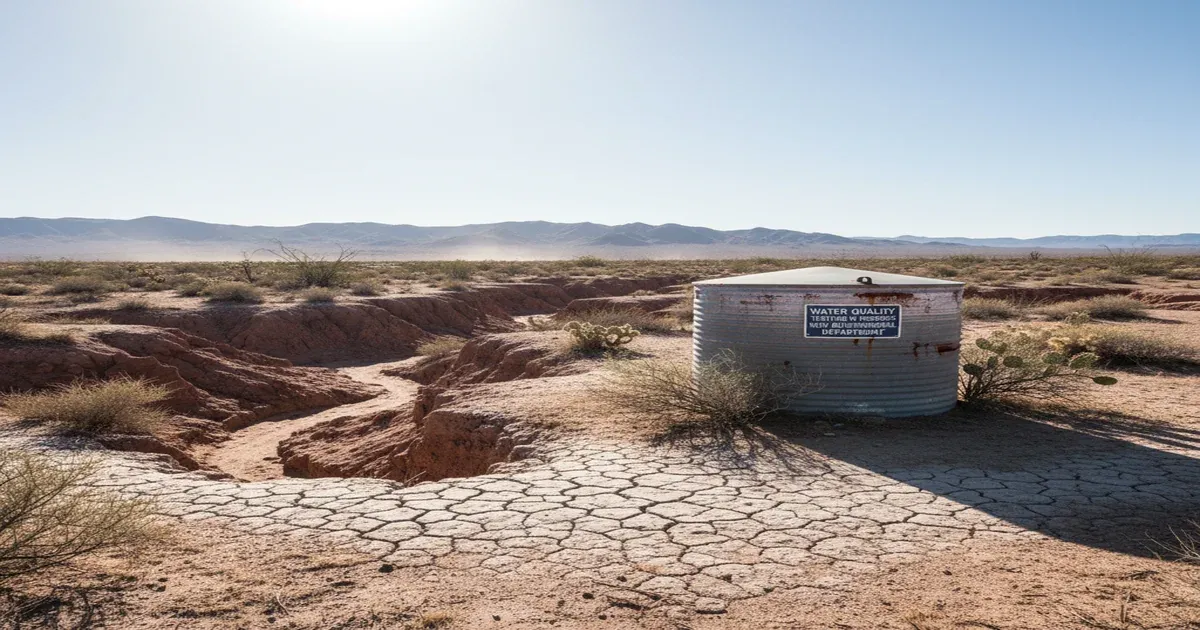
Santa Fe is one of the oldest cities in the United States, founded in 1610. It’s also one of the driest. Sitting at 7,000 feet in the high desert of northern New Mexico, the city receives about 14 inches of rain per year — less than half the national average.
Water has always been precious here. But in recent decades, the challenges have intensified: naturally occurring arsenic in the groundwater, surface supplies diminished by drought, and a population that — while modest by Sun Belt standards at around 90,000 — keeps pushing against the limits of what the landscape can provide.
The Arsenic Problem
New Mexico’s groundwater naturally contains arsenic. It’s a geological reality — the volcanic and sedimentary rocks that form the state’s aquifers contain arsenic-bearing minerals. When water passes through these formations, it picks up dissolved arsenic.
The EPA’s MCL for arsenic is 10 ppb. When the standard was lowered from 50 ppb to 10 ppb in 2006, it hit New Mexico harder than almost any other state. Hundreds of water systems across New Mexico — including wells in the Santa Fe area — exceeded the new limit.
Santa Fe has invested in treatment to bring its municipal wells into compliance, including installing arsenic removal systems. But the treatment adds cost, generates arsenic-laden waste that requires special disposal, and doesn’t help the many private well owners in the surrounding area who are responsible for their own water quality.
For private well owners in Santa Fe County, arsenic testing isn’t optional — it’s essential. Some wells in the region exceed the MCL by significant margins, and arsenic exposure has been linked to skin, lung, and bladder cancers, as well as cardiovascular effects.
Drought and Surface Supply
Santa Fe’s surface water comes primarily from the Santa Fe River watershed and the Buckman Direct Diversion (BDD), which takes water directly from the Rio Grande. Both sources have been hammered by drought.
The Santa Fe River watershed has seen declining snowpack and earlier runoff in recent decades. The city’s reservoirs — McClure and Nichols — have been at critically low levels during drought years, forcing heavier reliance on groundwater and the BDD.
The Buckman Direct Diversion, completed in 2011, was designed to reduce Santa Fe’s dependence on its own limited watershed by pulling water from the Rio Grande. It’s been a crucial addition, but the Rio Grande itself is under extreme pressure. Flows have declined significantly, and the river has literally gone dry in some stretches downstream of Albuquerque during recent drought years.
Santa Fe County has some of the most aggressive water conservation programs in the country. Per-capita water use has dropped dramatically — from about 160 gallons per person per day in the 1990s to under 100 gallons today. But conservation alone can’t solve the problem if supply keeps shrinking.
Uranium and Radionuclides
Northern New Mexico has a legacy of uranium mining and nuclear research, centered on the Los Alamos National Laboratory. While Santa Fe itself isn’t in the direct footprint of these activities, the broader regional groundwater system connects to areas with elevated radionuclide and heavy metal concentrations.
Monitoring of uranium, radium, and gross alpha radiation in Santa Fe’s water supply has generally shown compliance with federal standards. But the proximity to legacy contamination sites means ongoing vigilance is warranted.
Infrastructure and Distribution
Santa Fe’s water distribution system reflects the city’s age. Some neighborhoods have pipes dating back decades, and the hilly terrain creates pressure variations across the system. The city has been investing in infrastructure upgrades, but replacing aging mains in a historic city with narrow streets and protected architecture is slower and more expensive than in a typical American municipality.
Disinfection byproducts are less of a concern in Santa Fe than in many cities, partly because the city uses chloramines rather than free chlorine for residual disinfection, and partly because its source waters tend to have lower organic matter loads than surface water systems in wetter climates.
Water Rights and the Future
Water in New Mexico is governed by a priority-based rights system — “first in time, first in right.” Santa Fe has been aggressively acquiring and banking water rights to ensure future supply. The city also has one of the most forward-thinking water reuse programs in the Southwest, treating and reinjecting wastewater to recharge the aquifer.
But even with these measures, Santa Fe’s water future depends on factors largely beyond its control: regional precipitation patterns, Rio Grande flows, and competing demands from agriculture, tribal nations, and other municipalities.
What Santa Fe Residents Should Do
- Test for arsenic. If you’re on a private well anywhere in Santa Fe County, arsenic testing is the single most important thing you can do. Don’t assume your well is safe because a neighbor’s tested fine — arsenic levels can vary dramatically over short distances.
- Use a point-of-use RO system. Reverse osmosis is the gold standard for arsenic removal at the household level. It also handles uranium, radium, and most other dissolved contaminants found in New Mexico groundwater.
- Conserve aggressively. Santa Fe’s water supply is finite in a way that most American cities don’t experience. Every gallon saved extends the community’s water security.
- Read the water quality report. The city publishes annual results. If you’re outside city limits on a community water system, check that system’s report separately.
- Understand your water rights. If you’re drilling a new well or buying property with a well, understand the water rights attached to it. New Mexico’s water law is complex, and rights matter.
If you’re concerned about your water quality, a certified water treatment professional can test your well or tap water and recommend the right system. In Santa Fe’s high-desert environment, where every drop matters and the geology adds its own challenges, knowing exactly what’s in your water isn’t a luxury — it’s a necessity.
Related Reading
- Albuquerque Water: Arsenic and Kirtland Air Force Base PFAS
- El Paso TX Water Quality: Hueco Bolson and Desalination
- Tucson Water: CAP, PFAS, and Water Reuse
- Reno NV Water Quality: Truckee River and Arsenic
Sources
- City of Santa Fe Water Division annual water quality reports
- New Mexico Environment Department drinking water bureau monitoring data
- EPA arsenic rule implementation records for New Mexico
- USGS Rio Grande Basin water quality assessments
- Santa Fe County water resources management plans