
Sarasota, Florida, sells itself on water — the turquoise Gulf, the white-sand beaches, the bayfront lifestyle. But the city’s relationship with water quality is more complicated than the tourism brochures suggest.
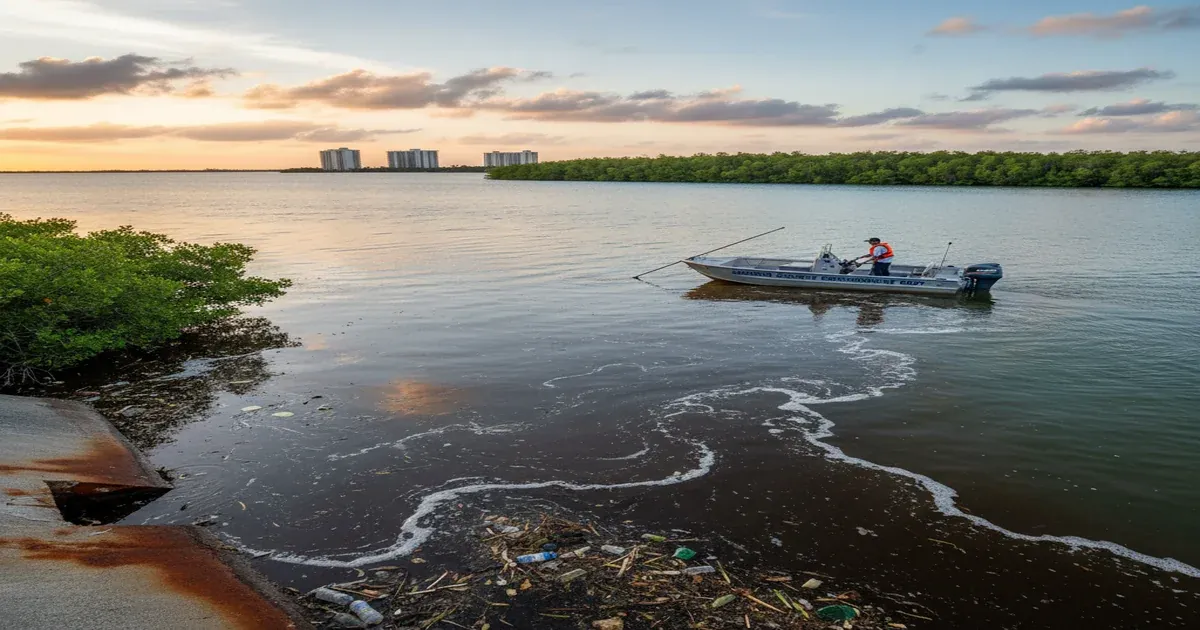
In March 2026, a broken force main near West John Ringling Causeway sent approximately 14,000 gallons of raw wastewater into Sarasota Bay. It wasn’t an isolated incident. Sarasota and Sarasota County have a pattern of wastewater infrastructure failures, and the bay and surrounding waterways have been paying the price.
Wastewater Spills: A Recurring Problem
Sarasota’s wastewater infrastructure — like much of Florida’s — was built during the mid-20th century development boom and is approaching or exceeding its designed service life. Force mains (pressurized sewer pipes), lift stations, and treatment plants are aging simultaneously.
Recent notable spills:
- March 2026 — 14,000-gallon spill into Sarasota Bay from a broken force main near the Ringling Causeway
- Multiple incidents in 2024-2025 — The City of Sarasota and Sarasota County have reported numerous sanitary sewer overflows (SSOs) due to pipe failures, lift station malfunctions, and heavy rainfall overwhelming the system
- Piney Point (2021) — While technically in neighboring Manatee County, the breach of a phosphogypsum wastewater reservoir at the former Piney Point phosphate processing facility sent hundreds of millions of gallons of nutrient-laden water into Tampa Bay and the Gulf. The environmental impact reached Sarasota County waters.
These spills introduce pathogens, nutrients, and other contaminants into waterways that residents use for recreation — and that support the commercial fishing and tourism industries that drive the local economy.
The underlying problem is infrastructure age combined with rapid population growth. Sarasota County’s population has grown significantly in recent decades, placing more demand on systems that weren’t designed for current loads.
Red Tide: The Recurring Nightmare
Southwest Florida experiences periodic blooms of Karenia brevis, the algae that causes “red tide.” While red tide is a natural phenomenon in the Gulf of Mexico, the severity and duration of recent blooms have raised questions about whether nutrient pollution is making them worse.
The 2018 red tide event was catastrophic for the Sarasota-Fort Myers coast — lasting months, killing massive quantities of marine life, and causing respiratory irritation that drove tourists away and affected residents’ quality of life.
Red tide doesn’t directly contaminate drinking water (Sarasota’s tap water comes from groundwater, not surface water). But it devastates the aquatic ecosystem, affects property values, and creates public health concerns from airborne toxins. The connection between nutrient loading from wastewater spills, agricultural runoff, and red tide intensity remains an active area of scientific research.
Drinking Water: The Floridan Aquifer
Sarasota County’s drinking water comes primarily from the Floridan Aquifer system — the same massive limestone formation that supplies much of Florida.
Sarasota County Utilities and the City of Sarasota operate multiple wellfields tapping the intermediate and Floridan aquifer zones. Treatment typically includes lime softening (Florida groundwater is very hard), disinfection, and fluoridation.
Water quality concerns:
- Hardness — Sarasota’s groundwater is extremely hard, which affects taste, causes scale buildup, and leads many residents to install water softeners. Hard water isn’t a health risk, but it’s a quality-of-life issue.
- Sulfate and hydrogen sulfide — Parts of Sarasota County have groundwater with elevated sulfate levels and dissolved hydrogen sulfide (the “rotten egg” smell). Treatment removes most of this, but some areas experience periodic odor issues.
- Disinfection byproducts — Florida’s warm climate and the organic matter in treated water can produce elevated DBP levels. Utilities monitor this closely and adjust treatment to stay within EPA limits.
- PFAS — Like all Florida water systems, Sarasota-area utilities are subject to EPA’s 2024 PFAS MCLs. While Sarasota doesn’t have major military PFAS sources like Tampa (MacDill AFB) or Jacksonville (NAS Jacksonville), PFAS is ubiquitous enough that all systems need to monitor and potentially treat.
Private Wells and Shallow Groundwater
Many rural and semi-rural areas of Sarasota County rely on private wells. These wells often tap the surficial or intermediate aquifer systems, which are more vulnerable to contamination than the deeper Floridan.
Risks for private well owners include:
- Nitrates from septic systems and agricultural operations. Sarasota County still has significant areas on septic rather than centralized sewer — and the connection between septic system density, groundwater contamination, and nearshore water quality is well-established.
- Bacteria — Shallow wells are vulnerable to bacterial contamination, particularly during heavy rain events that can carry surface contaminants into the water table.
- Arsenic — Naturally occurring arsenic has been detected in some Sarasota County groundwater at levels requiring attention.
- Pesticides and fertilizers — Agricultural and residential landscaping chemicals can reach shallow groundwater in Florida’s porous soils.
The Septic-to-Sewer Transition
One of the most significant water quality issues in Sarasota County is the estimated tens of thousands of homes still on septic systems. In Florida’s sandy, permeable soils and high water table, conventional septic systems can be significant sources of nitrogen, phosphorus, and bacteria that reach groundwater and surface water.
Florida has been pushing septic-to-sewer conversions, and Sarasota County has an ongoing program to extend centralized sewer service to areas currently on septic. But the cost is enormous — connecting a home can run $10,000 to $30,000 or more — and property owners often resist the expense.
The irony: the same septic systems that contribute to nutrient pollution in waterways may also be contaminating the shallow groundwater that some of those homeowners are drinking from private wells.
What Sarasota Residents Should Know
- Your tap water is treated and tested. If you’re on a public water system, your water meets federal standards. Read your annual CCR for specific testing results.
- Consider a softener. Sarasota’s hard water is tough on plumbing and appliances. A properly sized water softener can make a significant quality-of-life difference.
- Private well owners — Test annually at minimum. Florida’s geology means your well water quality can change. Test for bacteria, nitrates, hardness, and any contaminants relevant to your area.
- Know your sewer connection status. If you’re on septic, understand that it affects both the environment and potentially your own well water quality if you’re also on a private well.
- Stay informed about spills and red tide. The Florida Department of Environmental Protection tracks wastewater spills, and the FWC monitors red tide. Both publish real-time data.
Related Reading
- Tampa Water: Desalination and PFAS — Sarasota’s Tampa Bay neighbor manages its own water quality challenges.
- Sarasota Bay Wastewater Spill 2026 — The latest incident in Sarasota’s ongoing wastewater struggles.
- Miami Water: Biscayne Aquifer and Saltwater Intrusion — Florida’s water challenges vary dramatically by region.
- Jacksonville Water: PFAS and Naval Station — Water contamination sources differ across the state.
The Bottom Line
Sarasota’s water quality story is shaped by the collision of rapid growth, aging infrastructure, and Florida’s uniquely vulnerable hydrogeology. The recurring wastewater spills into Sarasota Bay aren’t just environmental embarrassments — they’re symptoms of a system under more stress than it was designed to handle.
The drinking water from public systems is safe, but the broader water environment — the bay, the Gulf, the shallow groundwater — is under pressure from development, nutrient loading, and infrastructure that needs billions in investment.
If you’re concerned about your water quality at home, a certified water treatment professional can test your water and recommend solutions tailored to Sarasota’s specific water chemistry.