
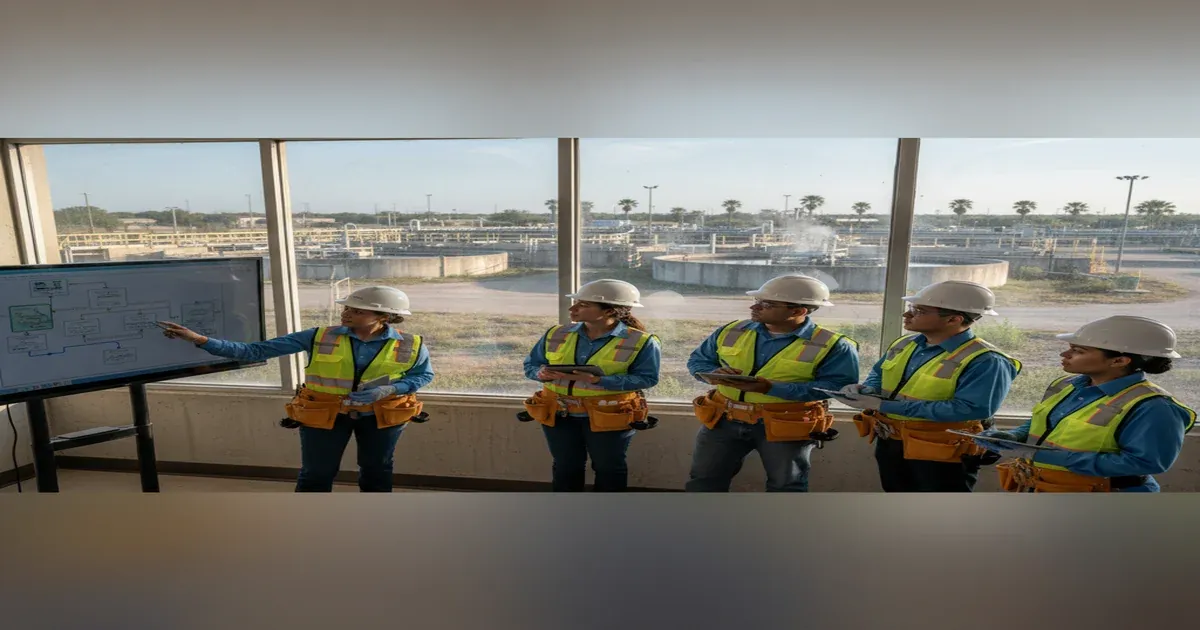
South Texas College (STC) announced in March 2026 that it’s introducing a new wastewater operator training program as part of a broader Rio Grande Valley workforce initiative. It’s a timely move. The RGV is one of the fastest-growing regions in Texas, and the gap between population growth and qualified water infrastructure workers has been widening for years.
But the problem isn’t unique to South Texas. It’s happening everywhere.
A national shortage that affects your tap water
The American Water Works Association (AWWA) has warned for years that the water sector faces a workforce crisis. Estimates suggest that roughly one-third of the water and wastewater workforce is eligible to retire within the next decade. In some states, it’s closer to half.
The numbers matter because licensed operators are required by law. Every public water system and wastewater treatment facility in the United States must have certified operators on staff — professionals who’ve passed state licensing exams and meet continuing education requirements. Without them, systems can’t legally operate.
In Texas, the Texas Commission on Environmental Quality (TCEQ) oversees operator certification. Operators must pass exams at various classification levels depending on the size and complexity of the system they manage. Getting certified takes time — typically a combination of education, on-the-job training, and passing a state exam. There’s no shortcut.
Why the Rio Grande Valley needs this now
The Rio Grande Valley has seen explosive growth over the past two decades. Hidalgo County alone grew from about 569,000 people in 2000 to over 900,000 by 2020, according to U.S. Census data. Cameron, Starr, and Willacy counties have all grown substantially too.
More people means more water demand and more wastewater to treat. But the region has historically had fewer training pathways for water and wastewater operators compared to more urban parts of Texas. Many operators in the Valley have had to travel to San Antonio, Austin, or Houston for training and exam prep — an expensive and time-consuming barrier for working adults.
South Texas College’s new program aims to change that by providing local, accessible training for aspiring wastewater operators in the RGV. The program is part of a broader regional initiative to build workforce capacity in essential infrastructure roles.
What wastewater operators actually do
If you’ve never thought about what happens after you flush, that’s by design. Wastewater operators are the professionals who make sure the process works — collecting, treating, and safely discharging millions of gallons of wastewater every day.
Their work involves monitoring treatment processes, testing water quality, maintaining equipment, adjusting chemical dosing, and ensuring that discharged water meets Clean Water Act standards before it enters rivers, streams, or the Gulf of Mexico. It’s technical, regulated, and essential to public health.
When a system doesn’t have enough qualified operators, things go wrong. Undertreated wastewater can release pathogens, excess nutrients, and chemical pollutants into waterways. EPA enforcement data shows that small and mid-sized systems — the kind common in rapidly growing areas — are disproportionately likely to have staffing-related compliance issues.
The broader Texas water workforce picture
Texas has more public water systems than any other state — over 7,000. Many are small, rural systems serving fewer than 10,000 people. These systems often struggle the most to recruit and retain licensed operators.
The reasons are straightforward: pay is often modest (especially in smaller communities), the work is physically demanding, the licensing requirements are rigorous, and the profession doesn’t have the visibility of other trades. Young people entering the workforce often don’t know the career exists.
In 2023, the Texas Legislature passed HB 2804, which directed the Texas Workforce Commission and the Texas Education Agency to create career and technical education pathways for water and wastewater operations in high schools. The goal was to build awareness of the profession earlier and create a pipeline of future operators.
South Texas College’s program builds on that momentum. Community colleges across the state are increasingly stepping up to fill the training gap — offering certificate programs, exam prep courses, and partnerships with local utilities that provide hands-on experience.
What this means for residents
If you’re in the Rio Grande Valley — or anywhere in Texas — the quality of your drinking water and wastewater treatment depends directly on having enough trained, licensed operators running your local systems.
When systems are fully staffed with qualified professionals, compliance rates go up, water quality improves, and the risk of infrastructure failures drops. When they’re not, communities pay the price through boil-water notices, consent decrees, and degraded environmental quality.
The STC program won’t solve the workforce crisis overnight. But it puts training within reach for people in a region that badly needs it. And it’s part of a broader national recognition that investing in water workforce development is investing in public health.
If you’re concerned about your water quality, a certified water treatment professional can test your water and advise on solutions tailored to your specific situation.
Sources: South Texas College, KSAT San Antonio (March 9, 2026), TCEQ Operator Certification, American Water Works Association, U.S. Census Bureau, Texas Legislature (HB 2804, 2023)
Related Reading
- San Antonio Water System Infrastructure — South Texas water infrastructure depends on a trained workforce.
- Rural Water Systems and Regional Partnerships — Small systems share the workforce challenges South Texas faces.
- El Paso Water: Hueco Bolson and Water Reuse — Another Texas border community managing scarce water resources.
- Jackson, Mississippi Water Crisis — What happens when workforce shortages meet infrastructure failure.