
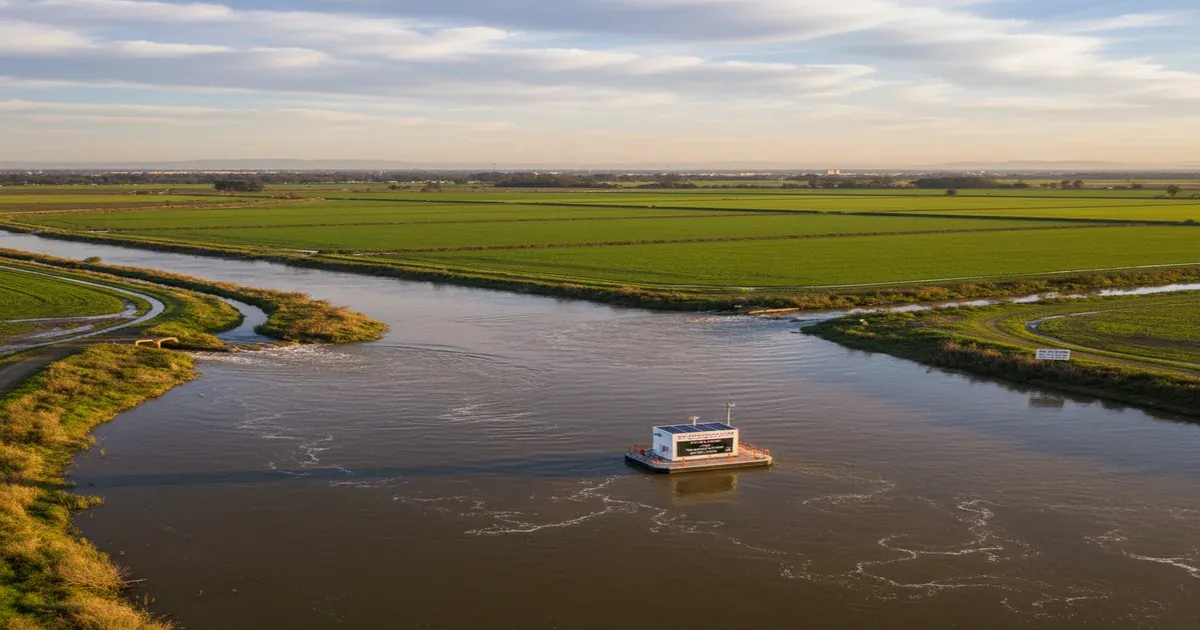
Stockton is California’s inland port city, built at the confluence of the San Joaquin River and the Sacramento-San Joaquin Delta — the largest estuary on the Pacific Coast. The city of 320,000 sits in the center of the Central Valley’s agricultural powerhouse, surrounded by some of the most productive farmland in the world. That productivity comes with a cost to the water.
Two Water Sources: Surface and Ground
The California Water Service Company (Cal Water) and the City of Stockton’s Municipal Utilities Department jointly serve the metro area, drawing from both surface water and groundwater sources.
The Delta Water Supply Project, completed in 2012, brought treated surface water from the Sacramento-San Joaquin Delta to Stockton for the first time, reducing the city’s dependence on groundwater. The $200 million project includes a 30 million gallon per day treatment plant using dissolved air flotation, ozonation, and granular activated carbon — advanced treatment designed to handle the Delta’s challenging source water.
That source water is challenging because the Delta is essentially a mixing zone. Upstream agricultural runoff, urban discharge from Sacramento, tidal saltwater intrusion from the San Francisco Bay, and the accumulated contamination of Central Valley farming all converge in the channels around Stockton.
Groundwater remains the other half of Stockton’s supply. And groundwater in the Stockton area carries its own set of problems.
Agricultural Nitrate: The Central Valley’s Chronic Contamination
The Central Valley is one of the most nitrate-contaminated groundwater regions in America. Decades of intensive agriculture — row crops, orchards, dairies, and feedlots — have loaded the shallow aquifer with nitrate concentrations that routinely exceed the EPA’s maximum contaminant level of 10 mg/L as nitrogen.
In San Joaquin County, where Stockton sits, the State Water Resources Control Board has documented widespread nitrate contamination in domestic wells and small community water systems. The sources are multiple: synthetic fertilizer application on cropland, dairy manure lagoon leaching, and septic system discharge in unincorporated communities.
For Stockton’s municipal system, nitrate is manageable — the city’s wells draw from deeper aquifer zones and blend groundwater with treated surface water to dilute nitrate below regulatory limits. But the dozens of small community water systems and private domestic wells in the unincorporated areas around Stockton — places like Lathrop, Manteca’s rural fringes, and the colonias south of the city — don’t have that luxury.
These disadvantaged communities often lack the financial resources to install treatment systems. California’s SAFER (Safe and Affordable Funding for Equity and Resilience) program has been directing funding to these systems, but the scale of the problem — hundreds of failing or contaminated small water systems across the Central Valley — exceeds available resources.
DBCP: A Banned Pesticide That Won’t Go Away
Dibromochloropropane (DBCP) is a soil fumigant that was heavily used in Central Valley orchards and vineyards from the 1950s through 1977, when it was banned after being linked to male sterility and cancer in production workers. Nearly 50 years after the ban, DBCP remains one of the most persistent groundwater contaminants in the San Joaquin Valley.
DBCP is slow to break down in groundwater. It has been detected in wells across San Joaquin, Stanislaus, and Fresno counties at levels above the California MCL of 200 parts per trillion. Several of Stockton’s municipal wells have required treatment or closure due to DBCP contamination.
The contamination plumes are well-characterized but essentially unremediable at scale — the chemical is distributed throughout the aquifer, and natural attenuation is extremely slow. Management strategies focus on treatment (granular activated carbon) and well abandonment rather than cleanup.
1,2,3-TCP: Another Pesticide Legacy
1,2,3-Trichloropropane (TCP) is a contaminant closely associated with DBCP — it was a manufacturing impurity in the soil fumigants used across the Central Valley. California set an MCL of 5 parts per trillion for 1,2,3-TCP in 2017, one of the strictest standards in the country.
Multiple wells in the Stockton area have detected 1,2,3-TCP at or above the MCL. Like DBCP, this contaminant is persistent in groundwater and expensive to treat. GAC treatment systems are effective but represent significant capital and operating costs for water utilities.
Drought, Subsidence, and Groundwater Depletion
California’s recurring droughts hit the Central Valley’s groundwater hardest. During the 2012-2016 drought, groundwater pumping in the San Joaquin Valley increased dramatically as surface water allocations were cut. The result was measurable land subsidence — the ground literally sank as aquifer compaction occurred.
In parts of San Joaquin County, subsidence rates of 1-2 inches per year have been documented. Beyond the infrastructure damage to roads, canals, and well casings, subsidence reduces the aquifer’s storage capacity permanently. That water-holding ability doesn’t come back.
The Sustainable Groundwater Management Act (SGMA), passed in 2014, requires local groundwater sustainability agencies to develop plans that achieve sustainability by 2040-2042. For the Eastern San Joaquin Subbasin that underlies Stockton, this means reduced pumping, managed aquifer recharge, and difficult conversations about agricultural water use.
For water quality, drought and over-pumping concentrate contaminants in remaining groundwater and can draw deeper, lower-quality water (higher in arsenic, salts, or naturally occurring contaminants) into production wells.
What Stockton Residents Can Do
Stockton’s municipal water supply is treated and meets federal standards. The risks are more acute for residents on private wells or small community systems in the surrounding area:
- Private well owners: test regularly — nitrate, DBCP, 1,2,3-TCP, and arsenic should all be on your testing list if you’re in San Joaquin County.
- Know your system — if you’re not on Cal Water or city water, find out who your water provider is and review their testing results.
- Municipal customers: review the CCR — both Cal Water and the city publish annual water quality reports.
- Point-of-use treatment for private wells — reverse osmosis systems remove nitrate, DBCP, and most other Central Valley contaminants effectively.
If you’re concerned about your water quality, a certified water treatment professional can help you test your water and recommend the right solution for your home.