
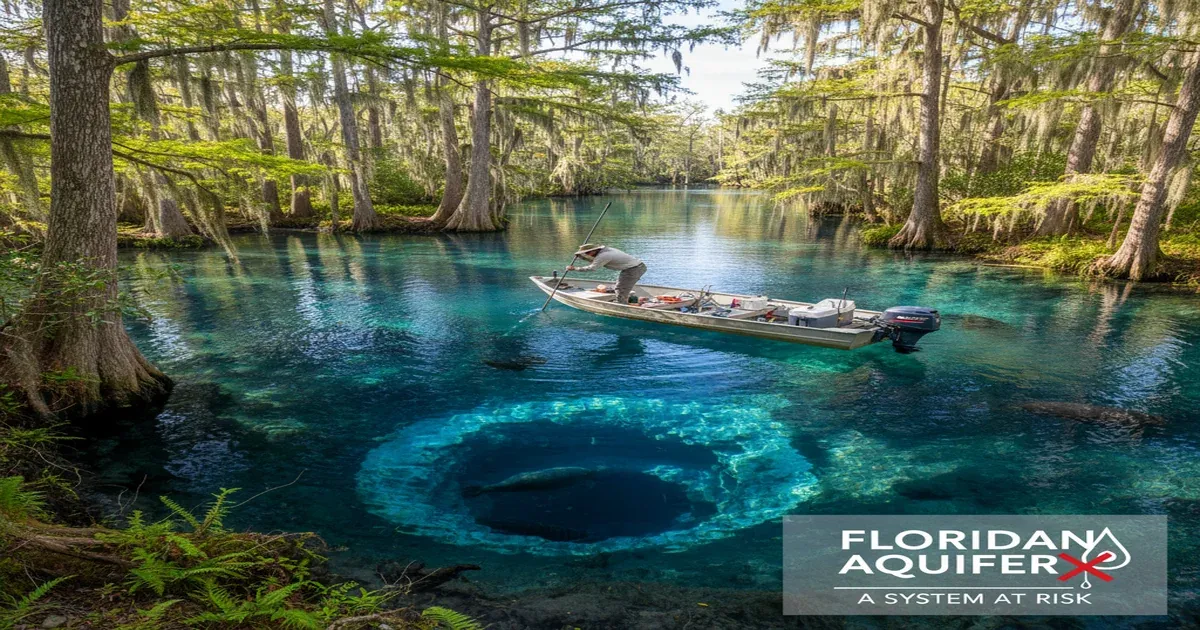
Tallahassee is Florida’s capital and the anchor of the Big Bend region, home to roughly 200,000 city residents and 385,000 in the metro area. The city sits atop the Floridan Aquifer, and it’s from those deep limestone wells that virtually all of Tallahassee’s drinking water comes.
The aquifer has been generous. Tallahassee’s water is naturally filtered through limestone and typically requires less treatment than surface water systems. But that natural protection has limits — and the pressures on it are growing.
The Floridan Aquifer in North Florida
The Floridan Aquifer behaves differently in the Tallahassee area than it does further south in the state. In North Florida, the confining clay layer above the aquifer is thinner or absent in some areas, making the aquifer more vulnerable to surface contamination.
Sinkholes are a visible reminder of this geology. The Tallahassee area has experienced numerous sinkholes, each one a potential pathway for surface contaminants to reach the aquifer directly. When the confining layer is thin, everything that happens on the surface — from septic system discharge to lawn chemicals to road runoff — can find its way into the drinking water supply faster than in areas with better geological protection.
The Septic System Problem
Leon County, which encompasses Tallahassee, has an estimated 60,000+ septic systems. In a region with thin aquifer confinement, that’s a significant source of nitrogen, bacteria, and other contaminants entering the groundwater.
Elevated nitrate levels have been a persistent concern in some Tallahassee-area wells. Nitrates from septic systems are the primary driver. The City of Tallahassee has been expanding sewer service and incentivizing septic-to-sewer conversions, but the process is slow and expensive.
The effects aren’t just about drinking water. Wakulla Springs — one of the world’s largest and deepest freshwater springs, fed by the same aquifer — has seen increasing algae growth and declining water clarity linked to nutrient loading from Tallahassee’s urban area. The spring is essentially a window into the health of the aquifer itself.
PFAS Contamination
PFAS have been detected in the Tallahassee area, with potential sources including:
- Tallahassee International Airport — airports are consistent PFAS sources due to AFFF use in fire training
- Military facilities — both current and former DoD sites in the region have histories of AFFF use
- Industrial and commercial sites — various businesses that used PFAS-containing products
Florida has established health advisory levels for PFAS (PFOS at 70 ppt, PFOA at 70 ppt) but enforceable MCLs remain under development. The City of Tallahassee has been testing its water supply wells for PFAS as part of expanding state and federal monitoring requirements.
What Testing Shows
Tallahassee’s annual water quality reports generally show the city meeting all federal and state primary drinking water standards. The treatment process — which includes aeration, chlorination, and fluoridation — is relatively simple compared to surface water treatment.
Key parameters to watch:
- Nitrates: Generally within limits at municipal supply wells, but private wells in the area may exceed the 10 mg/L MCL, particularly in areas with high septic density
- Total coliform bacteria: Municipal treatment effectively eliminates bacterial contamination, but private well owners should test regularly
- Radon: The Floridan Aquifer in North Florida naturally contains radon, a radioactive gas. Municipal treatment reduces radon levels, but private well owners may have significant exposure
- Hardness: Tallahassee’s water is naturally hard due to dissolved limestone. It’s not a health concern, but it affects appliances and plumbing
Private Well Owners at Higher Risk
An important distinction in Tallahassee: the city’s municipal wells are deep, professionally managed, and regularly tested. Many private wells in Leon County are shallower, less protected from surface contamination, and tested only when the homeowner chooses to do so.
If you’re on a private well in Leon County — particularly in areas with thin aquifer confinement or high septic density — your risk profile is fundamentally different from someone on city water. Annual testing for nitrates, coliform, and basic chemistry is essential.
What Tallahassee Residents Should Do
- Know whether you’re on city water or a private well. This is the single biggest factor in your water quality risk in the Tallahassee area.
- Test private wells annually. At minimum, test for nitrates, coliform bacteria, and basic water chemistry. Consider adding PFAS and radon.
- Consider a water softener. Tallahassee’s hard water can damage water heaters, reduce soap effectiveness, and leave scale deposits. A softener addresses this.
- Add point-of-use filtration. A reverse osmosis system handles nitrates, PFAS, radon, and hard water minerals at the kitchen tap.
- Support septic-to-sewer conversion. If you’re in an area transitioning from septic to municipal sewer, connecting helps protect the aquifer for everyone.
If you’re concerned about your water quality, a certified water treatment professional can test your supply and recommend the right combination of softening and filtration for Tallahassee’s naturally hard, aquifer-sourced water.
Related Reading
- Orlando FL Water Quality: The Floridan Aquifer and PFAS
- Jacksonville FL: Naval Station PFAS Contamination
- Savannah GA: Floridan Aquifer Water Quality
- Tampa Water Quality: Desalination and PFAS Concerns
Sources
- City of Tallahassee Utilities annual water quality reports
- Leon County septic system inventory and conversion program
- Florida Department of Environmental Protection Floridan Aquifer monitoring
- USGS North Florida/Southeast Georgia groundwater studies
- Wakulla Springs water quality monitoring data