
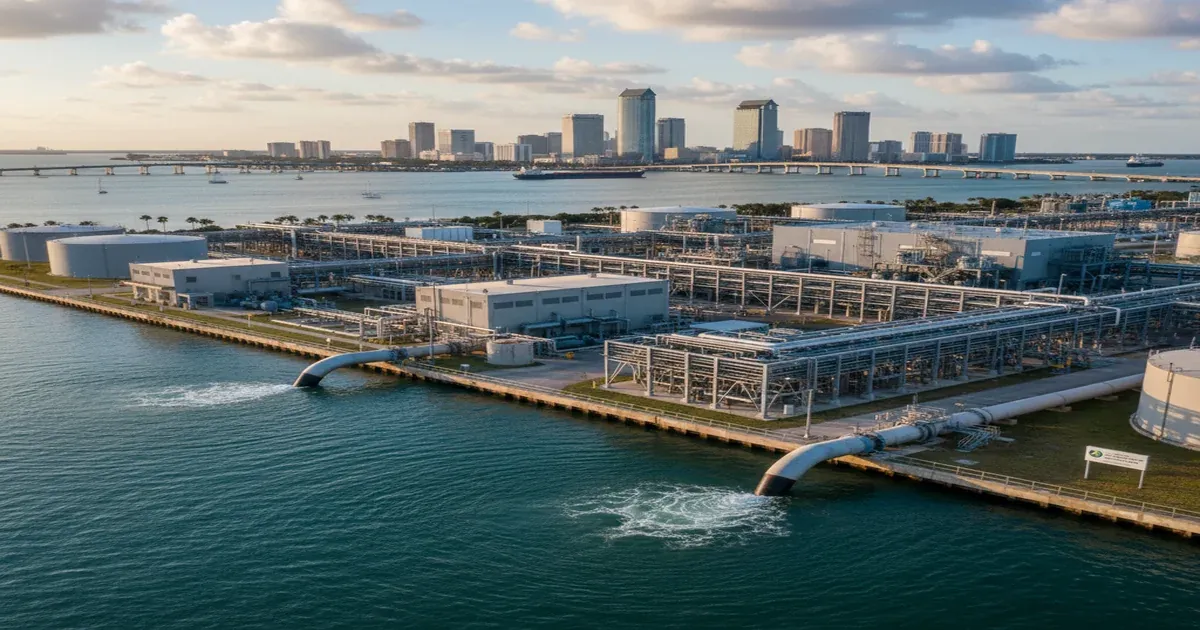
Tampa Bay’s water supply story is about diversification out of necessity. For decades, the region pumped heavily from the Floridan Aquifer and local wellfields — until overpumping caused lakes to shrink, wetlands to dry up, and sinkholes to proliferate. The environmental damage forced a fundamental rethinking of where Tampa’s water comes from.
Today, Tampa Bay Water — the regional wholesale utility serving about 2.5 million people across Hillsborough, Pasco, and Pinellas counties — operates one of the most diversified water supply portfolios in the country.
Where Tampa’s Water Comes From
Tampa Bay Water manages three distinct supply sources:
Surface water — The Alafia River and Hillsborough River provide treated surface water through the regional surface water treatment plant. This source is highly seasonal and weather-dependent.
Groundwater — Wellfields tapping the Floridan Aquifer still provide a significant portion of supply, but pumping has been reduced from historical levels to allow environmental recovery.
Desalination — The Tampa Bay Seawater Desalination Plant, located in Apollo Beach, is the largest desalination facility in the United States. It can produce up to 25 million gallons per day of drinking water from Tampa Bay seawater using reverse osmosis.
The desalination plant had a troubled start — construction delays, cost overruns, and equipment failures plagued the project from its inception in 1999 through multiple restarts. It finally achieved reliable operation around 2007-2008 and has since become a critical piece of the region’s supply infrastructure.
PFAS: MacDill Air Force Base
MacDill Air Force Base occupies a peninsula jutting into Tampa Bay at the southern tip of the city. The base has used AFFF firefighting foam for decades, and PFAS contamination has been confirmed in groundwater on and around the installation.
The contamination concerns:
- On-base wells — PFAS levels exceeding EPA’s health advisory levels have been detected in monitoring wells on MacDill property.
- Off-base migration — The peninsula’s hydrogeology means contaminated groundwater can migrate toward Tampa Bay and potentially affect nearby residential areas.
- Fish tissue contamination — PFAS has been detected in fish from waters near MacDill, raising concerns about recreational fishing and seafood consumption.
The Department of Defense has been conducting investigation under the CERCLA (Superfund) process, but cleanup timelines are typically measured in decades. Meanwhile, the base continues to operate and the surrounding community continues to be exposed.
Tampa’s municipal water supply draws primarily from surface water and the Floridan Aquifer at locations away from MacDill, so direct PFAS exposure through tap water is less of a concern than for nearby private well users. However, UCMR 5 testing has detected PFAS at low levels in various Florida water systems.
Disinfection Byproducts: A Florida-Wide Challenge
Florida’s warm climate creates elevated risk for disinfection byproducts (DBPs) in treated water. Higher temperatures accelerate the chemical reactions between chlorine and organic matter that produce trihalomethanes (TTHMs) and haloacetic acids (HAAs).
Tampa area water systems have historically struggled to stay below EPA’s maximum contaminant levels for DBPs, particularly during summer months when temperatures peak and water sits longer in distribution systems. Utilities have invested in treatment upgrades — including granular activated carbon, ozone, and chloramine conversion — to manage DBP formation.
For residents, this means Tampa’s water may have higher DBP levels than comparable systems in cooler climates. Point-of-use carbon filters effectively reduce DBPs in drinking water.
Infrastructure Age and Pipe Breaks
The Tampa Bay region has experienced significant water main breaks and infrastructure failures. Many of the region’s water distribution pipes were installed during Florida’s post-World War II building boom (1950s-1970s) using materials that have reached or exceeded their expected service life.
Hillsborough County and the City of Tampa have ongoing pipe replacement programs, but the scale of the problem — hundreds of miles of aging water mains — means that breaks, boil water notices, and pressure drops remain common occurrences.
Lead service lines are less prevalent in Florida than in Rust Belt cities because Florida’s construction boom occurred after lead pipes fell out of common use. However, lead solder was used in plumbing through 1986, and some older homes and buildings may have lead-containing fixtures.
The Floridan Aquifer: Stressed but Resilient
The Floridan Aquifer is one of the most productive aquifer systems in the world, underlying all of Florida and parts of Georgia, Alabama, and South Carolina. In the Tampa Bay area, decades of overpumping for public supply, agriculture, and phosphate mining reduced aquifer levels and caused environmental damage.
Since Tampa Bay Water implemented pumping reductions in the early 2000s, aquifer levels have partially recovered. But the system remains stressed:
- Saltwater intrusion in coastal wellfields as pumping lowers freshwater head
- Sinkhole risk — The limestone geology that makes the Floridan so productive also makes the area prone to sinkholes, especially when water levels fluctuate
- Agricultural and industrial contamination — Nitrates from fertilizer, phosphate mining byproducts, and other contaminants affect groundwater quality in parts of the region
What Tampa Bay Residents Should Know
- Read your water quality report. Whether you’re served by Tampa Bay Water (wholesale) through a local utility like the City of Tampa, Hillsborough County, or St. Petersburg, your retail utility publishes an annual CCR with testing results.
- Be aware of DBPs. If you’re concerned about disinfection byproducts, a carbon filter for your drinking water is an effective and inexpensive solution.
- Private well owners — If you’re near MacDill AFB or in areas with known groundwater contamination, get your water tested for PFAS. Also test for nitrates, bacteria, and any contaminants relevant to your area.
- Know your pipes. If your home was built before 1986, check for lead solder in your plumbing.
- Prepare for boil water notices. Main breaks happen in aging infrastructure. Keep bottled water on hand and know your utility’s notification system.
Related Reading
- Miami Water: Biscayne Aquifer and Saltwater Intrusion — Florida’s other coast faces different but equally serious water challenges.
- Jacksonville Water: PFAS and Naval Station — PFAS from military bases affects cities across Florida.
- Sarasota Water Quality and Wastewater Issues — Tampa Bay’s neighbor deals with wastewater infrastructure failures.
- San Diego’s Imported Water and PFAS — Another coastal city investing in desalination and water recycling.
The Bottom Line
Tampa Bay’s water supply diversification — including the country’s largest desalination plant — is a model for climate adaptation. The region recognized its overdependence on groundwater and invested in alternatives before the crisis became irreversible.
The ongoing challenges — PFAS from MacDill, disinfection byproducts in warm-climate systems, aging infrastructure, and the long-term sustainability of the Floridan Aquifer — are manageable but require sustained investment and attention.
If you’re concerned about your water quality, a certified water treatment professional can test your water and recommend the right approach for your home.