
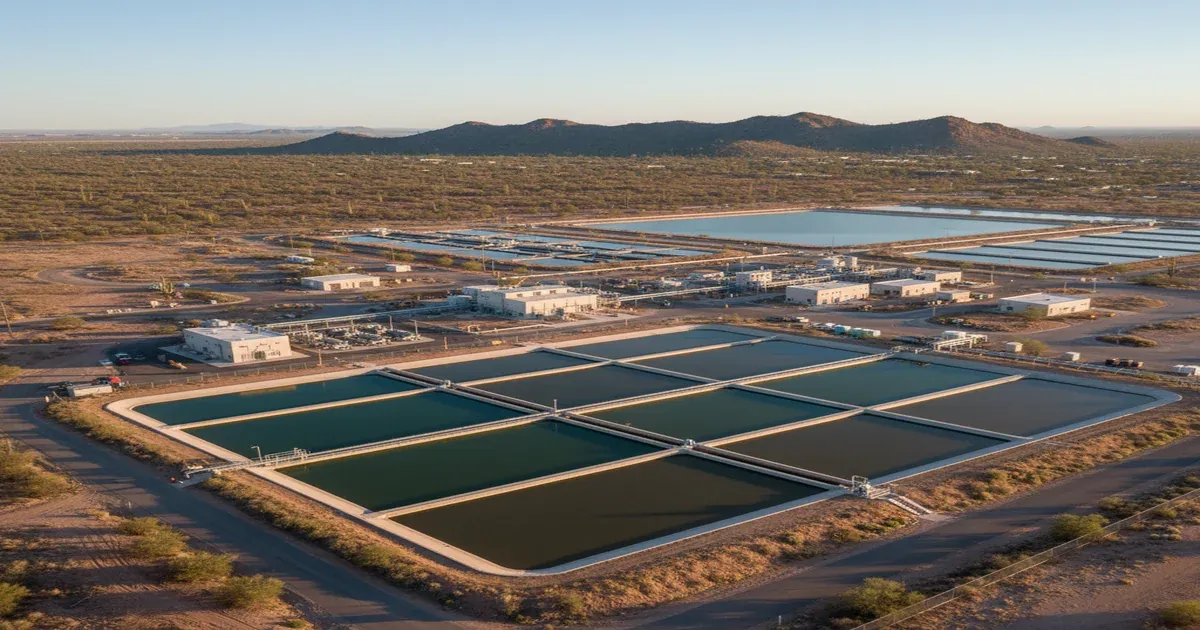
Tucson has a water history unlike any other major American city. For most of the 20th century, this desert metro of over a million people relied almost entirely on groundwater — pumping from the Tucson Basin aquifer faster than nature could recharge it. The water table dropped hundreds of feet. The ground literally sank.
Then, in 1992, Tucson started receiving Colorado River water through the Central Arizona Project (CAP) canal — a 336-mile engineered channel that pumps water uphill from Lake Havasu to central and southern Arizona. The transition was rocky (early deliveries caused brown, foul-tasting water from corroded pipes), but Tucson eventually integrated CAP water into its supply through aquifer recharge and recovery.
Today, Tucson Water serves about 750,000 people with a blend of CAP-recharged groundwater, direct CAP water, and recycled water. It’s a complex, innovative system — and it faces real threats.
PFAS: Davis-Monthan and Tucson International Airport
Tucson’s most significant water contamination issue is PFAS, and it’s concentrated around two major sources:
Davis-Monthan Air Force Base — Located in the heart of Tucson, this active military installation has used AFFF firefighting foam for decades. PFAS has been detected in groundwater wells near the base, and a contamination plume extends into surrounding residential neighborhoods. The Department of Defense has been conducting investigation and providing alternative water supplies to some affected areas.
Tucson International Airport — Adjacent to Davis-Monthan, the airport also has a history of AFFF use for firefighting training and emergencies. The combined plume from military and airport sources affects a significant portion of south Tucson’s groundwater.
Arizona has been slower than some states to establish state-level PFAS standards, but EPA’s 2024 federal MCLs of 4 parts per trillion for PFOA and PFOS apply to all public water systems. Tucson Water has shut down some contaminated wells and is investing in treatment upgrades to meet the 2029 compliance deadline.
The south side of Tucson — already an economically disadvantaged area — bears a disproportionate burden of PFAS contamination. Environmental justice advocates have pushed for faster cleanup and more transparent communication about exposure risks.
The Tucson Plume: TCE and Industrial Solvents
Before PFAS became the headline contaminant, Tucson had one of the country’s most notorious groundwater contamination events.
In the 1980s, trichloroethylene (TCE) — a toxic industrial solvent — was discovered in drinking water wells on the south side of Tucson. The contamination traced to multiple industrial sources, including Hughes Aircraft (now Raytheon) and Tucson International Airport operations. The area became a Superfund site, and the affected community experienced elevated rates of cancer, birth defects, and other health problems.
The Tucson International Airport Area (TIAA) Superfund site remains under active cleanup decades later. Groundwater pump-and-treat systems have been operating since the 1990s, but TCE and other volatile organic compounds persist in the aquifer. The recent discovery of PFAS in the same area means this community is dealing with overlapping contamination events from different eras.
Water Reuse: Tucson’s Innovation
Where Tucson leads is in water reuse. The city has been a national pioneer in using recycled water as a deliberate part of its supply strategy:
- Aquifer recharge with CAP water — Tucson doesn’t deliver most CAP water directly to taps. Instead, it percolates the water into the ground through recharge basins, allowing it to blend with native groundwater and be pumped later. This smooths out quality issues and provides storage.
- Recycled water distribution — Tucson operates one of the largest recycled water systems in the Southwest, delivering treated effluent for irrigation, industrial use, and environmental flows. The system includes over 70 miles of reclaimed water pipeline.
- Future potable reuse — Tucson Water has been studying indirect and direct potable reuse as a pathway to further stretch its water supply. As treatment technology improves and regulations evolve, recycled water may become a larger portion of the drinking water supply.
Climate and Supply Pressure
Tucson’s CAP allocation comes from the Colorado River — the same stressed system that supplies Las Vegas, Phoenix, and Southern California. As a junior priority holder, Tucson’s CAP allocation is among the first to be cut during shortage declarations.
Arizona has already experienced Tier 1 and Tier 2 shortage cuts on the Colorado River, reducing CAP deliveries. Tucson has banked significant amounts of water underground through recharge, providing a buffer — but that buffer isn’t infinite.
Additional pressures:
- Declining groundwater levels in the greater Tucson Basin despite conservation efforts
- Increasing temperatures driving higher evaporation and outdoor water demand
- Population growth in the metro area, though slower than Phoenix
- Competition for water with agriculture, mining (copper mining is a major industry), and other uses
What Tucson Residents Should Know
- Check your water quality report. Tucson Water publishes annual testing results. Pay attention to PFAS, THMs, and any contaminants specific to your service area.
- Know your area’s contamination history. If you live near Davis-Monthan AFB, Tucson International Airport, or the TIAA Superfund site, your groundwater has a different risk profile than other parts of the city.
- Private well owners — Testing is critical. The Tucson Basin has contamination plumes from multiple sources, and private wells aren’t monitored by the utility. Test for PFAS, TCE, nitrates, and arsenic at minimum.
- Conserve water. Tucson’s supply depends on how efficiently residents use what’s available. Low-water landscaping, efficient irrigation, and rainwater harvesting all help.
- Support water reuse. Tucson’s recycled water program is a model for arid cities. Public acceptance of these programs matters for their expansion.
Related Reading
- Phoenix Water Supply Challenges — Arizona’s capital faces parallel Colorado River dependency issues.
- El Paso Water: Hueco Bolson and Water Reuse — A fellow desert city pioneering water recycling out of necessity.
- Las Vegas Water: Drought and the Colorado River — How Las Vegas is adapting to shrinking Colorado River allocations.
- Colorado PFAS Military Base Contamination — Military-linked PFAS contamination parallels Tucson’s Davis-Monthan issues.
The Bottom Line
Tucson’s water story is one of adaptation under extreme conditions. The city overdrew its aquifer, transitioned to imported Colorado River water, and built a sophisticated recharge-and-recovery system — all while dealing with military and industrial contamination in its most vulnerable communities.
The next chapter depends on Colorado River politics, climate trajectory, and whether Tucson can continue to innovate on reuse and conservation. The city has already demonstrated it can do hard things with water. It’ll need to keep doing them.
If you’re concerned about your water quality, a certified water treatment professional can test your water and recommend the right treatment for your specific situation.