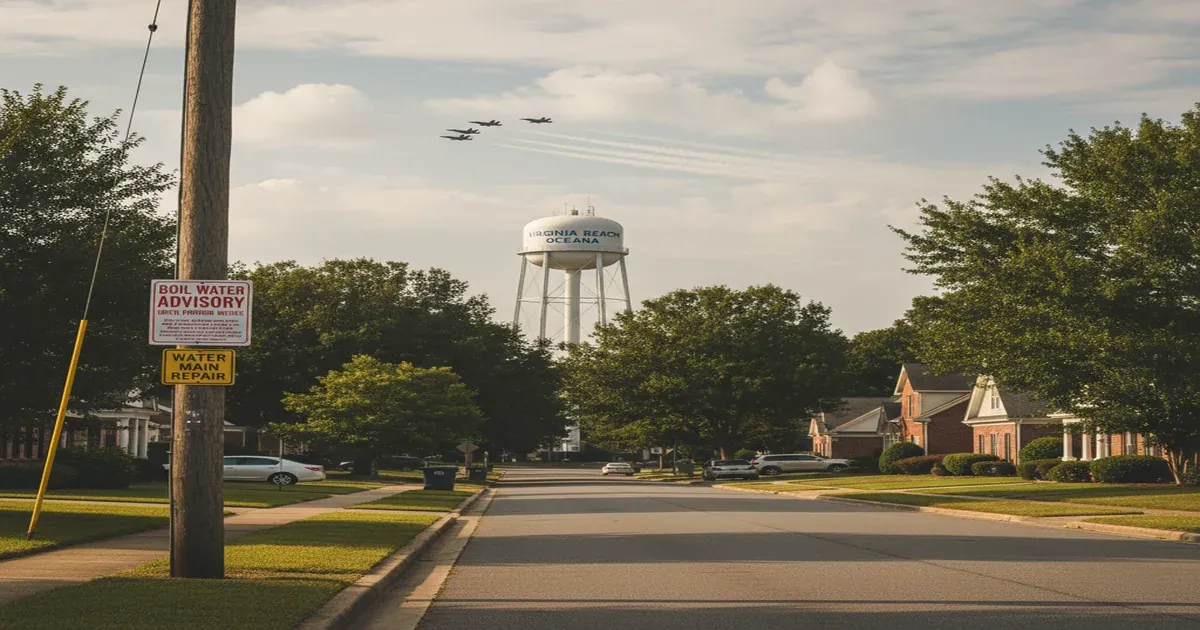
Virginia Beach is the largest city in Virginia by population — about 460,000 people — and sits in the Hampton Roads metro area of 1.8 million. The city occupies a unique position: sandwiched between the Chesapeake Bay and the Atlantic Ocean, home to one of the highest concentrations of military installations in the world, and dependent on water piped from 76 miles away.
That combination creates a water quality story unlike any other coastal city in America.
Where Virginia Beach Gets Its Water
Virginia Beach doesn’t have a local river or reservoir large enough to supply the city. Instead, the city operates the Lake Gaston Pipeline — a 76-mile, 60-inch diameter pipeline that brings raw water from Lake Gaston on the Virginia-North Carolina border to the city’s treatment facilities.
The pipeline, completed in 1998, was one of the most controversial water supply projects in the Southeast. North Carolina sued Virginia over the project, arguing that diverting water from the Roanoke River basin (which feeds Lake Gaston) would harm downstream communities. The case went to the U.S. Supreme Court, which ultimately allowed the pipeline to proceed.
Today, the Lake Gaston Pipeline provides approximately half of Virginia Beach’s water supply. The other half comes from the Norfolk/Virginia Beach Aquifer system and surface water purchased from Norfolk.
PFAS: The Military Capital of America
Hampton Roads has one of the densest concentrations of military installations in the United States, and PFAS contamination from these bases is the region’s defining water quality challenge:
- Naval Air Station Oceana — Located in Virginia Beach, NAS Oceana is one of the Navy’s largest master jet bases. Decades of AFFF use for firefighting training have contaminated groundwater beneath and around the base. PFAS plumes extend into surrounding residential areas.
- Naval Station Norfolk — The world’s largest naval base, located adjacent to Virginia Beach. PFAS contamination has been documented on the installation and in nearby areas.
- Joint Expeditionary Base Little Creek-Fort Story — An amphibious base in Virginia Beach with documented PFAS use and contamination.
- Numerous other installations — Hampton Roads hosts over a dozen military facilities, virtually all of which have used AFFF.
The cumulative impact: PFAS is present in groundwater across much of Hampton Roads. For Virginia Beach residents on private wells — and some areas of the city do rely on individual wells — the exposure risk is direct and significant.
The Department of Defense has been conducting investigation and remediation at these installations, but the scale of contamination across so many sites means cleanup will take decades and cost billions.
Virginia’s Department of Environmental Quality (DEQ) has been monitoring PFAS in drinking water systems and developing state-level regulatory responses.
Coastal Aquifer Vulnerability
Virginia Beach sits over the Yorktown-Eastover Aquifer system, a layered series of sand and clay formations that provide groundwater for the city and surrounding areas. Being coastal creates specific vulnerabilities:
- Saltwater intrusion — As groundwater is pumped from the aquifer, the freshwater-saltwater interface can migrate inland, contaminating wells with brackish water. Sea level rise — Hampton Roads is one of the fastest-sinking areas on the East Coast due to land subsidence — accelerates this process.
- Surface contamination — The shallow water table and sandy soils mean surface contaminants can reach groundwater relatively quickly. Stormwater, lawn chemicals, and fuel spills all pose risks.
- Military contamination plumes — PFAS and other contaminants from military installations are migrating through the aquifer system, and the coastal setting means contaminated groundwater ultimately discharges to the Chesapeake Bay.
Sea Level Rise and Infrastructure
Hampton Roads is experiencing sea level rise at roughly twice the global average rate — about 5 millimeters per year — due to the combination of rising ocean levels and regional land subsidence (the ground is slowly sinking as ancient sediments compact).
The water infrastructure implications:
- Flooding — Increasing tidal flooding affects water and sewer infrastructure, particularly pump stations, manholes, and low-lying treatment facilities.
- Saltwater intrusion — Rising seas push saltwater further into the aquifer and up tidal rivers.
- Stormwater contamination — More frequent flooding means more frequent mixing of floodwater with the drinking water and sewer systems.
- Infrastructure resilience — Water mains, valves, and pump stations in flood-prone areas face accelerated corrosion and more frequent damage.
The Hampton Roads Sanitation District (HRSD) has been investing in innovative approaches including its SWIFT (Sustainable Water Initiative for Tomorrow) project, which treats wastewater to drinking water standards and injects it into the Potomac Aquifer. This serves three purposes: replenishing groundwater, slowing saltwater intrusion, and reducing land subsidence.
What Virginia Beach Residents Should Know
- Know your water source. Virginia Beach’s supply comes from Lake Gaston, local aquifers, and Norfolk — the blend varies by location in the city. Your water quality report details your specific supply.
- If you’re on a private well — test for PFAS. Given the density of military PFAS sources in Hampton Roads, private well testing is critical. Virginia DEQ has resources for PFAS testing.
- Consider filtration. A reverse osmosis system or NSF/ANSI P473-certified carbon filter reduces PFAS. Lead-rated filters (NSF/ANSI 53) are also advisable if your home has older plumbing.
- Understand flood risk. If you live in a flood-prone area, flooding events can temporarily compromise water quality. Follow boil water advisories promptly.
- Support SWIFT and similar projects. Water reuse and aquifer recharge projects are critical for Hampton Roads’ long-term water security.
Related Reading
- Camp Lejeune Water Contamination — The Southeast military base case that changed contamination law.
- Colorado PFAS Military Base Contamination — Military PFAS contamination is a nationwide pattern.
- Jacksonville Water: PFAS and Naval Station — Another Navy community dealing with base-linked PFAS.
- Raleigh Water: Falls Lake and PFAS — PFAS contamination across the Southeast.
- PFAS Treatment: Ion Exchange vs. Activated Carbon — Treatment technologies for military-linked PFAS contamination.
The Bottom Line
Virginia Beach’s water quality story is defined by military PFAS contamination at a scale that few other American cities face. The sheer number of military installations in Hampton Roads, each with its own PFAS legacy, creates a contamination footprint that covers much of the region.
The city’s dependence on a 76-mile pipeline for half its supply, combined with coastal aquifer vulnerability and accelerating sea level rise, makes Virginia Beach one of the most complex water management challenges on the East Coast.
If you’re concerned about your water quality — especially if you’re on a private well anywhere in Hampton Roads — a certified water treatment professional can test your water and recommend treatment solutions for the specific contaminants in your area.