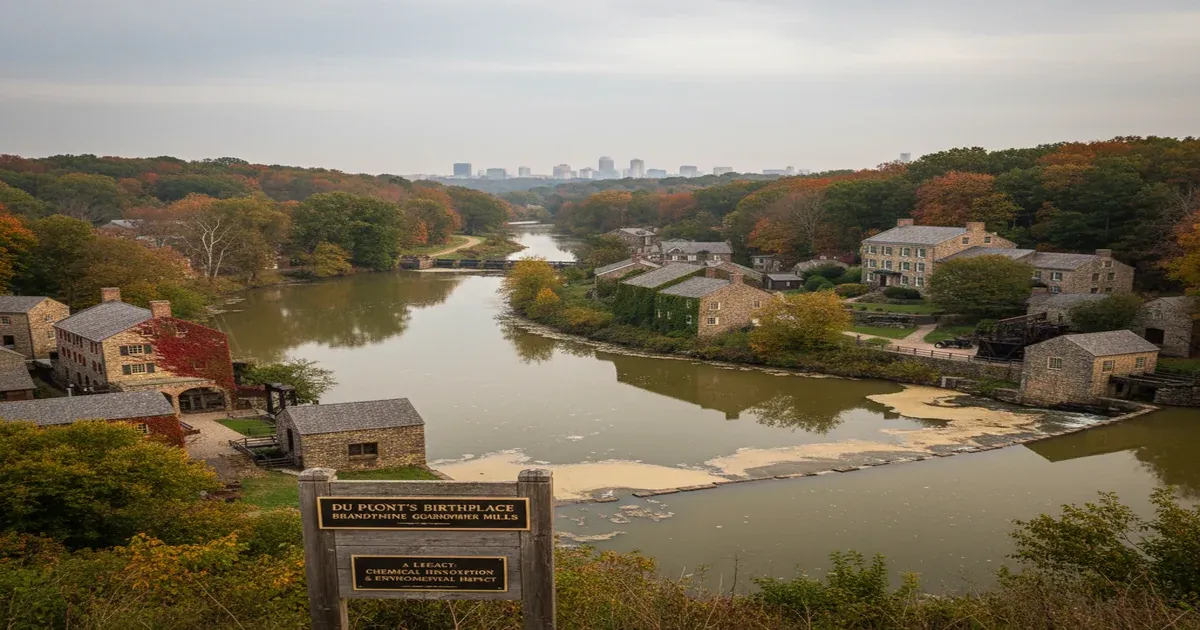
Wilmington, Delaware, has been synonymous with the chemical industry for over 200 years. DuPont was founded here in 1802 as a gunpowder mill on the banks of the Brandywine Creek. Over the next two centuries, it grew into one of the largest chemical companies in the world, eventually spinning off Chemours in 2015. The DuPont and Chemours corporate headquarters still anchor downtown Wilmington.
That chemical heritage has left an indelible mark on the city’s environment — and its drinking water. For a city of 71,000 people (in a metro area of 700,000), the intersection of chemical manufacturing history, PFAS contamination, and aging water infrastructure creates a water quality picture unlike almost anywhere else in the country.
Brandywine Creek and the Water Supply
The City of Wilmington’s water supply comes from the Brandywine Creek, treated at the Porter Filter Plant — one of the oldest continuously operating water treatment facilities in the United States. The Brandywine’s watershed stretches into southeastern Pennsylvania’s Chester County, collecting water from suburban development, agriculture, and a scattering of industrial sites.
The Porter Filter Plant uses conventional treatment — coagulation, sedimentation, filtration, and chlorine disinfection. The system serves Wilmington proper and some surrounding areas, while other parts of New Castle County are served by Artesian Water Company and United Water (now Suez/Veolia).
Brandywine Creek’s water quality reflects its suburban-to-rural watershed:
- Nutrient levels (nitrogen and phosphorus) from agricultural runoff and suburban lawns
- Sediment from construction and stream bank erosion
- Seasonal variation in organic compounds that drive disinfection byproduct formation
- Stormwater contributions from the growing suburban footprint upstream
The DuPont/PFAS Legacy
No discussion of Wilmington’s water quality is complete without addressing PFAS — and Delaware’s relationship with PFAS is uniquely direct.
DuPont manufactured PFOA (perfluorooctanoic acid, also called C8) at its facilities for decades, most notoriously at the Washington Works plant in Parkersburg, West Virginia. But the company’s Delaware facilities also handled PFAS compounds, and the chemical’s presence extends throughout the state:
Former DuPont sites in Delaware: Multiple former DuPont manufacturing and research facilities in New Castle County have documented soil and groundwater contamination, including PFAS compounds. The Chambers Works facility in Deepwater, New Jersey — just across the Delaware River from Wilmington — was one of the largest chemical manufacturing complexes in the world and a significant PFAS source.
Chemours and GenX: When DuPont spun off Chemours in 2015, the new company inherited many of DuPont’s environmental liabilities. Chemours replaced PFOA with GenX (a shorter-chain PFAS compound marketed as safer), but GenX has itself become a major contaminant concern — as demonstrated by the Chemours Fayetteville Works discharge into the Cape Fear River in North Carolina.
Statewide PFAS testing: Delaware has conducted testing of public water systems for PFAS. Results have shown detectable PFAS in multiple systems across New Castle County, including those serving the Wilmington metro. In 2022, Delaware set a maximum contaminant level of 33 parts per trillion for PFOA and 56 ppt for PFOS — stricter than the federal advisory levels at the time but less stringent than some neighboring states.
The Pompeii Run Superfund Site
Located in New Castle, just south of Wilmington, the Pompeii Run area was contaminated by solvents and chemicals from industrial operations. Groundwater contamination with volatile organic compounds — including trichloroethylene (TCE) and perchloroethylene (PCE) — has required ongoing monitoring and treatment.
While this site doesn’t directly affect Wilmington’s surface water supply, it illustrates the density of contamination in the region. New Castle County’s industrial history means contaminated groundwater is common, particularly in areas near former manufacturing sites.
Lead Service Lines
Wilmington’s water distribution system dates largely to the late 1800s and early 1900s, and lead service lines are widespread. The city has some of the oldest water infrastructure on the East Coast:
- Lead pipes were the standard material for service connections when much of the system was built
- Water main age — some mains are over 100 years old, with lead joints between pipe segments
- Home plumbing in older Wilmington rowhouses typically includes lead solder and potentially lead pipes
Wilmington’s Lead and Copper Rule sampling has shown lead levels that require attention. The city uses corrosion control treatment (orthophosphate) and has been working on service line inventory and replacement. Delaware’s relatively recent adoption of stricter lead standards has pushed accelerated action.
The environmental justice dimensions are significant — Wilmington’s demographics (roughly 55% African American, with poverty rates well above the state average) mean that lead exposure from water, paint, and soil disproportionately affects communities of color with the fewest resources to mitigate the risk.
Delaware River Influence
While Wilmington’s primary drinking water source is the Brandywine, the broader metro area’s water supply is influenced by the Delaware River. Some systems in New Castle County draw from the river or from groundwater influenced by it.
The Delaware River in this reach receives:
- Treated wastewater from Philadelphia and other upstream cities
- Industrial discharges from refineries and chemical plants along the Delaware waterfront
- Stormwater runoff from one of the most densely developed corridors in the eastern United States
- Ship traffic and associated pollution in one of the busiest ports on the East Coast
The Delaware River Basin Commission manages water quality standards for the river, and ongoing investment in Philadelphia’s wastewater treatment has improved Delaware River water quality significantly over the past two decades. But the river remains a complex source water influenced by massive upstream urban and industrial activity.
What Wilmington Residents Should Know
- Check your service line material. Contact the Wilmington Department of Public Works to find out if your home has a lead service line. In a city this old, assume lead until proven otherwise.
- Flush before drinking — 30 seconds to 2 minutes of cold water after periods of non-use. Never cook with or drink hot tap water in older homes.
- Request your utility’s PFAS testing results. Delaware requires public reporting, and residents should know what’s being detected in their treated water. The state’s MCLs for PFOA and PFOS provide a regulatory floor, but some health experts advocate for even lower levels.
- Activated carbon filtration at the point of use removes PFAS, lead (in combination with appropriate filter design), DBPs, and taste/odor compounds. Reverse osmosis provides the most comprehensive protection.
- Stay informed about DuPont/Chemours remediation. These sites are actively managed, and community engagement in the cleanup process matters.
If you’re concerned about your water quality, a certified water treatment professional can test your water and recommend the right system. In a city literally built by the chemical industry, knowing what’s in your water isn’t paranoia — it’s due diligence.
Related Reading
- Philadelphia: Oldest Water Pipes in America
- Newark New Jersey Lead Water Crisis
- Wilmington NC GenX PFAS: Chemours and the Cape Fear River
- Jersey City Water Quality: Lead, PFAS, and Aging Infrastructure
Sources
- City of Wilmington Annual Water Quality Reports
- Delaware Department of Natural Resources and Environmental Control PFAS testing data
- EPA Pompeii Run Superfund site records
- Delaware PFAS maximum contaminant level regulations (2022)
- DuPont/Chemours environmental liability disclosures
- Delaware River Basin Commission water quality monitoring