
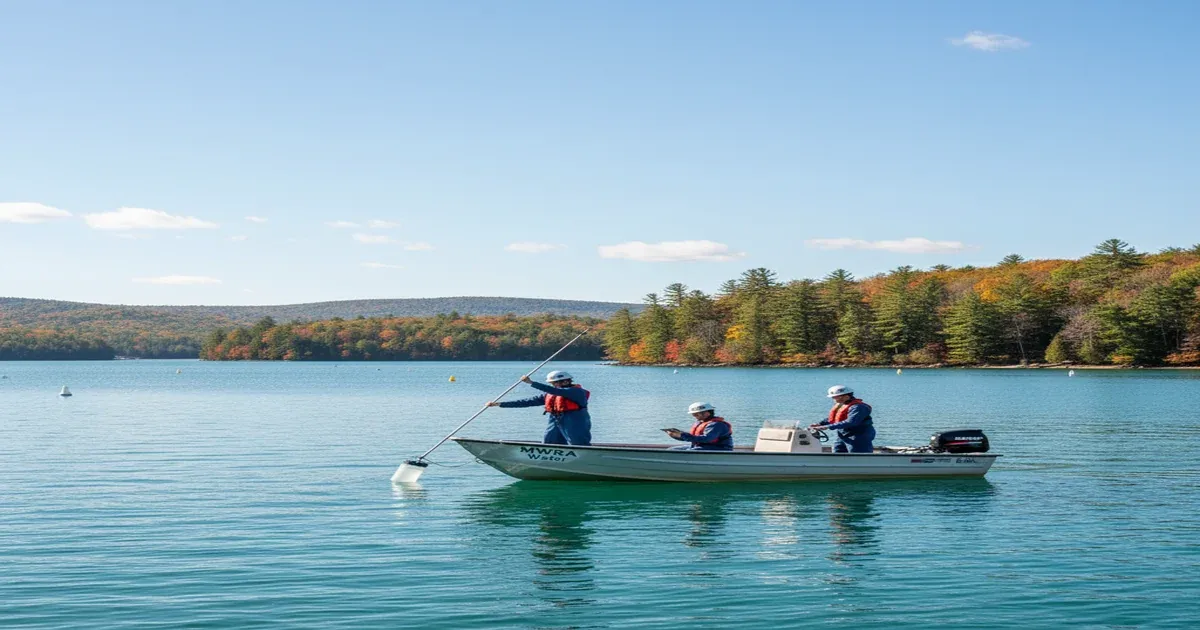
Worcester is Massachusetts’ second-largest city, sitting in the geographic center of the state at the edge of the Quabbin-Wachusett reservoir system. The city receives its water from the Wachusett Reservoir, part of the Massachusetts Water Resources Authority (MWRA) system that also supplies Boston — one of the most protected and highest-quality water supply systems in the Northeast.
Wachusett Reservoir: Excellent Source Water
The Wachusett Reservoir holds 65 billion gallons in a watershed of about 117 square miles in central Massachusetts. Like the Quabbin Reservoir to the west, the watershed is heavily forested and protected — the MDC and the MWRA own thousands of acres and restrict development aggressively.
The water requires minimal treatment: a small amount of chlorine, fluoride, and pH adjustment. The MWRA system draws on both Wachusett and the Quabbin (via a 25-mile aqueduct), blending water to optimize quality and supply. The Cosgrove Tunnel brings water from Wachusett to the metropolitan area.
Turbidity is typically very low. Algal blooms are rare given the deep, cold water and protected watershed. Naturally soft water is a characteristic — the reservoir runoff is essentially snowmelt and rainfall through forest soils, with minimal mineral content.
Lead: Worcester’s Primary Water Quality Concern
The quality gap between source and tap is starkest in Worcester because of lead. The city has a massive aging housing stock — a significant fraction of Worcester’s residential properties were built before 1940, when lead service lines and lead solder were universal.
Worcester has been working through its lead service line inventory. Thousands of lead service lines remain, concentrated in neighborhoods like Main South, Piedmont, and Vernon Hill — areas where 19th-century triple-deckers and mill-era housing still dominate the streetscape.
The MWRA adjusts water chemistry for corrosion control — pH is raised and orthophosphate is added — to reduce lead dissolution from pipes. Worcester’s own distribution system work adds additional corrosion inhibitor. Lead at the 90th percentile in Worcester has generally been below the federal action level, but the presence of lead infrastructure means the risk is real for residents who don’t flush their pipes or who have particularly old plumbing.
Worcester was one of the cities where the Massachusetts Department of Environmental Protection found evidence of elevated lead in some school drinking water samples — a pattern that led to the statewide school testing program.
Industrial History: Clark and Blackstone River Legacy
Worcester grew up as a machine tool capital. The city’s 19th-century industrial base — textile machinery, wire, steel, abrasives — left contaminated sites scattered across the urban landscape. The Blackstone River, which flows south from Worcester to Providence, received industrial waste for over a century.
The Blackstone River Valley was one of the first industrialized regions in America, and its water quality was among the worst in New England through most of the 20th century. Modern cleanup efforts have dramatically improved the river, but legacy contamination in river sediments and in the groundwater beneath former factory sites persists.
The contaminated groundwater plumes at former industrial sites are primarily a concern for private wells and shallow groundwater users rather than the municipal supply. But they represent a significant long-term remediation challenge for the city.
PFAS and Emerging Contaminants
The MWRA’s source water has been tested for PFAS, with levels in the Wachusett system at very low concentrations — reflecting the protected, rural watershed. The pristine forest source means essentially no PFAS input from industrial or military sources in the immediate watershed.
Worcester’s own stormwater, however, is a different story. Urban stormwater runoff carries PFAS from consumer products, building materials, and legacy industrial operations into local streams that feed the Blackstone rather than the Wachusett. This doesn’t affect the drinking water supply but affects local waterway quality.
What Worcester Residents Can Do
The source water is excellent — Worcester’s main action item is the lead distribution infrastructure:
- Test your water for lead — the MWRA and Worcester DPW offer testing resources; this is especially important for pre-1940 homes.
- Flush before drinking — run cold water for 2 minutes in the morning before using for drinking or cooking.
- Know your service line material — Worcester is building its lead service line inventory; contact the DPW to inquire about your property.
- Install a point-of-use filter — NSF 53-certified lead removal filters add a layer of protection in older homes.
If you’re concerned about your water quality, a certified water treatment professional can help you test your water and recommend the right solution for your home.